
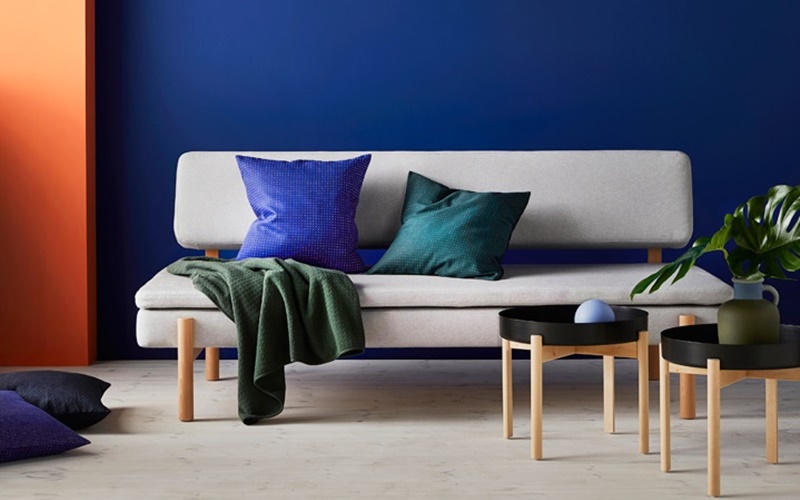
Swedish Furniture Giant Meets Danish Design: The YPPERLIG Collection by IKEA and HAY
Scandi style is now available in Swedish too: The highly anticipated collaboration between IKEA and HAY has finally hit stores as of October 2017.
In 2017, we reported on YPPERLIG, the collaboration between IKEA and HAY. What remains is a simple insight: Good living doesn’t require grand gestures, but rather clean lines, good proportions, and items you actually use.
- YPPERLIG arrived in IKEA stores in October 2017, bringing HAY’s Danish design language into an affordable setting.
- The collection focused on the living room, coziness, furniture, and small home accessories.
- Sofas, chairs, vases, mirrors, and the reimagined Frakta bag stood for muted colors and clear forms.
- Mette Hay articulated the core idea: combining IKEA principles with quality and affordable prices.
Why YPPERLIG Doesn’t Sound Like 2017
Some collaborations are loud, photogenic, and gone after one season. YPPERLIG was different. The partnership between IKEA and HAY was designed to be quieter from the start: no collector hype, no design object for the display cabinet, but furniture and accessories for the space where you actually live. That is precisely why it is worth looking back.
The name YPPERLIG translates roughly to “excellent” or “outstanding.” It sounds grand, but the collection itself was highly controlled. Muted tones like gray, green, and blue, clean lines, little ornamentation. The sofa wasn’t meant to shout, the chair didn’t need to explain, the vase didn’t pretend to be art. Everything served a sense of living that Scandinavian design does well: creating calm without becoming boring.
The original lookbook from IKEA Sweden already revealed what this was about. HAY brought Danish sharpness; IKEA brought reach and the idea of making design accessible to many people. The result was not dilution, but a shared language. Not every piece had to become a classic. But the attitude was clear: functionality is not the enemy of style.
This is rare in interior design. Many collections look great on press photos but lose their poise immediately at home. YPPERLIG was intended for real spaces: for sofas that are used, for tables with glasses on them, for vases that work even without perfect styling and remain calm.
YPPERLIG remains interesting because the collection never wanted to be loud. It simply wanted to look better than the ordinary.
The Frakta Bag Gained Poise
A small symbol of this collaboration was, ironically, the Frakta. The classic blue IKEA bag is almost too familiar to be perceived as a design object anymore. HAY took it seriously and gave it a makeover. Not as irony, but as proof that even an everyday item can appear more precise, calmer, and more mature.
This fits the rest of the collection. YPPERLIG cared about living rooms and coziness, but not decoration for its own sake. Mirrors, chairs, vases, and textiles were meant to blend in without becoming invisible. Anyone who loves Scandinavian interiors recognizes this exact point: The objects are not arbitrary. They hold back because they are well-proportioned.
In retrospect, it stands out how little trend-posturing was involved in this collection. Much of what looked like Scandi-style in 2017 later became interchangeable Instagram aesthetics. YPPERLIG had more substance because the forms were restrained and the colors didn’t scream seasonal trends. A gray-green chair, a simple mirror, a vase with a calm silhouette: This isn’t an effect; it’s everyday life with standards.
The color palette was crucial for this. Gray slows down a room, green brings warmth without decorative pressure, and blue appears calm when it isn’t meant to be too maritime. Together, they create a palette that withstands many living situations. You can add wood, leave walls light, complement with darker textiles. The collection doesn’t force a finished look but provides you with a framework.
What you can take from this for your home
The core idea behind YPPERLIG is simple: Don’t buy for the moment, but for use. A good sofa doesn’t need to announce itself as design. It needs to bring order to a living room. A chair doesn’t need to stand out if it already looks right at first glance. Accessories may set the mood, but they shouldn’t take over the room.
If you approach furnishing with this mindset today, you’re looking for pieces that will last several years. Muted colors help because they allow other materials to shine. Wood, glass, metal, fabric, and ceramic can work side by side if the shapes remain calm. This is where YPPERLIG excelled: The collection didn’t complicate things, but it treated the basics with seriousness.
This might be the most elegant aspect of this collaboration. HAY and IKEA showed that affordable design doesn’t have to feel arbitrary. It just needs a clear concept, good lines, and the courage not to decorate everything. Those who understand this don’t need a new home trend every year. They just need a few right pieces.
You can read the YPPERLIG philosophy very practically: start with the big lines, then add the small details. A sofa that calms the room. A chair that works equally well at the dining table or the desk. A mirror that reflects light back into the space. A vase that doesn’t seek attention but sits perfectly on a sideboard. This isn’t spectacular living. It’s better: It lasts.
That’s why the collaboration feels like a solid archival piece today. Not everything needs to come back, but the idea remains useful. Design can be accessible without becoming shallow. A furniture retailer can think practically without disenchanting the space. And a collection can show that coziness doesn’t come from mountains of cushions, but from proportion, material feel, and restraint.
So if you’re rethinking a living room today, YPPERLIG serves as a useful benchmark. Ask yourself about each piece whether it still feels natural after three months. If yes, it was probably a good choice. If it only catches the eye in the first moment, let it stay in the store.
Quick Answers
▸What was YPPERLIG?
YPPERLIG was the collaboration between IKEA and HAY, available from October 2017. The collection included furniture and home accessories, such as sofas, chairs, vases, mirrors, and a redesigned Frakta bag.
▸Why did IKEA and HAY fit together?
Both brands focus on functionality, timelessness, and accessible design. Mette Hay described the goal as combining IKEA principles with high quality and affordable prices.
▸Which rooms was the collection designed for?
The focus was primarily on living spaces and coziness. The pieces were intended for living rooms and everyday use, not as pure display items.


