Design Objects · Craftsmanship
Intarsia: How wood becomes a picture
Intarsia or marquetry, wood or tortoiseshell: how the art of inlay works, where it comes from and where you can see studioli and Boulle furniture.

 Design Objects
Intarsia or marquetry, wood or tortoiseshell: how the art of inlay works, where it comes from and where you can see studioli and Boulle furniture.
When you look at a piece of furniture with a picture in wood on its surface, you are seeing the art of inlay at work. Small pieces of matching or contrasting material form flowers, architecture, landscapes or figures, bringing many individual elements together in a single image. Depending on whether the pieces are set into the surface or laid on top, specialists call the technique intarsia or marquetry.
The art of inlay has ancient roots, reaching back to the Ancient Near East of the 3rd millennium BC. Its story leads through Islamic art and the Italian Renaissance to David Roentgen’s manufactory in Neuwied. The following sections explain the techniques and tools and explore striking examples, from Renaissance studioli and Boulle’s workshop to Roentgen furniture.
Intarsia is made by setting small pieces of matching or contrasting material into a solid base. Traditionally, the outlines are marked with a sharp knife, a shallow recess is cut or chiselled out, and the piece is glued into place. The recess holds the inlay, while the glue joins the two pieces.
Intarsia was already known in the Ancient Near East in the 3rd millennium BC. It was later practised in Islamic art and then during the Italian Renaissance; in Central Europe, it remained popular on furniture, musical instruments and boxes in particular.
Illusionistic landscapes, figurative scenes and architecture with a trompe-l’œil effect were a speciality of the Italian Renaissance. The choice of wood followed a plan: ebony, rosewood and lemonwood were selected for their colour and grain.
In German, the umbrella term for all these techniques is Einlegearbeit; the Kunstlexikon der Südwest Galerie describes intarsia as decorative inlay work. The position of the inlay in the wood reveals how closely related intarsia and marquetry are, and where the distinction lies.
The difference between intarsia and marquetry lies in the depth. In intarsia, the inlaid piece sits in a recess cut or chiselled into the solid base. Marquetry uses pieces laid on top: the elements of the pattern are placed on a supporting surface to create a picture in veneer. Visually, the two techniques can look very similar.
The Danish national encyclopaedia draws the distinction according to the supporting base: it defines intarsia as an inlay of different woods in a solid wood panel, and marquetry as an inlay in a thin veneered surface. By this stricter definition, the base is what separates them. The encyclopaedia also notes that the two terms are often used interchangeably.
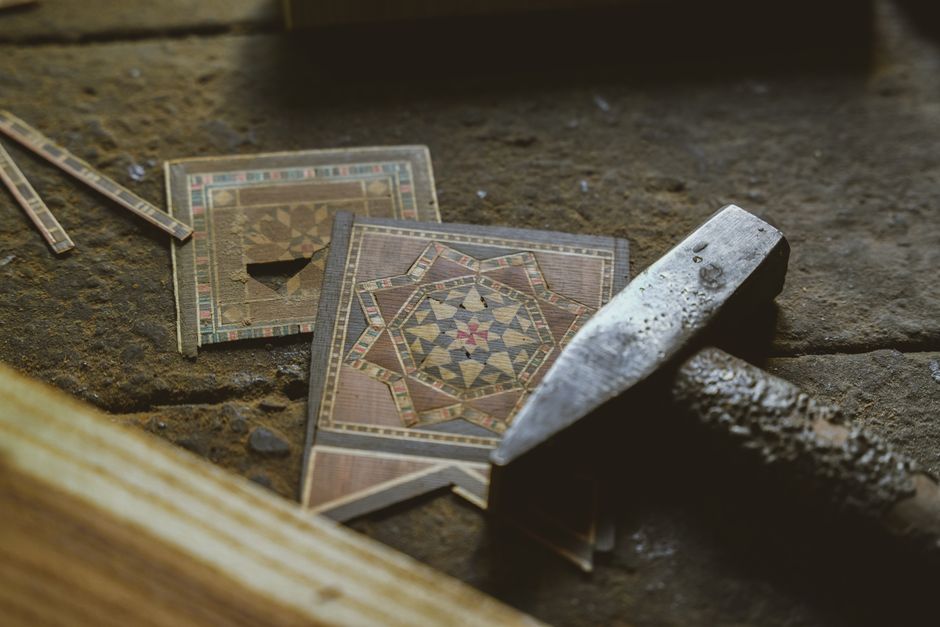
A different distinction is drawn in the Norwegian Store norske leksikon. Here, the material is decisive: intarsia usually means wood inlaid into wood, while marquetry also includes metal, mother-of-pearl, bone or tortoiseshell.
For you, this means that the distinction depends on the reference work. Both terms describe closely related techniques under different names. What you can usually tell reliably is whether the inlay is set into the base or glued onto it.
In the Ducal Palace of Urbino, the art of inlay meets the idea of study in the studiolo of Federico da Montefeltro. The inlays were made in the Florentine workshop of Giuliano and Benedetto da Maiano; the ceiling frieze bears the completion date 1476.
The images in wood depict half-open cupboards containing weapons, books, sheet music and musical and mathematical instruments. The inlays create the illusion of the contents and order of a scholar’s study. The room was used for study and meditation.
Closely related is the studiolo from the Ducal Palace of Gubbio, now installed in the Metropolitan Museum in New York. The Met dates the room to around 1478 to 1482 and names Francesco di Giorgio Martini as its designer.
The inlays are made of walnut, beech, rosewood, oak and fruitwoods on a walnut base. The room measures around 4.85 metres high, 5.18 metres wide and 3.84 metres deep. A complete room thus found a place in the museum: in 1939, it entered the collection with the help of the Rogers Fund.
The inlays create the illusion of the contents and order of a scholar’s study.
In 17th-century France, André-Charles Boulle brought other materials into the art of inlay. The cabinetmaker served Louis XIV; his Boulle marquetry traditionally involves cutting patterns from several layers of tortoiseshell, brass and other materials.
At its heart is the practice of sawing through the layers together: when brass is set against a dark background of tortoiseshell or ebony, the result is a première partie. When metal forms the background and tortoiseshell provides the inlay, it is called a contre-partie.
Because both versions are sawn from the same layers, the same motif appears once as a positive and once as a negative. For a pair of furniture pieces, this produced two complementary versions of the same design.
When you stand before a piece of Boulle furniture, look closely at the background and the inlay. A dark background with brass ornament signifies the première partie; a metallic background with tortoiseshell inlay signifies the contre-partie. If you find a pair, compare the two pieces: the motif reappears with the materials reversed.
The technique uses veneers, wafer-thin sheets that are glued on and cut to the design. According to the Victoria and Albert Museum Boulle work uses ebony, tortoiseshell, brass, tin and horn; dark tortoiseshell was sometimes backed with colour.
Precise cuts call for a specialised tool: the chevalet de marqueterie, a sawing frame for marquetry, is considered, according to Fine Woodworking to be a 19th-century French invention. Operated by hand and foot, it guides the blade quickly and accurately through a stack of several layers of veneer.
Soft transitions are created by sand shading: one edge of a piece of veneer is scorched in a pan of hot sand. This produces a permanent shadow that grades softly from dark to light. Fine Woodworking recommends washed quartz sand with a grit of 100; at the right temperature, five to ten seconds are enough. In the finished work, the result is a gradient within a single piece of veneer, with no colour applied.
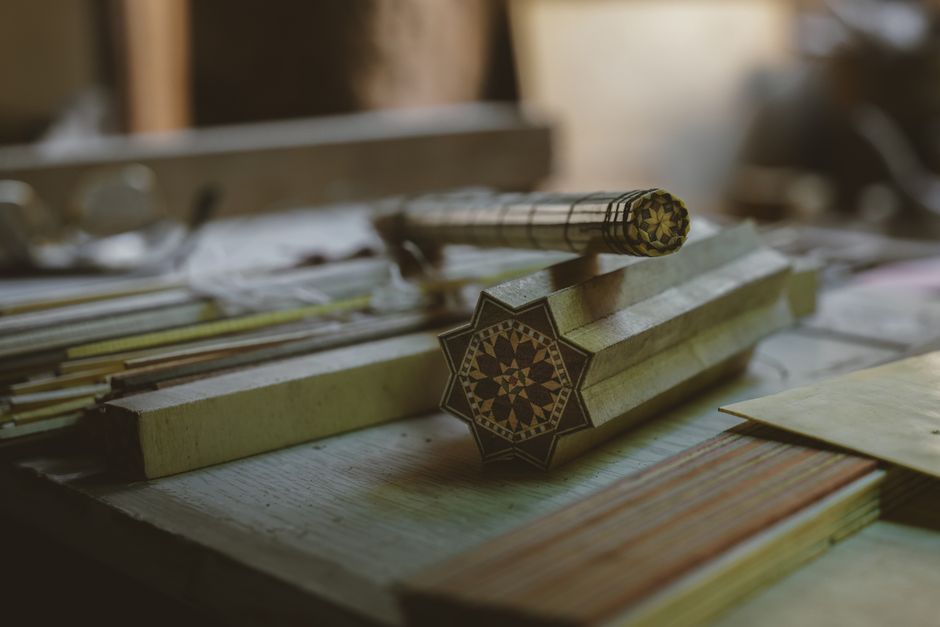
Alongside pictorial marquetry is geometric marquetry, known in English as parquetry: it arranges inlaid pieces of wood, often of different species, into geometric patterns for floors or furniture decoration.
David Roentgen (1743 to 1807) officially took over the Neuwied manufactory in 1772. In the 1770s, floral marquetry became a defining feature of his furniture; the à la mosaique technique dispensed with engraving for the first time.
The Koblenz court painter Januarius Zick supplied the designs for figurative marquetry. His customers included Catherine II; in 1780, Roentgen was admitted to the Paris guild.
Roentgen’s cylinder desk in the Metropolitan Museum, which the Met dates to around 1780, shows how deliberately colour can be drawn from wood. Among the woods the museum lists are maple and hornbeam, some of it stained, alongside tulipwood, stained burr wood, mahogany, holly and walnut. The colours come from the choice of woods and deliberate staining.
If you want to see Roentgen’s furniture in context, head to the Roentgen-Museum Neuwied. Furniture by Abraham and David Roentgen is displayed alongside clocks by Peter Kinzing; according to the Rheinsteig tourism page the collection is considered unique in the world.
In intarsia, the inlaid piece is set into a recess in the solid base. In marquetry, the pieces of the pattern are applied to a supporting surface as veneer. Reference works define the terms differently and often use them interchangeably.
Above all, woods with different colours and grains, such as ebony, rosewood, lemonwood, walnut or maple. Boulle marquetry also uses tortoiseshell, brass, tin and horn.
The studiolo of Federico da Montefeltro is in the Ducal Palace of Urbino, while the studiolo from Gubbio is in the Metropolitan Museum in New York. The museum in Neuwied displays furniture from the Neuwied manufactory.
More pieces that bring order to rooms rather than simply fill them.