Mobile and efficient outdoor power solutions
In 2023 we reported on mobile power solutions from Munich. Three years later the provider has a new name, but the question remains: how do you get reliable power to your tent, campervan and festival site?
Power away from the socket is no longer a luxury extra at the campsite, festival or in the campervan, but basic equipment. Cool boxes, lights, phones and laptops need charging without the racket of a generator. In 2023 we introduced Plug-in Festivals, a Munich-based company renting and selling power stations, cool boxes and solar panels. Since then a lot has changed: the provider has rebranded as MAENTUM. The core idea stays the same: rent portable energy instead of buying expensive single-use devices.
- Power stations are portable battery packs with USB, DC and AC ports, rechargeable via mains, car or solar.
- For a weekend, 300 to 500 watt-hours are enough; for cool boxes and multi-day trips, look for 1,000 watt-hours or more.
- Solar panels deliver residual power even when cloudy and noticeably extend runtime.
- Renting makes sense if you only need the gear for festival season or a handful of trips.
- The Munich provider Plug-in Festivals is now MAENTUM; the rental model continues.
Power Stations, Coolers, Solar: What You Actually Need
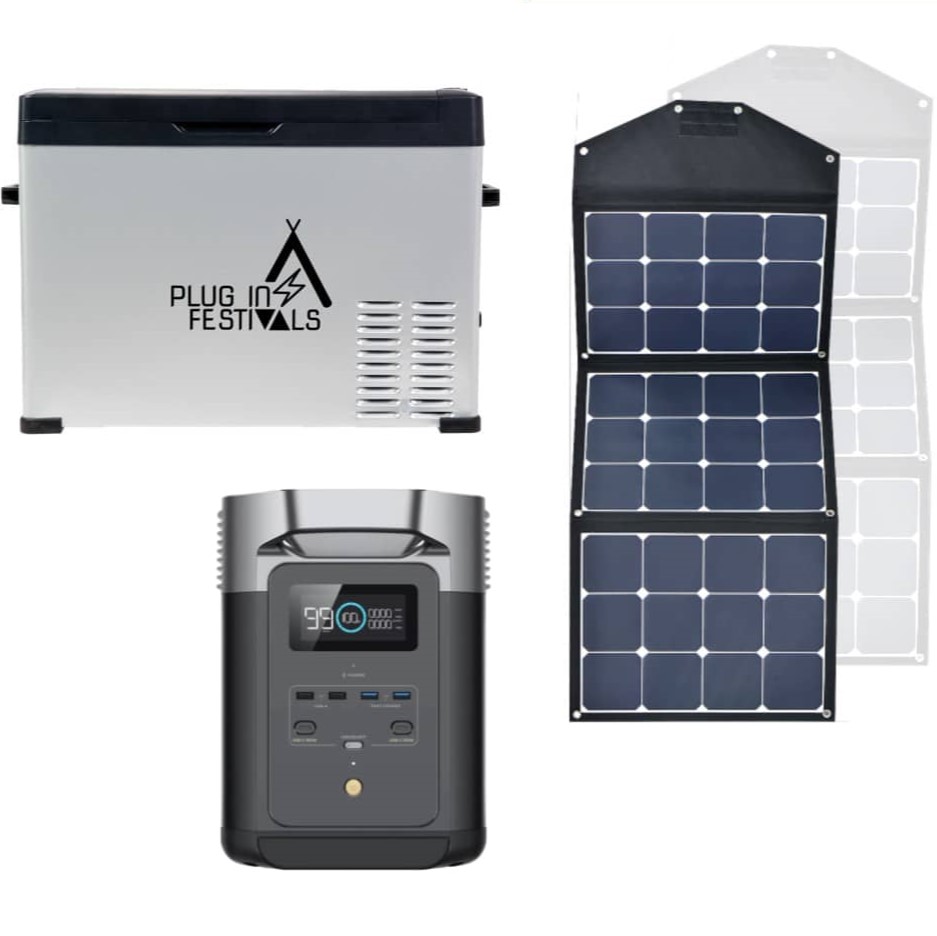
The heart of any mobile power supply is the power station, a portable battery storage unit with an integrated inverter. It powers smartphones and laptops just as easily as small household appliances and coolers. The key factor is capacity in watt-hours: small models with 300 to 500 watt-hours cover a weekend trip with a phone, lamp, and Bluetooth speaker. If you want to run a cooler for several days, opt for models starting at 1,000 watt-hours. Charging is possible via the mains, the car’s cigarette lighter, or a solar panel.
The cooler is often more essential at a festival than any gadget. Compressor coolers keep food and drinks reliably cold for days and operate quietly enough for tents or motorhomes. Larger models hold around 50 litres. Power consumption is the decisive factor when sizing your power station, because a cooler runs continuously and draws noticeable capacity over the course of a day.
Solar panels complete the cycle. Foldable panels can be set up in minutes and feed the power station during the day. Modern panels use MPPT technology to extract residual power even under overcast skies. A 500-watt-hour station paired with a 100-watt foldable panel is enough on a sunny day for cooler, phone, lights, and music-without ever needing a wall socket.
If you only need to get through festival season, renting is usually cheaper and more flexible than buying a system that sits in the basement for eleven months.
Buy or Rent: The Honest Math
A solid power station with 1,000 watt-hours and a matching solar panel quickly costs a mid-to-high three-figure Euro amount. That’s worthwhile if you’re regularly off-grid, live in a motorhome, or want a backup power reserve at home. Current LiFePO4 batteries last over 3,500 charge cycles, translating to years of use without significant capacity loss.
For everyone else, renting is the calmer option. That’s exactly where the Munich-based provider steps in-formerly known as Plug-in Festivals and now called MAENTUM. During the season, the company is present at roughly 25 to 30 festivals with a booth on-site. Rented power stations can be swapped for fully charged units when the battery runs low, and simply returned at the end of the festival. A single rental of a power station for an entire festival starts at around €89; a PowerFlat rate offers unlimited charging for devices up to 500 watts continuous output. So if you only head to a festival once a year, you save on purchase, storage, and maintenance.
How to Plan Your Weekend Power
Before your trip, roughly tally up what you plan to run. A smartphone needs about 15 watt-hours per charge, a laptop around 50 to 100 depending on the model, an LED light string a few watts in continuous operation, and a compressor cooler 200 to 400 watt-hours per day depending on outside temperature. Add the daily consumption, include a 30 percent buffer, and you have the required capacity. If you have sun, you can choose a smaller station because the solar panel recharges during the day. This logic applies just as well to the festival grounds as to your next road trip in a camper van.
If you’re new to off-grid living, run your gear at home beforehand. That way you’ll know exactly how long your setup lasts before you’re left in the dark at the campsite. If you prefer a more comfortable approach, find the right ideas in our features on holidaying with a camper and glamping as a stylish camping alternative.
Good to Know
▸How many watt-hours do I need for a festival?
For a weekend with phone, lights and a Bluetooth speaker, 300 to 500 watt-hours will do. If you’re running a cooler for several days, budget at least 1,000 watt-hours or pair it with a solar panel for top-ups.
▸Should I buy a power station or just rent one?
Buying makes sense if you’ll use it regularly, live in a camper van or want it as emergency backup. If you only need it for festival season or a handful of trips, renting is cheaper and you don’t have to worry about storage or maintenance.
▸Do solar panels still work in bad weather?
Yes, though output drops. Modern foldable panels with MPPT technology still deliver residual current even under overcast skies. On rainy days the charge rate falls sharply, so make sure your power station is large enough to ride out a wet spell.
▸Are there still plug-in festivals?
Yes-the Munich provider is still active, but rebranded under the name MAENTUM. The rental model offering power stations, coolers and solar panels for festivals and outdoor events continues under the new banner.