
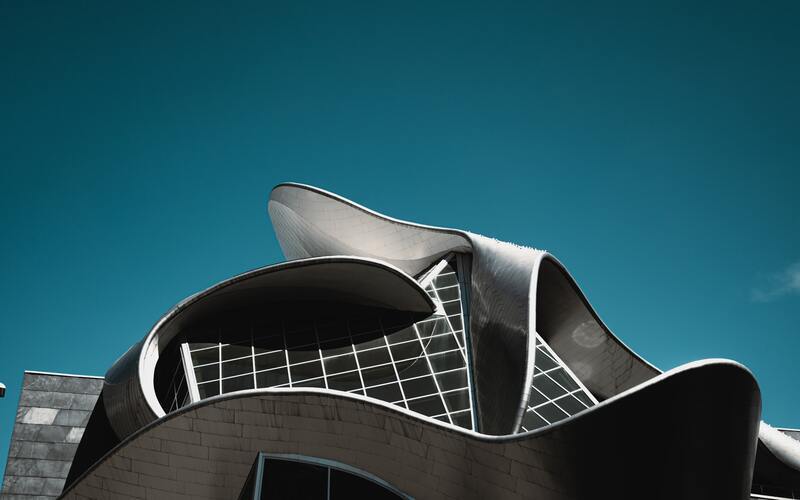
Architecture at its finest – when buildings become works of art
You think architecture is dull? Let us show you the opposite. Architects are transforming buildings into true works of art.
In 2021 we showcased buildings that refused to settle for “practical.” What remains? Architecture becomes compelling when it has a clear idea: to vanish, to move, or to perch like a ship on a mountain peak.
- The Invisible House in Joshua Tree uses mirrored sides and modern interiors to disappear into the landscape.
- Shanghai’s Bund Finance Center features kinetic gold and bronze steel-tube curtains.
- An unrealized hotel concept places a ship atop a mountain summit.
- These examples prove architecture can be a gesture, not just a shell.
When a House Wants to Disappear
The old article begins with the question of whether architecture is boring. The answer emerges through examples, not theory. The first is the Invisible House in California, in Joshua Tree. Its sides are fully mirrored, so from a distance it appears almost invisible. This idea is powerful because it doesn’t rely on size but on restraint. The house makes itself small by reflecting its surroundings.
Inside, the article describes it as modern, where the apparent mirrors are actually windows. It’s also presented as sustainable. The design comes from Tomas Osinski. What’s fascinating is the contradiction: a house that draws attention because it wants to vanish. It’s these very contradictions that make architecture come alive. You see the landscape first, then the house, then the landscape again.
Movement Over Static Facades
The second example takes us to Shanghai, to the Bund Finance Center. The archived text links Thomas Heatherwick and Norman Foster to the building. Three curtains of gold and bronze steel tubes surround the cultural center, constantly shifting around the structure. Even this description is enough to understand why the building sticks in your mind.
Many facades aim to impress, but they remain rigid. Here, movement becomes part of the building. The envelope doesn’t feel like a conclusion but like a scene. Gold and bronze could easily look heavy or ostentatious. Through movement, they take on a different quality. The building isn’t just standing there. It changes its expression.
A Steamship on the Mountain
The third example isn’t a finished place but an idea. According to the text, architects Laertis Antonios Ando Vassiliou and Pantelis Kampouropoulos wanted to build a hotel designed like a ship. Not by the harbor, not in the water, but on the summit of a mountain. The two ends of the ship were meant to jut far beyond the steep slopes. Whether it will ever be realized remains open in the article.
That’s precisely why it’s so intriguing. Some architecture exists first as an affront to the imagination. A ship on a mountain is technically, visually, and narratively almost absurd. But it forces you to rethink place entirely. A hotel doesn’t have to be just accommodation. It can be the very reason you decide to take a trip.
Architecture as Memory
The archived text cites residential houses, concert halls, museums, and hotels. What they share is that they don’t stay in the background. They show how far creativity can go and how close architecture can verge on art. Of course, not every idea can be built. Not every idea should be built. But the good ones linger in the mind because they ask a simple question: Why must a building look the way we expect it to?
Perhaps that’s the best test. A good building doesn’t need to shout, but it must have character. The Invisible House chooses camouflage, the Bund Finance Center movement, the ship hotel a break with its location. Three utterly different gestures, one shared effect: you look twice. And afterward, you view ordinary facades with a little more awareness.
What the Three Examples Have in Common
The Invisible House, the Bund Finance Center, and the ship hotel may sound like very different stories at first. One house wants to disappear, a cultural center moves its envelope, a hotel is meant to sit like a ship on a mountain. What they share is that they make a simple idea radically visible. That’s what sets them apart from architecture that merely decorates.
With the Invisible House, the landscape becomes part of the building because the mirrors reflect it back. With the Bund Finance Center, time becomes part of the facade because the curtains move. With the ship hotel, the location itself becomes provocative because a ship sits where no ship is expected. Three strategies, one effect: the building forces you to look more closely.
The old text ends by asking whether it succeeded in convincing you. The better question is: What lingers in your mind? With these examples, the answer is easy. Mirrors, movement, ship. Good architecture can sometimes be remembered in a single image. Everything else follows: materials, structure, use, history. But first, you need that image.
Why this isn’t just Instagram architecture
These buildings are quickly dismissed as mere photo ops-and that’s understandable, but too simplistic. At Invisible House, the allure isn’t just in the mirrored reflection; it’s in the question of how a house can engage with its surroundings. At Bund Finance Center, it’s not just the gold and bronze, but the movement. At the ship hotel, it’s not just the wild shape, but the rupture between object and place.
The original piece celebrated architects’ creativity. Today we can be more precise: great architecture gives an idea a form you don’t soon forget. It doesn’t have to be comfortable. It doesn’t even have to please everyone. But it must do more than close square metres. These examples can.
The view after
After seeing such examples, even ordinary houses look different. A reflection, a shifting façade, a shape in the wrong spot-any one of these is enough to shift habits. That’s the real gain of the original piece. It doesn’t claim to explain which architecture is objectively best; it shows that buildings can ask questions before you even reach their door.
Architecture doesn’t become more exciting because it’s more complicated. It becomes more exciting when an idea holds firm all the way to form.
Quick Answers
▸Where is Invisible House located?
The alt text names Joshua Tree, California.
▸What makes Bund Finance Center special?
The moving curtains made of gold and bronze steel tubes.
▸Was the ship hotel ever built?
The original piece said it was unclear whether it would ever be realised.
▸Why does this fit //LIVING?
Because it’s about spaces, architecture, materials and the impact of built ideas.


