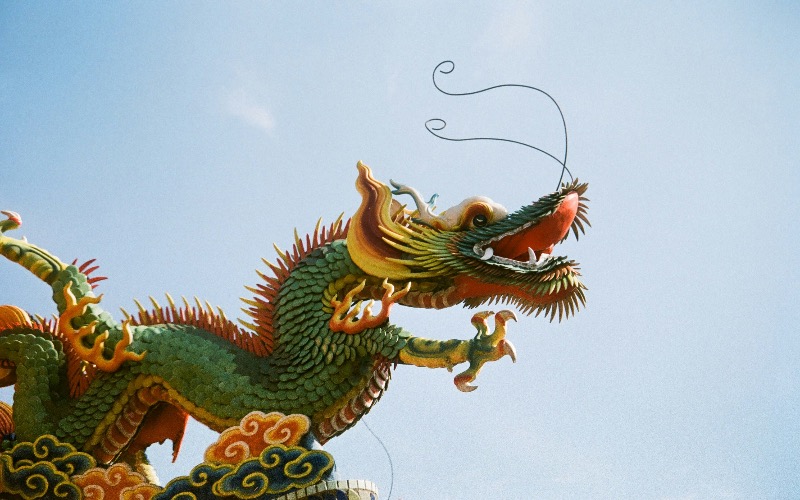
Five elements multiplied by twelve animal signs produce 60 combinations. It is this 60-year cycle that forms the true unit of Chinese astrology.
Ten Heavenly Stems, Twelve Earthly Branches
In traditional interpretation, it is less the animal names that matter and more two abstract sequences: the twelve Earthly Branches (地支, dìzhī), which correspond to the animal signs, and the ten Heavenly Stems (天干, tiāngān), which in pairs represent the five elements. The ten Heavenly Stems cycle every ten years, while the twelve Earthly Branches cycle every twelve years. Since ten and twelve share the least common multiple of 60, a specific combination repeats only after six decades.
The Wood Dragon is written in this notation as 甲辰 (jiǎchén) and stands at position 41 in the current cycle. The ongoing cycle began in 1984 with the Wood Rat (甲子, jiǎzǐ). To find your own position, simply count from 1984 as year one. The Wood Dragon of 2024 was therefore the 41st year. This logic also explains why the cycle is called 干支 (gānzhī) in Chinese-after the first characters of the two sequences.
Where We Stand in 2026
Following the Wood Dragon in 2024 came 2025, the Year of the Wood Snake, which we have explored in a dedicated feature. Since February 17, 2026, the Year of the Fire Horse has been underway. In East Asia, this constellation carries a special reputation: Fire Horse years are seen as energetic yet unpredictable, and in Japan, historical records even document a decline in births during such years. The next Dragon, however, is still some time away. Not until 2036 will it return-then as the Fire Dragon.
The Chinese New Year does not follow the Gregorian calendar but the lunisolar Chinese calendar. It begins on the first new moon between January 21 and February 21. Thus, each zodiac year starts on a different date, which is why the Wood Dragon did not begin on January 1 but on February 10, 2024.
Why Superstition Has Survived
What’s remarkable is how stubbornly this tradition has endured. In 1966-1976, China’s leadership tried to eradicate superstition entirely during the Cultural Revolution. Yet the Mao Zedong Mausoleum, built after his death in 1976, was aligned according to Feng Shui principles. Exactly what Mao had fought against in life was applied at his final resting place. The twelve earthly branches also governed time in antiquity: every two hours, the sign of the rat (子, zǐ) marked the period from 11 p.m. to 1 a.m. Midday is still called 中午 (zhōngwǔ) in Chinese-literally “the middle time of the horse.”
Dismissing Chinese astrology as mere fortune-telling overlooks its deeper appeal. Behind the twelve animals lies a sophisticated system of numbers, elements and polarities that links years, hours and compass directions. Whether you draw life forecasts from it or simply marvel at its cultural logic is a matter of taste. Either way, it remains fascinating. For those eager to dig deeper, we also offer a look back at the Year of the Wood Snake 2025 and a feature on how the Yanyou festival brings a slice of China to Munich .
Good to Know
▸ When exactly was the Year of the Wood Dragon? The Year of the Wood Dragon ran from 10 February 2024 to 28 January 2025. Because the Chinese calendar is lunisolar, each zodiac year begins on a different date between 21 January and 21 February.
▸ When is the next dragon year? The next dragon year arrives in 2036, though it will be the Fire Dragon. A full sixty years must pass before another Wood Dragon appears-in 2084.
▸ What’s the difference between the twelve animals and the 60-year cycle? The twelve animals form only one layer. Added are five elements in yin-yang alternation. Ten heavenly stems and twelve earthly branches combine to create 60 possible constellations that repeat only after 60 years.
▸ Which year will 2026 be? 2026 is the Year of the Fire Horse, beginning 17 February 2026. It follows the Wood Dragon 2024 and the Wood Snake 2025.