Most things in a room are at their most beautiful on day one. From then on, they fade. A select few only begin to shine at that point: oak, linen, brass, stone. A meditation on materials that absorb life instead of breaking under it-and why we should dare to trust them again.
There’s a table I know-an old oak slab where three generations have gathered to eat. You can see it in the wood. Near the window the grain is lighter, where thirty summers of sunlight have settled. Along the narrow edge, where the same hand always pulled the chair up, there’s a shallow hollow no deeper than a thumb. A water ring from some long-ago summer, a dark spot from something hot. None of it was planned. And yet this table is lovelier than anything new you could buy to take its place.
Quick Take
There are two kinds of beauty in living spaces: the kind that’s finished on day one and only declines afterward, and the kind that matures through use.
Solid oak, linen, untreated or waxed brass, vegetable-tanned leather, and natural stone belong to the second category. They age like a face, not like a coat of paint.
High-gloss laminate, piano-lacquer plastics, and thin coatings belong to the first. They conceal rather than endure; every trace of life is a flaw.
Patina isn’t wear. It’s the story of a material made legible – and the only luxury you can’t buy, only wait for.
That’s the difference at the heart of this story. Most surfaces we live with today reach their peak the moment they’re delivered. From there it’s all downhill-slowly for the good stuff, quickly for the cheap, but always in the same direction. There’s a small, stubborn family of materials that do the opposite. They arrive raw and almost unfinished, and only through use, light, and touch do they become what they’re meant to be.
We call that patina. The word conjures museums and verdigris on statues, yet it simply describes the layer a material accumulates because it’s lived with. Not a defect to be polished away, but proof that the thing has a life.
Wood that drinks the sun
Start with the obvious: wood. Solid oak, oiled rather than drowned in lacquer, may be the most patient material a room can know. It drinks in light and gives it back transformed. Pale oak darkens under UV exposure, deepening over the years into burnished gold. Other woods respond even more dramatically. Cherry visibly deepens until its hue turns rich and warm. That’s not marketing-it’s chemistry. Lignin and other wood components react to light and air.
An oiled surface lets this reaction happen. The oil soaks in instead of forming a film, and that has a lovely consequence: you can refresh it without sanding. A tired stain plumps up again with a little oil, a scratch fades as the grain re-oils. Lacquered wood, by contrast, wears a skin. As long as that skin is intact, it gleams. When it cracks, you see the wound – and the only fix is to redo the whole surface.
That’s a small life decision. A lacquered table must be coddled: coasters, caution, a little fear around the red-wine glass. An oiled oak table wants to be used. It expects the water ring. Over time, it turns that ring into character. The first approach keeps life at bay. The second invites it in.
Beauty that cannot endure use is not beauty at all. It’s merely packaging that hasn’t been opened yet.– A mindset, not a material spec sheet
Materials that grow softer
Let’s move on to what you touch without even noticing: textiles. Linen is the most honest fabric of all. Freshly woven, it’s stiff-almost brittle – with that cool, slightly crinkly feel that makes some shoppers hesitate. That’s exactly its promise. Linen softens with every wash. One of the oldest fibres humans have woven, it gradually sheds its stiffness and settles into a drape no new piece can match. The familiar creases that some see as a flaw are in fact the signature of the material.
Then there’s the flip side: cheap microfiber or polyester upholstery that looks smooth and flawless on day one. It doesn’t stay smooth. It pills, it gleams greasily on the seat areas, it absorbs every odour and never lets go. Synthetics don’t age; they fatigue. There’s no stage where a worn-out polyester sofa is more beautiful than it was on day one. There’s only less bad and more bad.
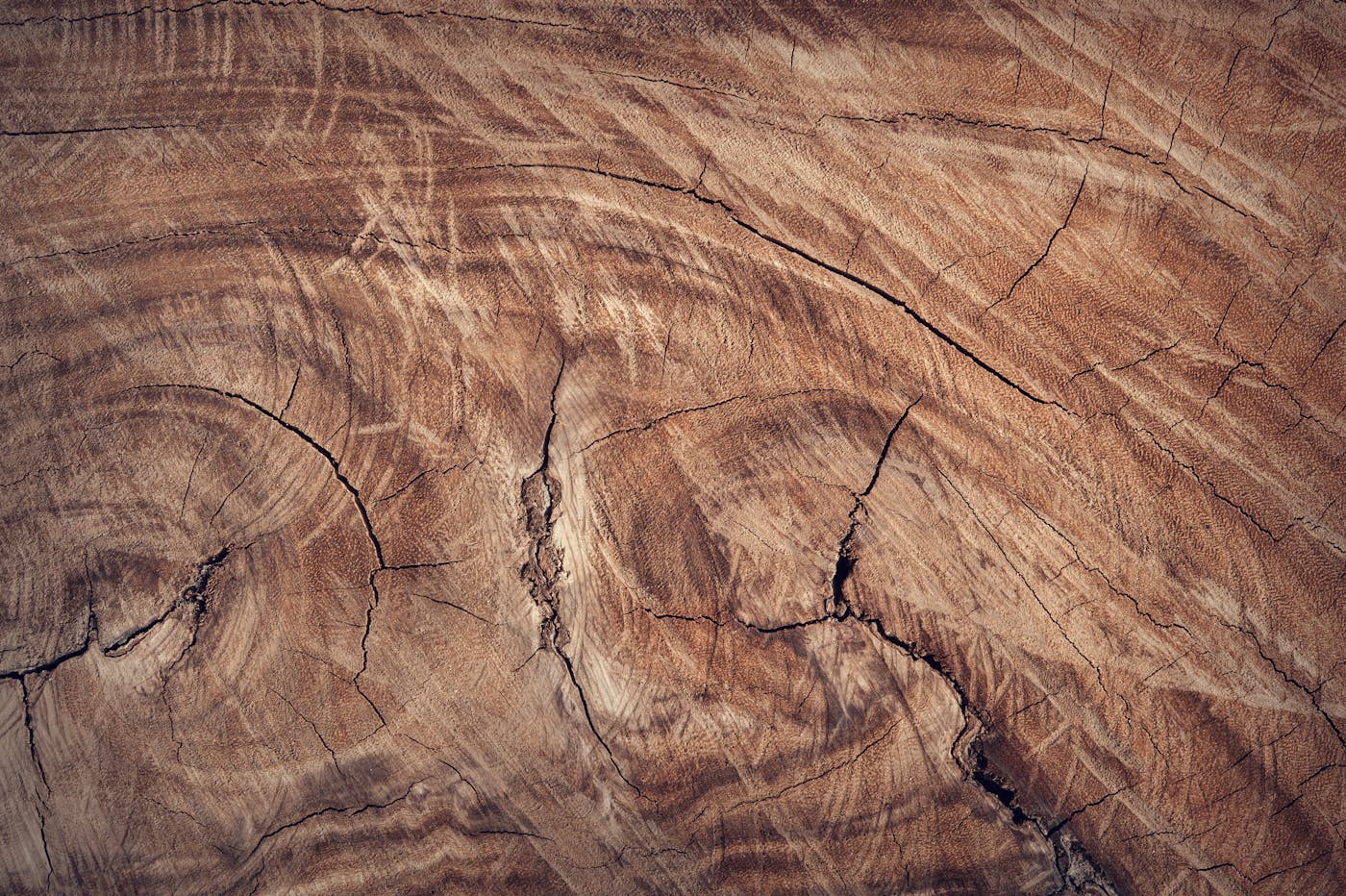
Wood that has lived a life: grain, cracks and mellow tones make the surface what it is. What looks like wear is the handwriting of the material. Image: Pexels / FWStudio.
Leather belongs in this family too-but only the right kind. Vegetable-tanned leather, tanned with bark and plant extracts instead of chromium salts, develops a patina over the years: it darkens, takes on a warm sheen and records every touch and bend. An old briefcase, a well-used armchair: the leather tells the story of how it was used. Coated, heavily pigmented leather can’t do that. It wears a colour layer on top that starts flawless and eventually cracks and peels, leaving nothing underneath that could mature.
Metal that reflects
Now to the material most people misunderstand: brass. Untreated or simply waxed brass doesn’t stay golden. It oxidises in the air, darkens to honey-brown and, in damp spots, can turn greenish. A door handle in raw brass carries lighter streaks where hands grip it daily and darker patches where they don’t. The metal keeps a ledger of how the room is lived in.
Many makers strip that vitality away. Lacquered or clear-sealed brass is meant to look catalogue-perfect forever. For a while it does, until the finish rubs thin at the grip points – and you end up with the worst of both worlds: patchy shine, patchy yellowing, and nothing uniform. Raw brass has no such problem. It ages everywhere, just at different speeds, and that ends up creating a coherent picture. Want it golden again? Polish it. Let it patinate and you get a depth no new piece can match.
Stone that was already old when it arrived: travertine carries its depth and fine veins from the start, a surface that was never sterile and to which further years do no harm. Image: Wikimedia Commons / James St. John, CC BY 2.0.
Copper follows the same path, only more visibly. It shifts from rose to deep brown and, over decades, to the green patina familiar from old roofs. A copper pan in the kitchen, a copper tap in the bathroom: both start bright and grow quieter and warmer with time, less vain. The simple rule still holds: either let the metal live its life, or seal it and accept that the seal will eventually fail.
Stone that was already ancient when it arrived
Natural stone is the exception in this list because its aging follows a different timeline. A slab of marble or travertine was already millions of years old when it was hewn from the mountain. A marble kitchen countertop will, over time, develop its own surface: acids from lemon or wine can dull the sheen, light spots appear, and a silky, slightly irregular patina emerges. In many Italian homes, this isn’t seen as damage but as the proper, lived-in surface of marble.
Travertine, the porous limestone riddled with fine holes and used to clad Roman buildings, carries its age within itself. It never looks sterile, not even on day one, and precisely for that reason, the passage of further years doesn’t bother it at all. If you want stone that always looks like it did in the showroom, buy a quartz composite slab: uniform, hard, easy to care for. It barely ages at all. But it doesn’t mature either, and no two square centimetres of it will ever carry their own story.
The Patina Family
Solid oak, oileddarkens over time, absorbs light, can be spot-oiled instead of refinished entirely.
Linenstarts stiff, softens with every wash, grows fuller with the years.
Vegetable-tanned leatherdarkens, develops a warm sheen, records every touch.
Raw or waxed brass, copperoxidise, darken, keep a log of every contact.
Marble, travertinedevelop a silky, lived-in surface; travertine was never sterile to begin with.
Why high-gloss only looks good for a day
Place the patina family beside its opposite, and the contrast becomes razor-sharp. High-gloss laminate, piano lacquer on chipboard, the thin foils and coatings that gleam so brightly in the furniture store you can see your own face in them: they’re engineered to look their best on delivery day. After that, time works against them.
High-gloss reveals everything. Every fingerprint, every dust haze, every micro-scratch from the microfibre cloth meant to clean it. A matte, oiled oak absorbs these tiny marks; a high-gloss front collects them like evidence. And because the gleaming surface is often only a wafer-thin layer over cheap substrate, there’s no going back. Once that layer is gone, the chipboard is exposed. You can sand a solid oak plank a hundred times. A veneered high-gloss panel won’t tolerate even one.
That’s the real point, and it’s more than a matter of taste. Some materials are built so life improves them. Others so life ruins them. One kind you can use without offending it. The other you must protect as if it’s too good for daily life. And anything too good for daily life ultimately proves rather useless in a home.
A home that ages with you
You can make this a guiding principle without replacing half your house. The next time you bring something new inside, ask yourself one quiet question: will it be more beautiful in ten years, or less? An oiled table instead of a lacquered one. A linen cover instead of microfibre. A raw fitting instead of a sealed one. A stone slab allowed to age instead of a composite forced to age without permission.
It’s also, incidentally, the more honest way to treat what we buy. A material that gains with use doesn’t need replacing when it shows marks; the marks are the whole point. The disposable interior works the opposite way: it looks good at the start, wears predictably, and ends up on the curb because a high-gloss front can’t be repaired. Patina is, in this sense, a quiet form of respect for the things around us.
The table from the beginning remains: the old oak with its light patch by the window and its gentle hollow along the edge. No one polished it to perfection. Life did the work, summer after summer, hand after hand, glass after glass. You can’t buy that. You can only wait for it, and to do that you have to choose materials once that make the waiting worthwhile. The rest is patience. And, if you look closely, patience is the only material from which true beauty in a home has ever been made.
Details
Isn’t patina just wear and tear with a fancier name?
Not quite. Wear and tear is when a material loses its function: the sagging foam, the peeling coating. Patina is when a material gains a new surface through use without losing substance: darkening wood, softening linen, tarnishing brass. One is deterioration; the other is maturity.
Does raw brass need maintenance?
Only if you want to keep its bright, golden hue-then you polish it. If you let natural oxidation take its course, you do nothing; the metal darkens evenly on its own. Waxed brass sits in between: it ages more slowly and can be re-waxed when needed.
Doesn’t marble in the kitchen scratch right away?
True, marble is softer and more acid-sensitive than, say, granite or quartz composite. Acids dull the shine and leave pale spots. If you want a flawless surface, marble isn’t the right choice. If you’re open to a surface that develops a silky, lived-in patina over time, marble is exactly the stone for that.
Is the premium for solid wood and natural materials worth it?
Almost always, over time. A solid, oiled table can be sanded and re-oiled and last generations; a veneered high-gloss top is scrap-yard material after the first scuff. The higher upfront cost spreads across a much longer life – and a surface that gets better instead of worse.
❖
Cover image source: Pexels / Pixabay. Inline images: Pexels / FWStudio, Wikimedia Commons / James St. John, CC BY 2.0.
Jakob Bach writes for InspiredByLuxury about what’s worth it and what lasts. This column is a personal take on materials, not an expert assessment. It champions surfaces that endure life instead of keeping it out.
//Living
More from //Living
Spaces that grow more beautiful with time. Light, material, and home as an attitude. Stay in //LIVING.

 //LIVING