Craft · Presepe
The Neapolitan nativity: How figures are made by hand
A clay head, a body of wire and tow, clothes made from fabric: this is how Neapolitan nativity figures are made. Plus their history and the best museums to see them in.

 Art & Collecting
A clay head, a body of wire and tow, clothes made from fabric: this is how Neapolitan nativity figures are made. Plus their history and the best museums to see them in.
In Naples, the nativity has its own alley, its own history at court and its own method of construction. The figures are small, jointed dolls with clay heads, bodies of wire and tow and clothes made from real fabric. Hold one in your hand and you soon understand why collectors draw such a careful distinction between a souvenir and a piece of craftsmanship.
The Landesmuseum Württemberg sums up the character of these nativity scenes in a single sentence: market women, proud citizens and beggars populate the scene. Somewhere among them stands the Holy Family. According to the museum, this blend of everyday life and devotion, together with its lifelike portrayal, sets the Neapolitan nativity apart from those of other regions.
At the heart of this method of construction was the flexible body. The sculptor Michele Perrone is credited with introducing figures whose heads and limbs were made of wood and whose bodies had an iron wire core wrapped in tow. Tow is the short, coarse fibre left over from processing hemp or flax. The advantage lies in the joints: because the wire bends, a figure can sit, lean forward or raise an arm. The scene comes to life.
In the second half of the 18th century, many figures had clay heads. For its Neapolitan nativity figures from between 1750 and 1800, the Landesmuseum Württemberg lists these exact materials: terracotta, polychromed wood, wire, tow and textiles. Polychromed means painted. The head is modelled in clay and fired, while the limbs are carved from wood and painted. The body remains a framework of wire and fibre, hidden beneath the clothing.
The clothing is the second major difference from a carved nativity scene. The figures wear fabric garments, sewn and fitted as they would be on a doll. Each figure thus becomes a work of costume design. A market woman, a shepherd or a noblewoman can be distinguished by their fabric, cut and colour.
This division of labour gives the figures their character. The head reveals the modeller’s skill: features, age and expression take shape in the clay and are brought to life with paint. The wooden limbs give the figure structure and gesture. The framework of wire and tow remains invisible, yet it shapes the overall effect by holding the pose. A well-made figure never looks stiff; it seems caught in the middle of a movement.
The Munich collection’s object records give a sense of the figures’ size. A Mary from Naples, made in the second half of the 18th century, measures 41.9 centimetres. A young noblewoman from the same period is 24.6 centimetres tall. The Bayerische Nationalmuseum lists terracotta as the material for both.
If you travel to Naples today to see nativity figures, you will find yourself on Via San Gregorio Armeno. The alley lies in the heart of the historic centre, a few steps from the Piazza Nicola Amore metro stop. Italy’s official tourism portal describes it as a place where Christmas is celebrated all year round. The workshops welcome visitors 365 days a year, well beyond Advent.
Handmade figures are sold here, ranging from the traditional characters of the nativity to figures from current affairs. In some displays, sportspeople and politicians stand beside shepherds and angels. It is a long-established tradition: the Neapolitan nativity has always depicted the people of its own time.
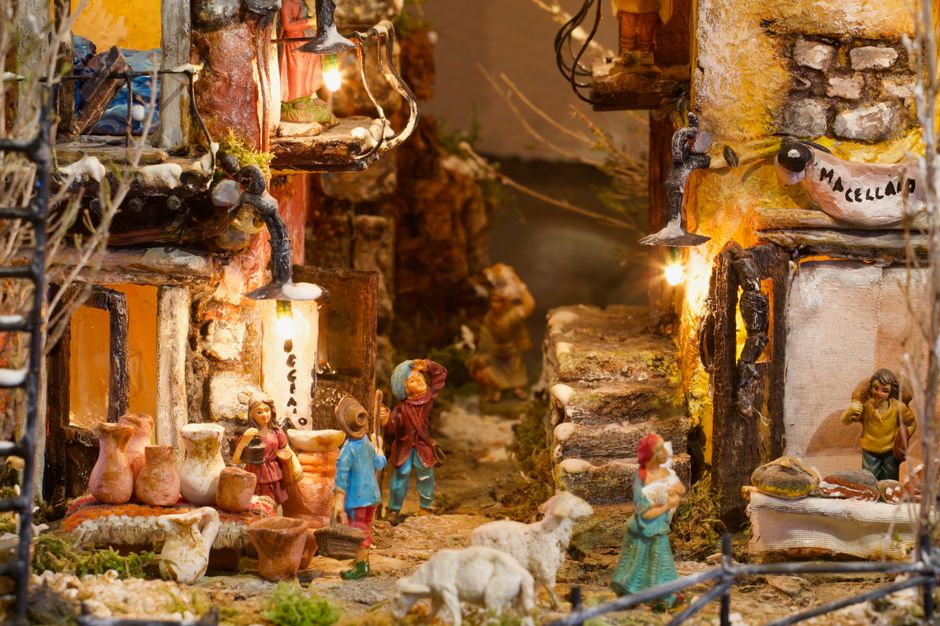
For you as a visitor, the alley is a lively market where shepherds and angels stand alongside figures from current affairs. A look at the materials helps you understand what you are seeing. A figure cast in a single piece is made differently from the historical jointed dolls described here.
The Neapolitan nativity has always depicted the people of its own time.
Towards the end of the 17th century, what appeared in the nativity scene began to change. Alongside the sacred events came figures from everyday life: innkeepers, cobblers, beggars and traders. The scene came to reflect the squares and alleys that shaped Naples at the time. The devotional image became a theatre of everyday life.
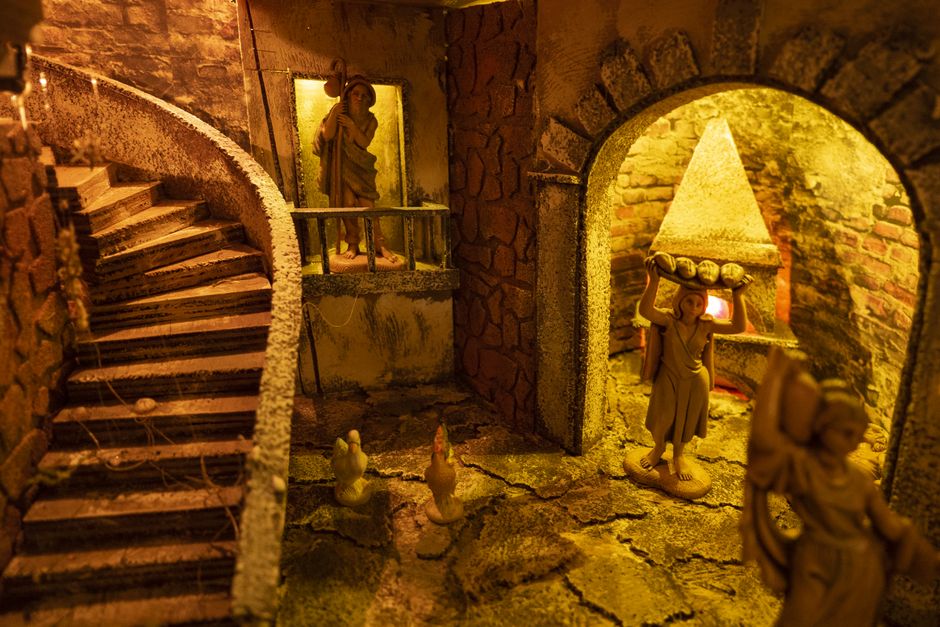
This embrace of everyday life remains its distinguishing feature. The Landesmuseum Württemberg specifically names market women, citizens and beggars as typical figures. When you look at a Neapolitan nativity scene, you see life first: traders with baskets, animals, stairways, niches and archways. The birth of Christ is at its centre, but is often hidden deep within the scene.
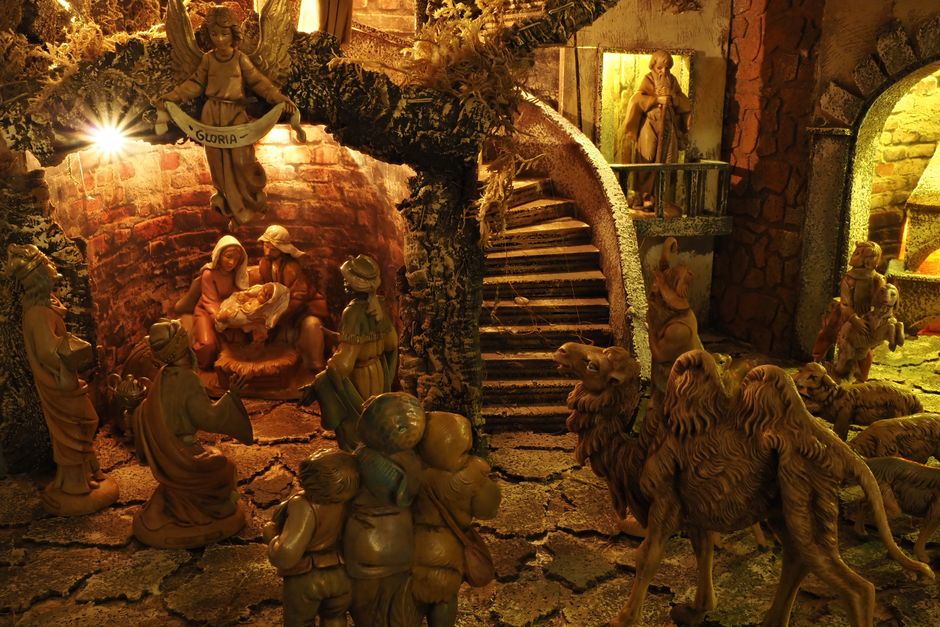
The art flourished in the 18th century under Charles III of Bourbon. The nobility and wealthy citizens joined religious orders as patrons. The Landesmuseum Württemberg describes the making of nativity scenes during these decades as a royal priority. Artists from the Capodimonte porcelain manufactory made figures that quickly became a sought-after luxury export.
The nativity scenes grew with their owners’ ambitions. Some palaces acquired dedicated nativity rooms. Other families placed their nativity scene on the flat roof of the house so that the real landscape formed the backdrop. In the courtly tradition, the figures stood on a cork base known as the scoglio, on which the individual scenes could be arranged in tiers, as on a stage.
The best-known collection is in Naples itself. The Museo Nazionale di San Martino houses the Cuciniello nativity, with around 800 pieces, including figures, animals and accessories. It was assembled by Michele Cuciniello, who lived in Naples in the second half of the 19th century. He gave the collection to the city.
The Reggia di Caserta presents the courtly version: a large Neapolitan nativity scene with figures from the 18th century. It has been reconstructed after the model that Ferdinand II had installed in 1844. The setting is a royal palace, exactly the kind of place these nativity scenes were made for.
You do not have to travel to Italy to see fine examples. The Bayerische Nationalmuseum in Munich has one of the great nativity collections, with works from southern Germany, the Alpine region and southern Italy spanning three centuries. Highlights include a nativity scene depicting a Naples street with market scenes and a Vesuvius nativity. The Landesmuseum Württemberg in Stuttgart also owns Neapolitan nativity figures from the second half of the 18th century.
The comparison is worthwhile. Once you have seen the museum pieces, you can more readily recognise which figures on Via San Gregorio Armeno follow this tradition. Look at how they are made: a modelled head, movable limbs, a body of wire and fibre and a fabric garment. A figure with these features is a small work of sculpture, tailoring and painting all at once. For a collection, it also matters that dealers can state the materials and provenance in writing.
For figures from 1750 to 1800, the Landesmuseum Württemberg lists terracotta, painted wood, wire, tow and textiles. The head is modelled in clay, while the body is a framework of wire and fibre beneath a fabric garment.
The Museo Nazionale di San Martino in Naples houses the Cuciniello nativity, with around 800 pieces, including figures, animals and accessories. The Reggia di Caserta also displays a large courtly nativity scene.
Yes. The Bayerische Nationalmuseum in Munich displays, among other works in its nativity collection, a nativity scene depicting a Naples street with market scenes. The Landesmuseum Württemberg in Stuttgart also owns Neapolitan nativity figures from the 18th century.
More on the market, the houses and the pieces with verifiable provenance.