Craft · Textile Art
Tapestries: How conservators save pictures woven from wool
Silk ages faster than wool, and the weight hangs from the weakest thread: how conservators preserve historic tapestries stitch by stitch.

 Art & Collecting
Silk ages faster than wool, and the weight hangs from the weakest thread: how conservators preserve historic tapestries stitch by stitch.
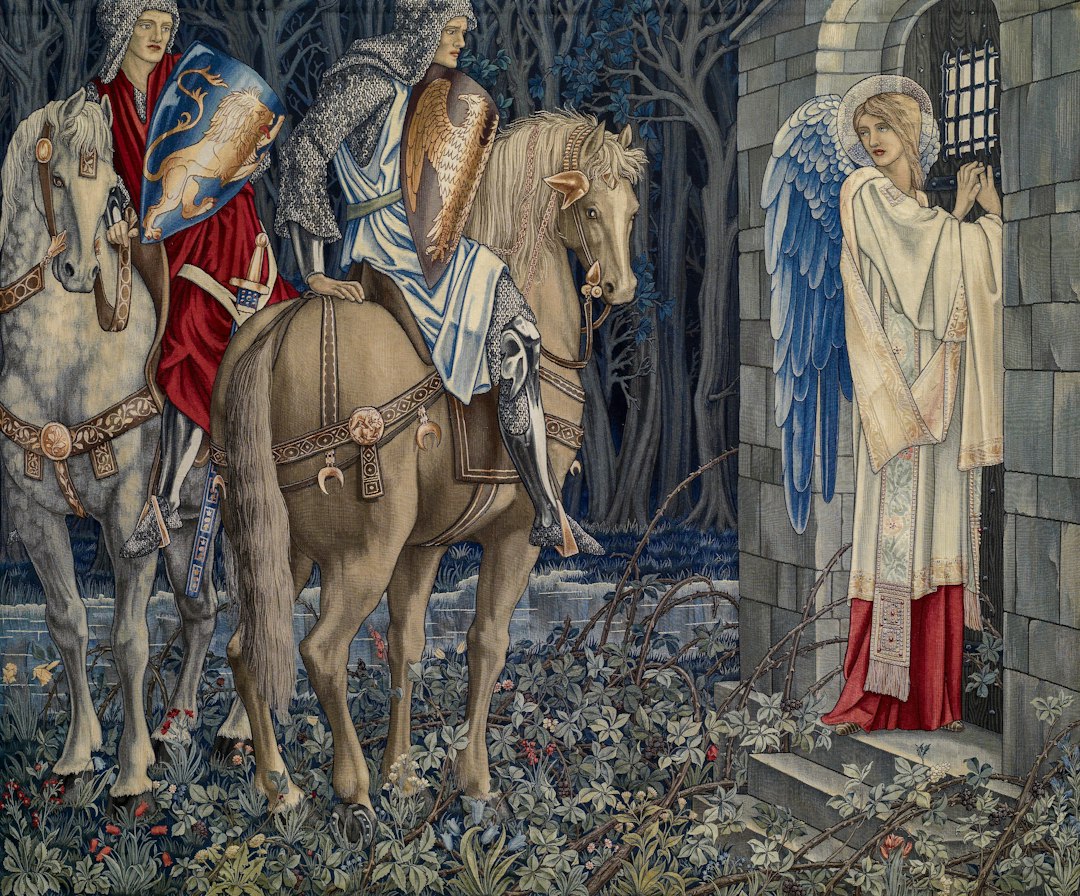
From a distance, a tapestry looks like a painting. Up close, it is a structure of thousands of threads that have hung on a wall for centuries, carrying their own weight. That is precisely where the problem lies. Light damages the silk, while the weight pulls on the weakest threads. Even old repairs can put the original at risk.
Two examples show in particular detail how conservators preserve these pictures of wool and silk: the tapestry and textiles laboratory at the Vatican Museums and the restoration of the Solebay Tapestry for Royal Museums Greenwich. Both examples show why this work is measured in square centimetres.
The technique behind a tapestry is called tapestry weaving. It is related to cloth weaving, yet follows its own logic. In cloth weaving, the weft thread runs across the full width of the fabric, from edge to edge. In tapestry weaving the weaver takes each coloured weft thread only as far as the edge of the area of colour specified by the design, then brings it back again. The image emerges area by area. A tapestry is therefore always made by hand.
This determines how the tapestry is constructed. The warp forms the framework, held taut as the weaver works. The weft carries the colour and design. Because it ends at each boundary between colours, it consists of countless individual sections. The warp is the stronger thread and gives the tapestry its structure. In historic pieces such as the Solebay Tapestry in Greenwich, it was generally made of wool. The weft of this tapestry is predominantly silk, with wool in some areas.
The terminology deserves a closer look too. In German, the French word for tapestry has been used for classical works since the 19th century, alongside terms meaning pictorial and wall tapestry. Strictly speaking, only pieces made at the Gobelin manufactory in Paris are called Gobelins. Gobelin painting and Gobelin embroidery, by contrast, imitate tapestry weaving. In one, the design is painted onto fabric; the other is actually petit point embroidery.
The Solebay Tapestry reveals where the weak points lie. It depicts the naval battle of 1672 and is one of six large tapestries commissioned by King Charles II of England. The designs are based on drawings by Willem van de Velde the Elder. The tapestry is almost four metres high and around six metres long.
The Royal Museums Greenwich describe the central problem clearly: silk deteriorates faster than wool and is more sensitive to light. Yet silk forms most of the design in this tapestry. Then there is the question of support. A historic tapestry hangs from its weft, the many short, interrupted lengths of thread. The weight of the entire picture rests on its most delicate part.
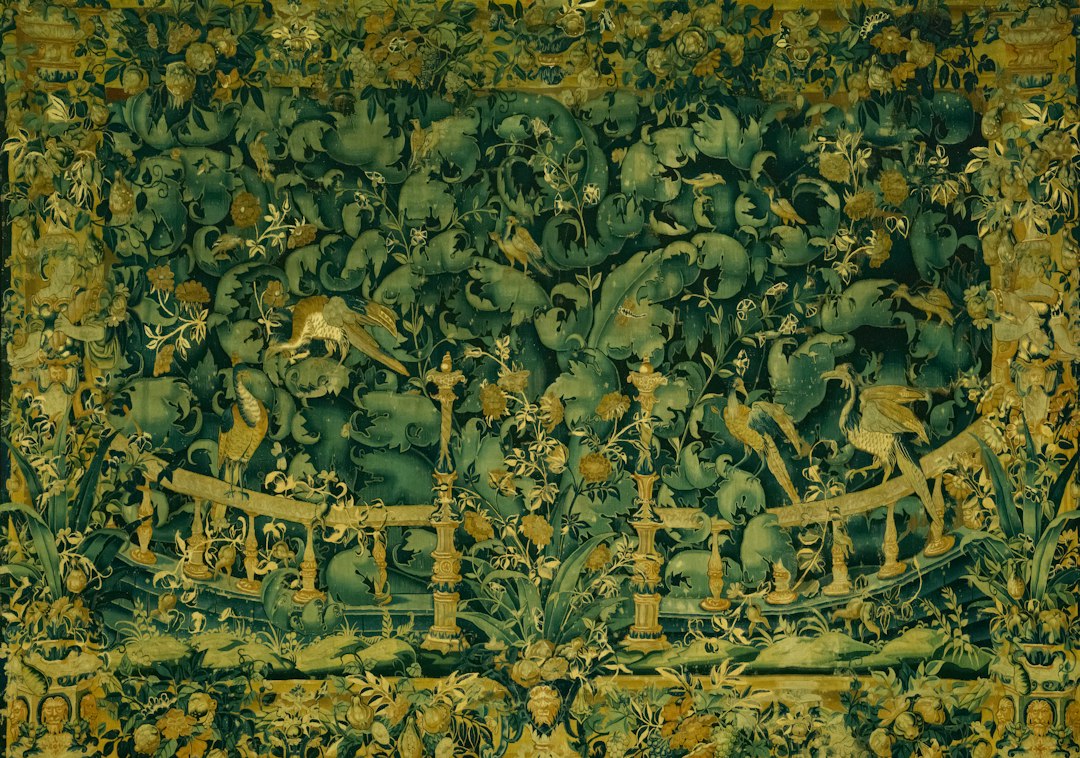
Earlier repairs can make matters worse. In Greenwich, the tapestry had a taut linen backing, as well as fabric patches from previous repairs. The patches had deteriorated so badly that they crumbled to powder. The old repair threads were in worse condition than the tapestry itself. If too much of the resulting dust had remained in the fabric, it would have made the subsequent cleaning more difficult. Restoration therefore often begins with the careful removal of earlier interventions.
As a viewer, this means you are looking at a tapestry that ages in several places at once. Light affects the silk, weight bears on the weft, and earlier interventions bring damage of their own. Each cause calls for a separate step in the work.
Silk deteriorates faster than wool and is more sensitive to light.
The workshop at the Vatican Museums works according to three principles: recognisability, reversibility and minimal intervention. Any intervention should remain recognisable as such, be reversible later and affect the original as little as possible. Before work begins, the tapestry is documented graphically and photographically and its condition is carefully assessed. The next steps are mechanical cleaning, removal of earlier restorations where necessary, washing, dyeing support materials and threads, and finally stabilising the damaged areas.
The equipment gives a sense of the scale of the work. There are dedicated machines and pulley systems for tapestries up to ten metres long, as well as a large basin for gentle washing with water and surfactants. The mechanical looms can rotate up to 360 degrees so that both front and back can be inspected. Seven conservators work there daily on restoration, ongoing care and emergency repairs. Even so, progress is slow. Under normal conditions, the workshop completes about ten square centimetres of fabric per working day. Restoring a medium-sized tapestry can therefore take up to four years.
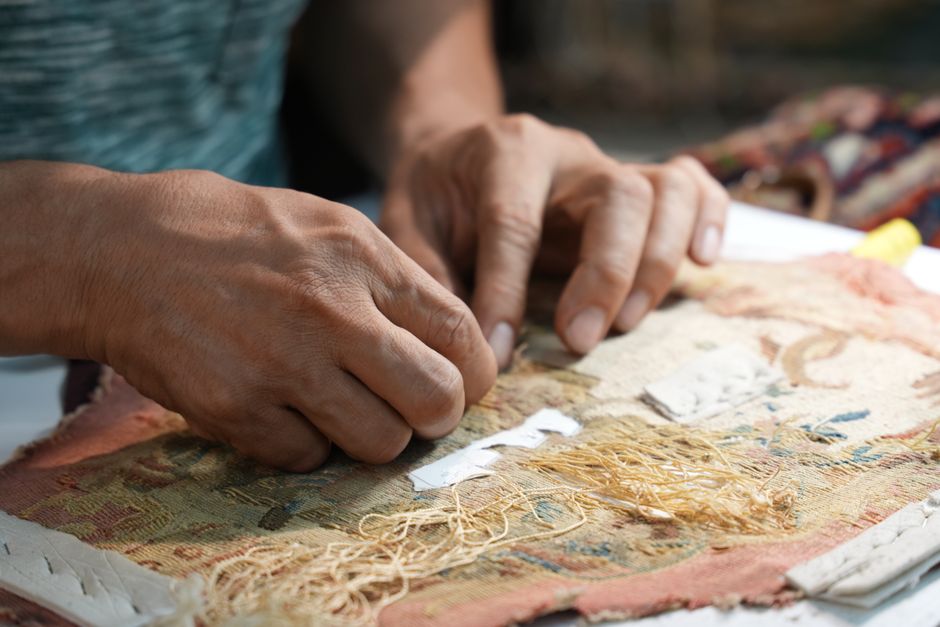
The Solebay Tapestry illustrates the individual steps in detail. Preparation included around 200 hours of work to remove the taut linen backing and fabric patches. The tapestry was washed at the De Wit Royal Manufactory in Belgium. It lay face down on a large mesh screen while water vapour and cleaning-agent vapour were drawn through the fabric under slight negative pressure. It was then thoroughly rinsed and dried. Afterwards, it received a full support of fine linen that had been boiled and pre-shrunk.
The tapestry was stitched onto this linen by hand. The conservators worked in 29 sections, each around 20 centimetres wide, over 18 months, with at least two people working at a time. For the wool areas, the team specially dyed new wool threads using chemical dyes tested for lightfastness and colourfastness when wet. The way these dyes age is more predictable than that of the original plant dyes. For the silk areas, the team used a mixture of cotton embroidery yarn and polyester thread. They worked with embroidery needles in two sizes, their sharp points drawing the thread through the fabric without damaging the original fibres.
Once stabilised, a tapestry must return to the wall. This step determines its future. The Vatican Museums explicitly regard the choice of a suitable display system as part of the restoration process. The question is always the same: how can the weight be distributed so that no single thread carries the entire load?
For Greenwich, the tapestry first received a tightly woven cotton lining, a task that took around 150 hours. It was attached with many vertical rows of running stitches and along every edge to prevent it from billowing like a sail. The team sewed hook-and-loop tape by hand along the upper edge. The tapestry hangs from it today. Before returning to Greenwich, it was hung two to three times. This allowed the fabric to settle and relax after spending so long stretched taut on the working frame.
The work was completed in 2023. Today, you can see the Solebay Tapestry at the Queen’s House in Greenwich. A crowdfunding campaign made the restoration possible, and the team at Zenzie Tinker carried it out in a specialist studio in Brighton. The team carefully restored the dark rigging of the sails and the ships’ national flags.
This shows what a good restoration achieves. It preserves the original, supports the fabric, distributes its weight and makes the picture legible again. If you own a historic tapestry or want to buy one, it is always worth asking whether and how it is lined, supported and hung.
Silk deteriorates faster than wool and is sensitive to light. The weight of a historic tapestry also hangs from the weft, the many short lengths of thread that make up the design. Old repairs can deteriorate too, creating dust.
Under normal conditions, the Vatican Museums workshop treats about ten square centimetres of fabric per working day. A medium-sized tapestry can therefore take up to four years.
No. Strictly speaking, only tapestries from the Gobelin manufactory in Paris are called Gobelins. Gobelin painting and Gobelin embroidery are imitations of tapestry weaving.
More from the market, the houses and the pieces with verifiable provenance.