
2018’s interior trends: what replaced “minimalism was yesterday”
In 2018 we called five interior trends that we believed would ring the death knell for minimalism. Eight years on, it’s clear: four of them are now mainstream, and one has even become a status symbol. Time for a look back.
Summer 2018: we urged you to embrace five interior trends and declared that minimalism was yesterday. Eight years later, it’s time for an honest fact-check. Which of those trends fizzled out, which have landed in your living room, and which is now more expensive than most designer pieces?
- Curved furniture felt risky in 2018; today, round sofas and arched silhouettes are staples on almost every 2026 interior shortlist.
- Natural living has become a permanent fixture, woven into Japandi, Neo-Nature and the comeback of honest materials.
- Maximalism has evolved from a bold experiment into a statement, summed up by the new mantra “Yes is More.”
- Vintage is still going strong-especially rattan and cane, which in 2026 are seen as emblems of craftsmanship and authenticity.
- Four out of five trends from back then are now mainstream. That says less about our crystal ball than about how slowly interior design actually changes.
Interior trends have a reputation they rarely deserve: they sound like quick swaps, a single season, an Instagram hype cycle. In reality, most movements in interior design take years to migrate from magazine pages to real homes. That’s exactly why a look back at 2018 is so revealing: you can see what had real staying power and what was merely pretty mood-board fodder.
Curved Furniture: What Was Daring Then Is Standard Today
In 2018, the statement “What takes the catwalk will soon land in our living rooms” was still a gentle provocation. Round sofas, curved armchairs, soft edges instead of rigid lines. Anyone who placed such pieces in their living room back then needed courage. Most furniture retailers stocked almost nothing that fit the bill.
Today the situation is reversed. Organic shapes and curves appear in almost every trend forecast for 2026, from arched mirrors to round sofas and sweeping light fixtures. The reason is not purely aesthetic. Soft forms demonstrably calm the nervous system, an effect the industry now discusses under the umbrella of neuro-aesthetics. What we sold in 2018 as a playful fashion statement has quietly become a deliberate design decision.
The fastest route to a timeless home has never been a trend; it has always been patience. The curved furniture of 2018 proves the point.
Natural Living: From Leaf Prints to a Whole Mindset
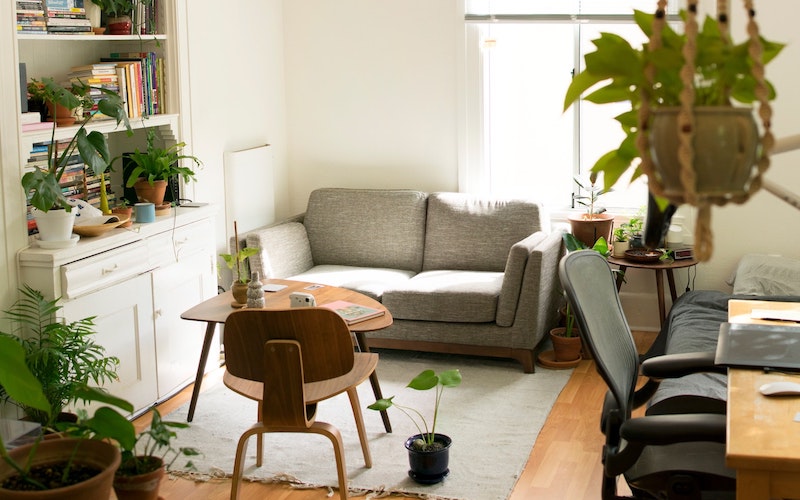
Leaf prints, houseplants, natural materials. In 2018 this was a fresh accent-slightly botanical, slightly whimsical. What then looked like mere decoration has become baseline essentials. The green idea has peeled away from the wallpaper and evolved into a material question.
The buzzwords today are Japandi and Neo-Nature. Japandi blends Japanese reduction with Scandinavian functionality and is tilting warmer, favoring more wood tones and softer textiles. Neo-Nature bets on genuine materials such as wood, stone and ceramics, organic shapes and earthy hues. Both are simply the grown-up version of what we called natural living in 2018. How this idea has matured is explored in our feature on the Japandi living trend.
Maximalism: From “Dare to Colour” to “Yes Is More”
“More is more,” we wrote in 2018, and it sounded almost defiant after a decade of minimalism. Courage to use colour, heavy materials, layered complexity. Many hesitated. A few bright cushions were often the entire act of rebellion.
Today maximalism is no gamble; it is a statement with its own slogan. Under the banner “Yes Is More” it celebrates creative freedom, an abundance of colour, form and texture. Comfort is deliberately exaggerated and turned into a declaration. What has grown out of this is telling: eclecticism-the deliberate mix of styles, eras and patterns-has become the more refined cousin of pure maximalism. To see where it is heading next, read our piece on eclecticism as a living trend.
Vintage & Wicker: The Quiet Winner
The fourth trend we flagged in 2018 was vintage: bold 70s patterns, playful silhouettes, chunky timber. Back then it was a matter of taste. Today it has quietly morphed into something you might almost call a status symbol, especially in one category: basketry and wickerwork.
Rattan, cane, visible wood grain and ribbed glass stand for authenticity and craftsmanship in 2026. Oak and walnut remain the core timbers, joined by linen, ceramics and natural stone. The driver is not nostalgia alone. In an age of digital overload, many crave rooms that exude warmth and character. A well-made 70s cane shelf now fulfils that wish-and often at prices far above its original cost.
What the Hindsight Really Reveals
Four out of five trends we called in 2018 now shape the mainstream. That sounds like a bullseye, yet it is chiefly a lesson in the tempo of interior design: what works, stays. What was merely a mood-board image quietly fades away.
For you, that means: don’t let seasonal logic rush you. A curved sofa, an honest natural material, a carefully chosen vintage piece. These choices outlast the next trend forecast. And that, in itself, is a luxury that has nothing to do with price tags.
Quick Answers
▸Will curvy furniture still be in vogue in 2026 or already passé?
They’re more popular than ever. Round sofas, arched shapes, and sweeping lamps appear in virtually every 2026 trend forecast, partly because soft forms have been proven to have a calming effect. What felt daring in 2018 has matured into a thoughtful design choice.
▸What’s the difference between “Natural Living” from 2018 and Japandi?
It’s the same idea, refined. In 2018, “Natural Living” leaned toward decor with plants and leaf prints. Japandi blends Japanese reduction with Scandinavian function and turns the concept into a material question: real wood, warm tones, soft textiles.
▸Is vintage rattan a smart investment?
Don’t buy furniture as a financial asset. Yet well-preserved 1970s wicker and rattan pieces will command high prices in 2026 because they symbolize craftsmanship and authenticity. If you find a genuine piece, you gain character that can’t be industrially replicated.
▸Is maximalism just clutter with clever marketing?
The distinction lies in intent. Maximalism under the banner “Yes is More” deliberately mixes colors, shapes, and materials in curated abundance. Its subtler cousin, eclecticism, intentionally combines styles and eras. Both are designed, not accidental.


