No grid, no seam, no click system. A poured mineral floor into which someone scattered marble and then polished the stone itself to a mirror. A Venetian idea that today feels quieter than any glossy tile – and precisely for that reason is in demand again.
There are floors you walk across without ever looking at them. And then there is terrazzo, which forces you after a few steps to glance down. Not because it’s loud, but because up close it does something no uniform material can: it shows every single stone that someone poured into it, turning a thousand chips into a calm, seamless surface. You could write it off as just flooring. You’d miss why this idea has never vanished since antiquity.
Key Takeaways
Terrazzo is a mineral floor covering known since antiquity, made from aggregates, lime or cement, water, and pigments.
In Italy, the historic covering is generally called Terrazzo alla veneziana, because it was especially common in the Venice and Trieste area.
Ancient terrazzo floors survive to this day in Herculaneum.
The Venetian pastellone is a three-layer lime mortar floor made of cocciopesto, fine gravels, chippings, and marble dust.
In Germany, the production of terrazzo floors is regulated by standard DIN 18500-1.
Almost every floor in a home is a compromise between effort and effect. Laminate is quick, tiles are tough, parquet is warm – and all three come with visible boundaries: joints, edges, grids. Terrazzo refuses exactly that. It is not laid but poured, as a viscous mass of binder and stone granules that you work into the room, let harden, and then grind flat. What remains is a continuous surface without a seam, where the stones are not glued on but embedded. That single difference explains almost everything about its character.
A Mass, Not a Surface
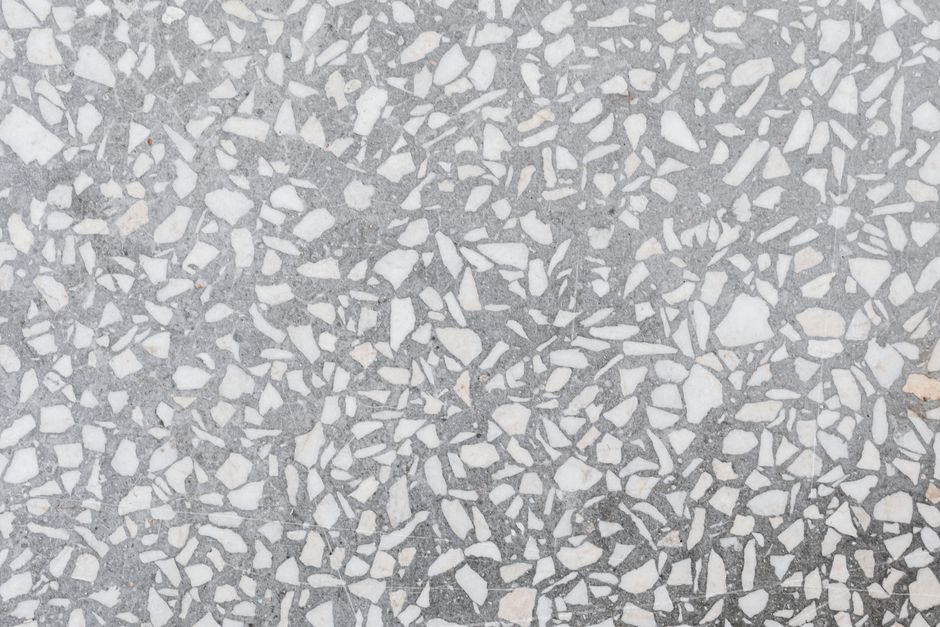
At its core, terrazzo is surprisingly simple to describe and surprisingly difficult to execute well. It is a mineral floor covering made of aggregates, a binder of lime or cement, water, and pigments. That’s all it takes for the definition. The aggregates are usually marble, sometimes other rock, crushed into grain sizes ranging from fine grit to coarse chips. The binder holds everything together, the pigment colors the matrix in which the stones float. Only after grinding does what we call terrazzo emerge: a cut through this mass that slices every stone at the surface and exposes it to view.
This is the real trick and the reason why this flooring never looks like an imitation. On a printed tile, the pattern sits on the surface. With terrazzo, the pattern is the cross-section through a volume. What you see continues into the depth. A marble chip that appears as a light spot on top sits as a whole chunk within the floor. This is precisely why terrazzo ages so graciously: You don’t sand off a decoration; you only reveal a new layer of the same stone. The floor has no front side that can be worn out. It is entirely what it shows.
The grain size determines the character. Fine chips create an almost textile, calm surface that looks nearly monochromatic from two meters away and only reveals its fragments when you look down. Coarse grain makes the floor more talkative, almost graphic, with clearly legible stones and strong contrast between the matrix and the aggregate. Both are terrazzo, and both tell a different story in the same room. Choosing one over the other isn’t about color, but about the floor’s volume.
Then there is a behavior you only appreciate over time. A mineral floor is vapor-permeable; it absorbs moisture and releases it again, rather than sealing it off like a coated plastic layer. It feels cool in summer without being damp, and it possesses that peculiar acoustic quietness of heavy materials. A room with terrazzo sounds different from one with vinyl. Fuller, muted, more mature. You don’t consciously notice it, but you feel it as soon as you return to a generic, echoing floor.
How Venice Gave the Floor Its Name
The flooring is far older than its Venetian address. Antique terrazzo floors can still be found today in Herculaneum, that city on the Gulf of Naples buried by Vesuvius just like Pompeii. Contextualizing this helps clarify that we are not dealing with a trendy surface from the last decade, but a construction technique that has survived two millennia. A floor for which there is proof of specimens older than almost everything we casually stand on today.
The name we most often associate with it, however, is owed to a region. In Italy, the historic flooring is generally called Terrazzo alla veneziana because it was installed particularly frequently in the Venice and Trieste areas. This is no coincidence of fashion, but a response to the location. Venice stands on water, on piles, on a substrate that shifts and moves. A rigid stone floor laid in slabs would crack at its joints under such conditions. A cast, jointless, mineral surface that is elastic to a certain degree copes much better. For Venice, terrazzo was not only beautiful; it was practical.
As a built surface, terrazzo reveals its second charm: It remains a continuous material across edges, steps, and plinths, without joints or transition strips. Image source: Unsplash / Jan van der Wolf.
Thus, an ancient technique became a Venetian craft with its own tradition, workshops, and pride. The city, which imported and refined everything anyway, also created something unique from broken marble: floors that lay in palaces just as they did in bourgeois apartments, because the material consisted of remnants and courage, not just wealth. This is part of its dignity, often overlooked today. Terrazzo was never pure luxury. It was smart utilization that happened to turn out beautiful as well.
This origin also explains why genuine site-cast terrazzo still commands respect. It is mixed, applied, and polished on-site, not prefabricated in a factory and delivered. Every floor is bound to its space, to the hand that laid it, to the mix that was in that bucket on that day. Two terrazzo floors of the same recipe look related, but never identical. Those seeking uniformity are in the wrong place. Those seeking the opposite will hardly find anything more honest.
Good terrazzo does not hide its origins. It shows every stone someone put into it, and stands by it.
You can already sense this difference by touch. An industrial high-gloss tile feels smooth and anonymous, almost like glass. Polished site-cast terrazzo is smooth, but not lifeless. The different hardnesses of binder and stone leave an barely perceptible, yet present topography, a minimal relief that brings the surface to life. You touch a floor and feel that it consists of several materials. This is not a lack of perfection; it is the perfection of a different promise.
The Pastellone and the Layers Beneath
Those who look deeper into Venetian tradition encounter the Pastellone, a particularly refined relative of classic terrazzo. The Venetian Pastellone is a three-layer lime mortar floor made from cocciopesto, fine gravel, chippings and marble dust. Just this list constitutes a small lesson in materials by itself. Cocciopesto is crushed fired clay, meaning ground bricks and ceramic fragments-an ancient ingredient that gives lime mortar strength and a warm, often reddish hue. Combined with fine gravel, chippings and marble dust, this creates not a speckled stone carpet but rather a velvety, continuous, slightly cloudy surface.
The crucial aspect of Pastellone is its three-layer construction. Such a floor is not a single layer you apply, but a system of several layers that works from coarse to fine. At the bottom lies the supporting, coarser base layer, above it finer layers, and at the very top the sanded and polished visible surface. This logic is the same that has always supported quality craft floors: separate load from appearance, assign each layer its task, leave nothing to chance. A Pastellone is therefore not a quick product. It is a sequence of operations, each requiring time to set.
This multi-layering is also why such a floor can appear so even and calm. Stresses distribute across the layers instead of accumulating in a single thin layer. What appears above as a flawless surface is in truth a carefully stratified construction whose work remains invisible, only its tranquility apparent.
The warm, reddish tint indicates cocciopesto, crushed fired clay that gives the lime mortar strength and color. Instead of a stone carpet, this creates a continuous, slightly cloudy surface. Image source: Pexels / icon0 com.
This very slowness is today part of its appeal. In a construction world optimized for dry, click-together solutions that can be walked on the same day, a floor that develops over days in multiple layers and is finally hand-sanded and polished at the end seems almost defiant. It cannot be accelerated without becoming worse. Those who want it accept its rhythm. In premium interiors this is not a disadvantage but the point: The effort is visible in the result without anyone having to explain it.
Beyond that, this rhythm changes the outcome. A floor that gets time sets differently-harder, more compact, more durable. The speed at which we build today rarely benefits the material. Terrazzo is one of the few surfaces where patience translates directly into quality rather than just meeting deadlines.
Despite all tradition, terrazzo is not a museum material that can only be restored. Today it is a technically well-regulated floor. In Germany, the production of terrazzo floors is governed by standard DIN 18500-1, meaning a defined regulatory framework for materials, processing and requirements. This takes nothing away from its poetry-in fact, quite the opposite. It means this ancient floor is not dealt with vaguely but exists as a serious, standardized construction service that a specialist company can reliably execute. Craftsmanship and standards don’t contradict here-they support each other.
Why terrazzo is making a comeback right now
Some materials return in waves, and terrazzo is riding one of those waves right now. This is not the first time. In the late 19th and early 20th centuries, terrazzo spread through residential and public buildings, lying in countless stairwells, hallways, offices, and apartments. Many of those floors are still there-under carpet, laminate, decades of coating that someone laid over the old stone when it was deemed unfashionable. Anyone renovating a period property today and uncovering such a surface often ends up with a floor far better than anything they were about to buy.
Today’s renaissance is fed by several sources, and none of them is pure style reflex. There is a renewed appetite for material honesty, for surfaces that show what they are made of rather than imitating something else. There is a growing appreciation for mineral, breathable, long‑lasting materials that support a healthy indoor climate instead of burdening it. And there is, quite pragmatically, the arithmetic of time. A floor that lasts for generations and can be rejuvenated by re‑polishing rather than being replaced is not an expensive luxury in the end-it is a long, intelligent decision.
In the premium interior sphere, this fits perfectly into a shift away from logos and toward substance. A terrazzo floor does not shout. It bears no brand, no pattern you recognize from ten metres away. It works up close and over time, through its material, workmanship, and the way it handles light. That is precisely why it now lies in homes that no longer have anything to prove. It is the opposite of fast, cheap, and loud – and it was, long before those qualities were once again considered values.
Whether as a polished, speckled classic or as a velvety pastellone in a warm hue: terrazzo is not a floor covering you choose and then forget. It is a decision in favor of a surface that ages with the space, that you care for instead of replacing, and that after years does not look worn out but lived in. That sets it apart from almost everything that is quickly laid today and just as quickly replaced. And it is the reason why a Venetian idea born from salvaged marble and a little courage has endured for millennia.
Quickly Clarified
▸What actually distinguishes terrazzo from a patterned tile?
The structure. A tile carries its pattern as a print or glaze on the surface, whereas terrazzo is a cast mass of binder and stone aggregates that is ground flat after curing. The visible pattern is therefore a cross-section through the material, not a layer on top. This means the stones extend deeper into the floor, allowing it to be reground without losing its appearance.
▸Why is this flooring specifically called Terrazzo alla veneziana?
Because it was particularly common in the Venice and Trieste regions, even though the technique itself is much older. Ancient terrazzo floors are still preserved in Herculaneum today. In Venice, the seamless, cast floor also had a practical advantage on the shifting lagoon substrate, which is why it developed into its own craft tradition with its own name there.
▸What exactly is a Pastellone?
A particularly fine Venetian variant. The Pastellone is a three-layer lime mortar floor made of cocciopesto, fine gravels, crushed stone, and marble dust. Cocciopesto, i.e., crushed fired clay, gives it strength and often a warm, reddish tint. Instead of a speckled stone carpet, this creates a more closed, velvety, slightly cloudy surface.
▸Can old terrazzo in historic buildings be saved, or is it better to cover it up?
Saving it is almost always worth it before covering it up. During the Gründerzeit era and around 1900, terrazzo was widespread, and many of these floors still lie beneath later coverings today. A specialist company can often regrind and restore such a surface instead of masking it with tiles or laminate. In Germany, the production of terrazzo floors is regulated by DIN 18500-1, a standardized framework within which restoration is also cleanly possible.
In the end, what remains of a terrazzo floor is rarely a single image, but rather a gesture: that brief pause when you look down for the first time and discover a single bright marble chip in the gray base, which would have caught someone’s eye two thousand years ago. That is precisely why this floor is not a surface you install and check off. It is one that stays and ages with the room, without ever seeming old.
Image source: Cover image: Pexels / Kaboompics. Additional images: Unsplash / Jan van der Wolf, Pexels / icon0 com.

 //LIVING


