Material craft · Lime instead of tile
Tadelakt: The Wall That Holds Water
Moroccan lime plaster, compressed with soap: seamless, breathable, and at home in wet rooms. Why the wall feels softer than any tile.

 Interiors
Moroccan lime plaster, compressed with soap: seamless, breathable, and at home in wet rooms. Why the wall feels softer than any tile.
You step into a bathroom and look for the joint. It is not there. The wall runs in a soft curve into the tub; light holds instead of bouncing. Under your fingers the surface feels like stone that has learned to be still. This is not lacquer. This is Tadelakt.
I like materials that explain their work without a brochure. Tadelakt comes from Morocco, from hammams and riads, from rooms where steam and water belong to daily life. The name hangs on the Arabic tadlīk: to rub, to massage. That is exactly what happens to the wall. It is rubbed until it holds.
The recipe sounds simple and is not. The base is lime plaster, not Portland cement. Sometimes fine marble or limestone sand is added, not any rock powder. The plaster is mixed with water and rests. In classical practice, twelve to fifteen hours pass before pigment is added. Then it goes on the wall: thick, with the wooden float, in one pass that thinks of the surface as a whole.
Before the lime sets, a smooth river stone compresses the layer. Then trowel or stone polishes it. At the end comes black olive-oil soap. It is chemistry, not scent. The soap reacts with the lime into calcium soaps. They are insoluble in water and hard enough to repel the surface without sealing it like plastic.

The result joins water repellency with vapor permeability. The surface sheds water and lets water vapor pass. In a hammam that was survival. In a modern bath it is comfort without a tile grid, without silicone joints that turn gray after years.
The most beautiful joint is the one that was never needed.
Because Tadelakt arrives as a paste, it follows the body of the room. Niches, curves, inset tub edges: all of a piece. The surface can finish matte or with a silken sheen. Deep red is the classic color of the riads. Today the palette runs from warm sand through pink to quiet gray. Pigments give the surface its direction: from warm sand to quiet gray.
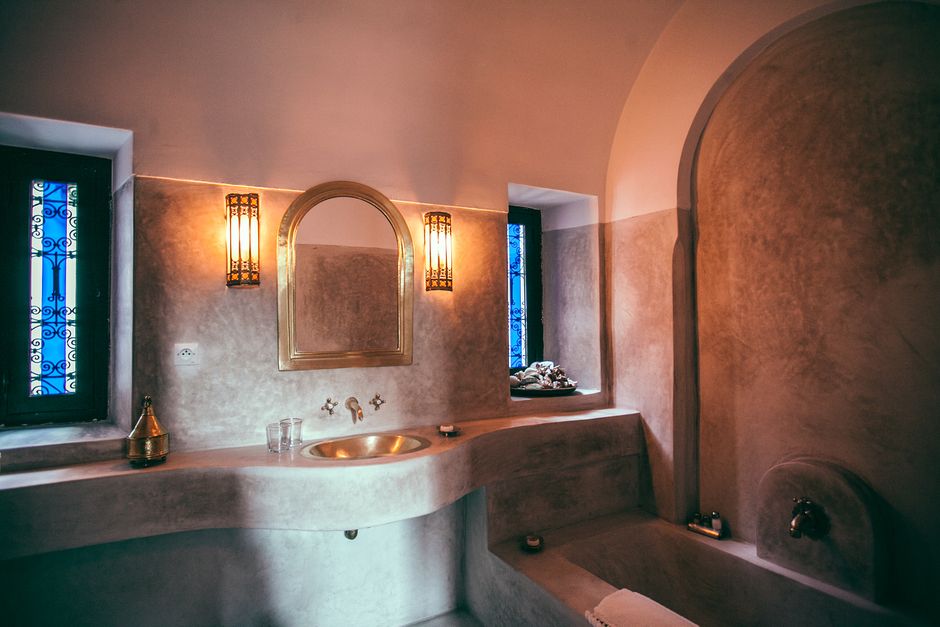
The work stays slow. Anyone who wants Tadelakt is not ordering a weekend project. Craftspeople apply, compress, polish, and maintain the surface. Care includes resealing with a soap solution. That sounds like effort and keeps the material honest: it lives with you instead of being finished once and then dead.
In Morocco, riad restoration has brought the craft back to the fore. In Europe it appears in hotels and private baths where people are tired of tile and still want hygiene and quiet. There Tadelakt is not exotic décor. It is a decision against the grid and for a surface that can take light and the hand.
What you feel when you place your hand on the wall in the morning: cool without cold. A slight unevenness that is intentional. No mirror gloss like acrylic. More the calm of stone that has been worked. In a room without a joint, water grows quieter. So does the day.
Not every “lime look” is Tadelakt. Ready-mix fillers and emulsion paints imitate the look and lose the chemistry. Without real lime and without the soap reaction, the water-repellent skin is missing. Without compressing with the stone, the density is missing. You recognize true craft in the unity of the surface and in edges that run soft rather than stick.
When you plan a bathroom, the question is worth asking: Do you want a surface you have to rejoint every few years? Or a skin cared for with soap and hand? Tadelakt answers with work at the start and calm afterward. The craftswoman knows the moment the stone has compressed the layer. You feel it later only as coolness under your fingers.
That is exactly what counts in living space: materials that bring a story of hand and place and still work in daily life. Tadelakt holds water, steam, and time. When the wall holds, the room holds. And you do not need the tile as an excuse.
The surface is water-repellent because lime and soap form insoluble lime soaps. Professionally executed, it suits baths and wet zones. At the same time it remains vapor-permeable.
The plaster is applied as a paste in one continuous layer and compressed. That is how curves and planes arise of a piece, instead of a tile grid.
Reseal regularly with a suitable soap solution and avoid aggressive scouring agents. The surface wants care, not hardness.
Rooms with character, materials with history, and the light between them. Stay in //Living.


