The sustainable car that charges itself
This Munich-based startup has one goal: to revolutionize the automotive industry. How do they plan to achieve this? With a car that charges itself.
In 2020, we reported on the Sono Sion. What remains of it? This article captures the moment when a Munich startup envisioned the solar car as an everyday vehicle: featuring integrated solar cells, a battery, an app interface, and the idea of not just consuming energy, but also sharing it.
- The Sion was described as the first self-charging electric car.
- 248 seamlessly integrated solar cells in the body were designed to harness solar energy.
- According to the article, up to 34 kilometers per day should be possible using solar power alone.
- According to manufacturer specifications, the battery was expected to deliver a range of 255 kilometers.
- Reservation: 500 Euro deposit, planned launch price: 25,500 Euro.
The Sun as Part of the Body
The original text started big: Sono Motors from Munich wanted to revolutionize the automotive industry. Such sentences rarely age gracefully. But what lay behind it concretely remains interesting. The Sion was not supposed to be an electric car that just hangs at the charging station. According to the report, its body consisted of 248 seamlessly integrated solar cells. Thus, the surface of the car itself became the energy carrier.
Just with solar power, 34 kilometers per day were supposed to be possible. For many short-distance commuters, according to the old text, this might be enough for the commute to work and back. That is the actual strength of the idea. Not the long journey, not the record run, but the daily remaining distance that repeatedly feeds on light.
For longer distances, the report foresaw a stronger battery, which should allow 255 kilometers according to manufacturer specifications. At a fast-charging station, the Sion should reach more than 80 percent in less than an hour. Thus, the car stood between two worlds: solar as a supplement, battery as the base. Exactly this mixture made it interesting.
The Sion was less a car for the grand gesture than a question to everyday life: How much distance can light take over?
Practicability Was Part of the Promise
According to the article, Sono Motors did not want to pit sustainability against usability. The interior was described as having 650 liters. The solar modules could supposedly be replaced by themselves without prior knowledge, according to manufacturer specifications. In addition, there was a smartphone app interface, as known from smart homes. This sounds like a car that didn’t just want to look ecological, but be handled in everyday life.
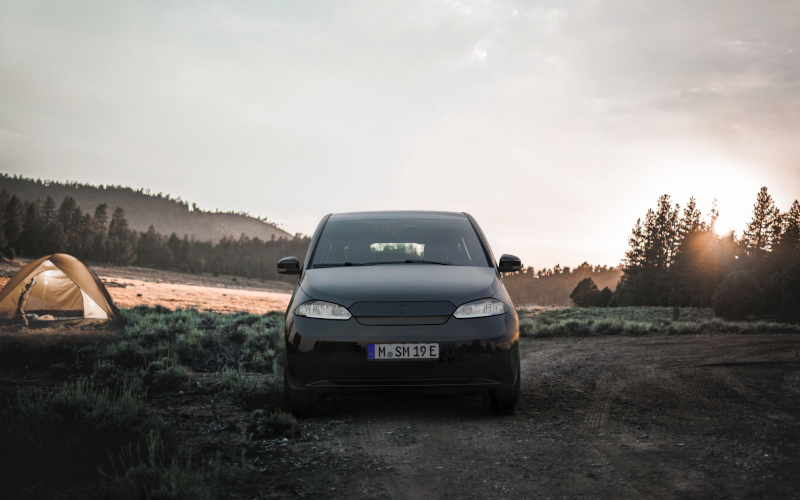
Particularly important was the bidirectional charging technology. The Sion was supposed to serve as a portable giant battery. Via a household socket, electronic devices could be operated with the solar car at the campsite, on the construction site, or at home. This may have been the nicest idea in the text: Not only viewing the car as a consumer, but as a mobile storage unit.
The report also mentioned the economic threshold. You could reserve the Sion with a 500 Euro deposit. At market launch, the solar car was supposed to cost 25,500 Euros. Thus, it was not told as a luxury object, but as an attempt to bring new technology into an affordable price range.
Milestones and Open Expectation
The archive text listed the milestones at that time. In 2015, the first successful pre-prototype was created. In 2017, Sono Motors officially presented the Sion to the press, politics, and fans. Partnerships with Bosch and Continental were named. In 2019, a production facility in Sweden was acquired. By then, the company had recorded over 10,000 reservations and raised more than 53 million Euros through community funding for the next steps.
The next goal according to the report was the start of production in 2022. The archive piece says nothing more, and it stays that way here intentionally. Without new research, the old article does not become a retrospective success story or an obituary. It remains a document of a moment when solar cells on the car did not sound like a toy, but like a serious attempt.
As an IBL topic, the Sion is precisely interesting for this reason. Not because of status, not because of sound, not because of leather. But because of a different definition of luxury: being less dependent, thinking about energy differently, spreading technology across the surface. You don’t have to romanticize that. But you can acknowledge that the question was good.
Why this archive piece belongs in //DRIVE
The Sion was originally categorized under Living. In terms of content, it clearly belongs to //DRIVE today. Not because it caters to classic automotive lust, but because it reimagines mobility. IBL //DRIVE shouldn’t just showcase vintage Jaguars, perfect steering wheels, and beautiful lines. It should also ask which car changes our daily lives without defining itself by noise or prestige.
The article highlights several practical motivations. Short-distance commuters, campsites, construction sites, home use, replaceable solar modules, app interfaces, fast charging. This isn’t the language of a concept car for trade show stands. It’s the language of a vehicle that wanted to fit into routines. That’s exactly why the idea was so compelling. The car wasn’t supposed to just look cleaner; it was meant to be more usable.
The community funding aspect is also notable within the old material. More than 53 million euros raised through community funding and over 10,000 reservations show that the project didn’t just have observers back then, but people who wanted to participate or at least secure a spot. The 500 euro deposit turned interest into action.
The article remains true to its time. It cites a production start in 2022 as the next goal and leaves the future open. Precisely this openness is valuable today. You don’t read the end, but the expectation. And sometimes expectation says more about an era than the eventual outcome.
The term self-charging was also important in the article. It doesn’t mean a car becomes completely independent of infrastructure. It describes the appeal of the surface working with you. For drivers, this changes the perception of energy. Charging then isn’t just a stop at a pillar, but something that happens incidentally in everyday life. This idea was the Sion’s true luxury: not range as status, but less friction in daily use.
When you categorize such luxury, size isn’t everything. What matters is whether space, calm, and materials truly work together.
For a luxury magazine, this is an unusual but good perspective. The Sion didn’t entice with leather, performance, or rarity, but with a different idea of independence. When a car collects energy in everyday life and releases it when needed, it changes the relationship between driver, vehicle, and environment.
Quick Answers
▸What was the core idea behind the Sono Sion?
An electric car with 248 integrated solar cells in the bodywork, designed to harness solar energy for daily commutes.
▸What ranges were mentioned in the article?
34 kilometers per day solely from solar power and 255 kilometers via battery according to manufacturer specifications.
▸What did bidirectional charging mean?
The Sion was designed not only to absorb energy but also to power devices via a household socket, for example while camping, on construction sites, or at home.