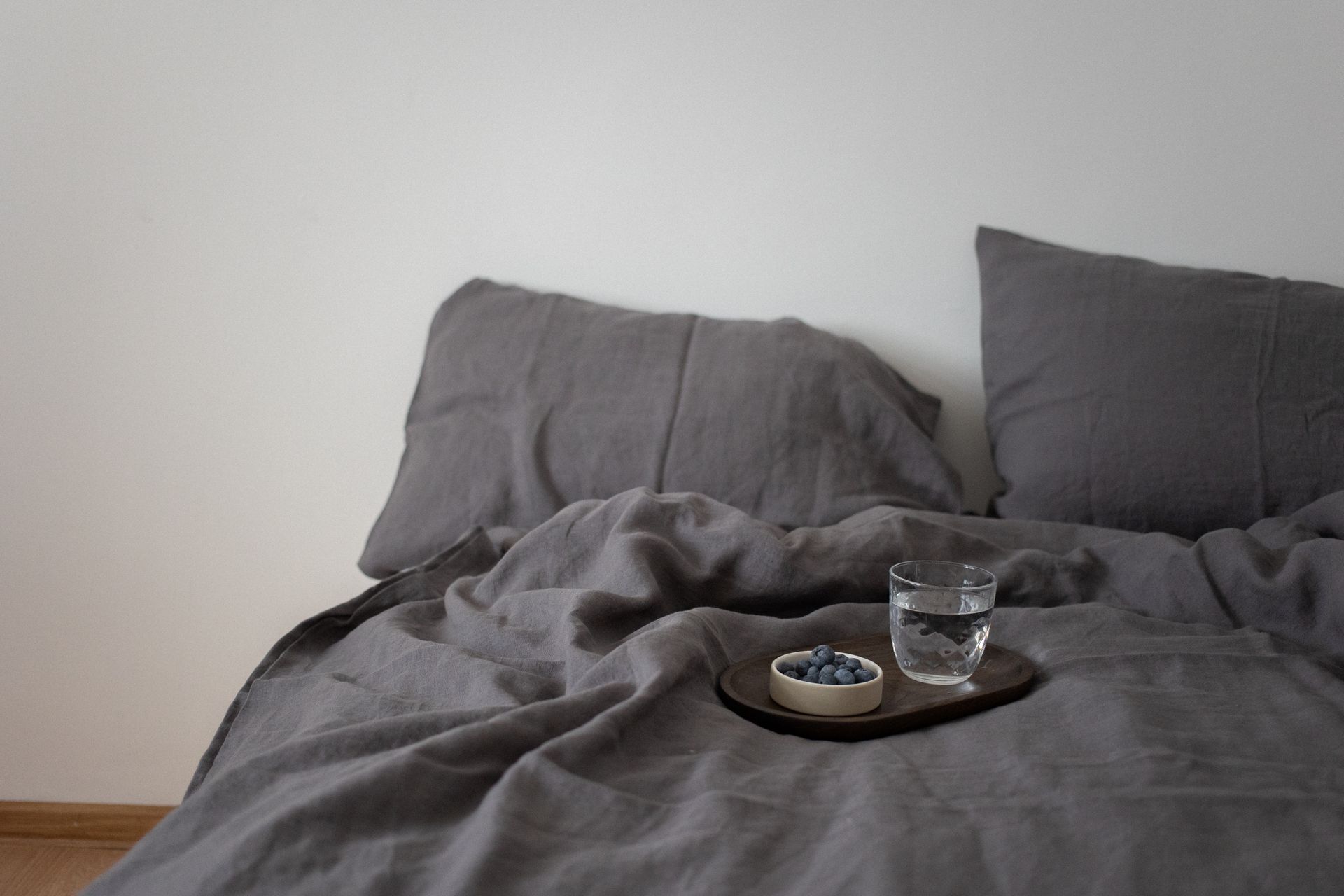
A bast fiber from the stem of a blue-flowering plant that once furnished every fine home and then nearly vanished. Why linen, as bedding and wall textile, is now returning to rooms where material matters more than the label.
There are fabrics you buy because they look flawless when new. And then there is linen, which rejects that very premise from the start. A freshly made linen bed never lies perfectly flat; it casts small shadows, crinkles at the edges, and looks as though someone has already slept soundly in it. Anyone who sees this as a flaw hasn’t understood the material. Because this fabric isn’t made to stay perfect. It’s made to grow softer, lighter, and more effortlessly itself over the years.
Key Takeaways
Linen refers both to the fibers from the common flax plant and to the woven fabric made from them, and it is classified as a natural fiber.
The fiber is found not in the flower, but in the stem of the plant: a bast fiber that is extracted in multiple steps.
Linen absorbs a great deal of moisture and quickly releases it back into the air, which explains its cool touch.
The fabric is boil-washable and highly tear-resistant, but it wrinkles noticeably and is harder to iron than cotton.
Since the late 19th century, cotton almost completely displaced linen in the textile industry; today, it is returning as a conscious choice.
Almost every household today owns textiles whose origins no one gives a second thought. Bedding is made of cotton, feels smooth, is inexpensive, and can be replaced at will. It is precisely this taken-for-granted nature that explains why linen long seemed like a relic: it is more expensive, more idiosyncratic, and less forgiving when it comes to care. And yet, hardly any other home material is experiencing such a quiet comeback right now. Not as a trend with a green label, but as a deliberate choice by people who want a textile that lasts, breathes, and gets better with time rather than worse.
The Fiber Resides in the Stem, Not the Flower
Linen begins in the field with a plant few have consciously noticed: common flax, botanically Linum usitatissimum. In early summer, it stands as a delicate, waist-high field of pale blue flowers, each blooming for just one day. What later becomes fabric, however, has nothing to do with the flowers. The valuable fiber lies within the stem, embedded between the woody core and outer skin. Linen is a bast fiber, and bast means: it must be extracted from the plant body before any spinning can even be considered.
These fibers are not all the same length. Individual elementary fibers measure only a few centimeters, ranging from roughly two and a half to six centimeters. Only when bundled together as technical fiber strands do they reach lengths of about fifty to ninety centimeters. These long bundles are the plant’s true treasure. They give the eventual yarn its strength and that characteristic, slightly irregular texture visible to the naked eye in linen. While cotton consists of short, fluffy fibers, linen works with long, smooth, sturdy strands. This is not a cosmetic difference-it’s the foundation for nearly all the properties that follow.
Before the stem becomes thread, a craft unchanged in principle for millennia takes place. First, the plants aren’t cut but pulled from the soil with roots intact to preserve the fiber’s full length. Next comes retting, the most delicate step: the plant resin binding the fiber to the wood is carefully broken down, typically by leaving the stems in the field for dew, rain, and microorganisms to do the work. This dew retting remains the dominant method, used on roughly three-quarters of global cultivation areas. It takes time and expertise-ret too long, and the fiber is destroyed; ret too short, and it won’t come clean.
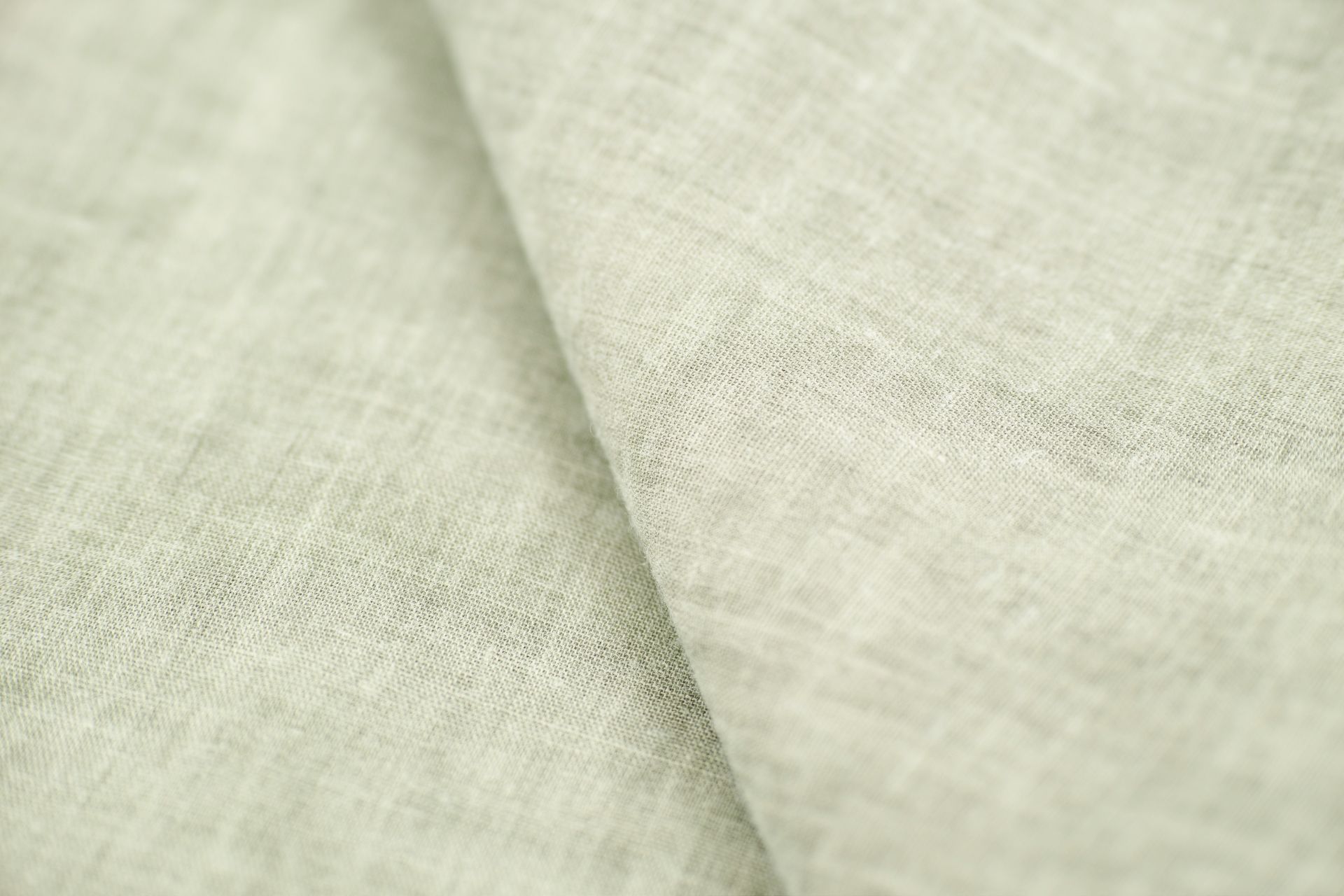
Up close, the fiber reveals its origin in the stem: no uniform threads, but thicker and thinner strands side by side, giving the surface its lively texture. Source: Pexels / Monstera Production.
After retting comes breaking and scutching, where the woody parts of the stem are crushed and removed. What remains is a tangle of fibers of varying quality. Hackling then separates them: long, lustrous fibers are drawn through nail combs, aligned, and separated from the short, scratchy tow fibers. Only these combed long fibers produce the fine linen yarn used for high-quality bedding and wall textiles. The tow isn’t discarded but processed into coarser yarns and fabrics. Anyone who grasps how many hands and steps lie between field and thread will view a piece of linen differently.
Why Linen Feels Cool
The most noticeable everyday quality becomes apparent as soon as the nights turn warm. Linen feels cool, and that’s not just a sensation-it can be explained physically. The fiber is highly hygroscopic: it absorbs up to around 35 percent of atmospheric moisture without feeling damp, and it quickly exchanges that moisture with the surrounding air. Any moisture that forms on the skin is absorbed by the fabric and released on the outside. This constant exchange draws heat away from the skin, delivering the dry, fresh feel you appreciate in midsummer – and hardly miss in winter, because heavier linen varieties feel just as cozy then.
Then there’s the fiber structure itself. Linen is smooth and has little elasticity-it doesn’t cling tightly and warmly like a fluffy material, but maintains a fine distance from the skin. That’s exactly what amplifies the cooling effect. Where a dense knitted synthetic fabric traps heat, linen’s open, slightly stiffer weave lets air circulate. Linen bed sheets don’t stick to you while you sleep; they stay pleasant even when you sweat, and they dry quickly. That’s why linen has been the material of choice in hot regions for centuries, long before anyone ever talked about climate comfort.
Linen isn’t a fabric that envelops you. It’s a fabric that leaves you alone while letting the air flow through.
This openness has a second consequence-one you hear and see rather than feel. Linen drapes differently. It doesn’t puff up; it breaks. A linen curtain hangs in clear, slightly angular folds at the window and filters light more softly than a smooth curtain, because the fabric is never perfectly flat. On a wall, as a hanging or stretched surface, it dampens sound and takes the hard edge off a room’s acoustics, much like heavy natural materials do. So linen works not only on the body, but on the whole room: on light, on sound, on the way a surface receives daylight.
Robust and Stubborn at the Same Time
Linen is one of the most resilient natural fibers out there. It is very tear-resistant-even stronger wet than dry-and it is boil-proof, so it withstands high washing temperatures that would ruin other fabrics long before. Unlike many soft materials, linen doesn’t shed lint or form pilling-those little pills that make cotton and synthetics look gray and tired after a while. A good linen cloth can last for decades, often through several owners. Dowry chests filled with linen bedding passed from grandmother to granddaughter weren’t sentimental-they were simply a result of this material’s durability.
But there’s a stubbornness to it that you should know about before getting disappointed. Linen wrinkles – and noticeably so. The low-elasticity fiber takes every crease and doesn’t give it back on its own, and it’s relatively hard to iron because it only gives in with a lot of heat and moisture. If you expect flawless smoothness, you’ll be unhappy with linen. If you read the wrinkles for what they are-a visible sign of a genuine natural material-you gain a fabric that looks relaxed because it is relaxed. The best care for linen bedding is therefore usually the most laid-back: wash, shake out well, hang flat or lay flat in the closet, and limit ironing to what really needs to be smooth.
In the room, linen remains robust and stubborn: unironed, soft folds that don’t look like neglect but like a material that has nothing to fake. Image source: Pexels / Katrin Bolovtsova.
It’s worth paying attention to the weight and weave density when buying, because not all linen is the same. Light qualities are suitable for summer bedding, curtains, and table linens; heavier fabrics for drapes, covers, and wall hangings that are meant to bring structure into a room. With every wash, the feel changes: the initially somewhat brittle, almost papery new fabric becomes softer and more supple with each wash, until it reaches that flowing, lived-in softness for which old linen is famous. This patina cannot be accelerated or bought. You have to sleep it in, cook it in, and wash it in-and that’s exactly what makes an old linen sheet more precious than a new one.
From Taken for Granted to Conscious Choice
The fact that linen today feels almost like a rediscovery has a clear historical reason. For centuries, it was the quintessential fabric in Europe, used for shirts, bed linens, tablecloths, and curtains, from peasant cottages to castles. This only changed with the industrial processing of cotton. Since the late 19th century, linen was almost entirely displaced by cotton in the textile industry, which was easier to spin mechanically, cheaper, and produced a smoother drape. Linen slid from everyday material into a niche, maintained by a few weavers and those who still remembered the difference.
What is bringing it back now is not nostalgia, but a changed expectation regarding household items. Those who value origin, durability, and repairability inevitably end up returning to materials like this. Linen fits an idea of living where the newest isn’t what matters, but what lasts: a cover you don’t replace every season, a curtain that ages with the room, a cloth you pass on. The ecological advantage follows almost as a side effect, because flax is a hardy plant, and a textile that lasts decades is always more honest than one you frequently repurchase. You don’t need to explain this loudly. You notice it when you place your hand on a fabric that has survived much and is far from tired yet.
Quick Clarifications
▸Why does linen wrinkle more than cotton, and how do you gently care for bedding made from it?
Linen consists of long, smooth, and low-elasticity fibers. They don’t bounce back from a crease but hold it, which is why the weave wrinkles significantly and is relatively difficult to iron. Gentle care involves washing at normal temperatures, shaking out the laundry well, and hanging it smoothly or laying it flat. If you accept fine wrinkles, you save most ironing without harming the material. Besides, linen becomes softer with every wash anyway.
▸Which part of the plant is actually used to obtain linen?
Not from the flower, but from the stalk of the common flax. Linen is a bast fiber, located between the woody core and the outer skin of the stalk. The individual elementary fibers are only a few centimeters long, ranging from about two and a half to six centimeters. As technical fiber bundles, they reach about fifty to ninety centimeters, and these long bundles create the strong linen yarn.
▸Is it true that linen feels cool?
Yes, and there is a physical reason for this. Linen is highly moisture-absorbent; it binds up to around thirty-five percent humidity and exchanges it quickly with the room air. This exchange draws heat away from the skin and keeps the fabric dry to the touch. Combined with its slightly more open, less clinging weave structure, this explains why linen bedding feels pleasantly cool in summer.
▸Why is good linen so durable?
The fiber is very tear-resistant, even stronger when wet than when dry, and the fabric can withstand boiling. It also does not form lint or pilling, those small balls that make other fabrics look worn. Therefore, linen laundry often survives decades and was traditionally passed down through generations. This longevity is also why linen is considered a conscious, long-term investment today.
In the end, rarely remains a smooth image of linen, rather a tactile impression: the hand on a sheet that doesn’t lie perfectly, is slightly cool, and feels as if it already has a little story. That is precisely the point. This fabric doesn’t want to stay new. It wants to be used, washed, and passed on, and it looks a bit better after each of these steps. In a home full of things you replace, that is a rare and quite reassuring quality.
Image source: Cover image: Pexels / Engin Akyurt. Further images: Pexels / Monstera Production, Pexels / Katrin Bolovtsova.

 //LIVING