Craftsmanship · Instrument making
Every pipe matters: How an organ finds its voice
Pipes, wind and stops: how a pipe organ is built, how a pipe produces its note and why organ builders voice every pipe individually.

 People & Places
Pipes, wind and stops: how a pipe organ is built, how a pipe produces its note and why organ builders voice every pipe individually.
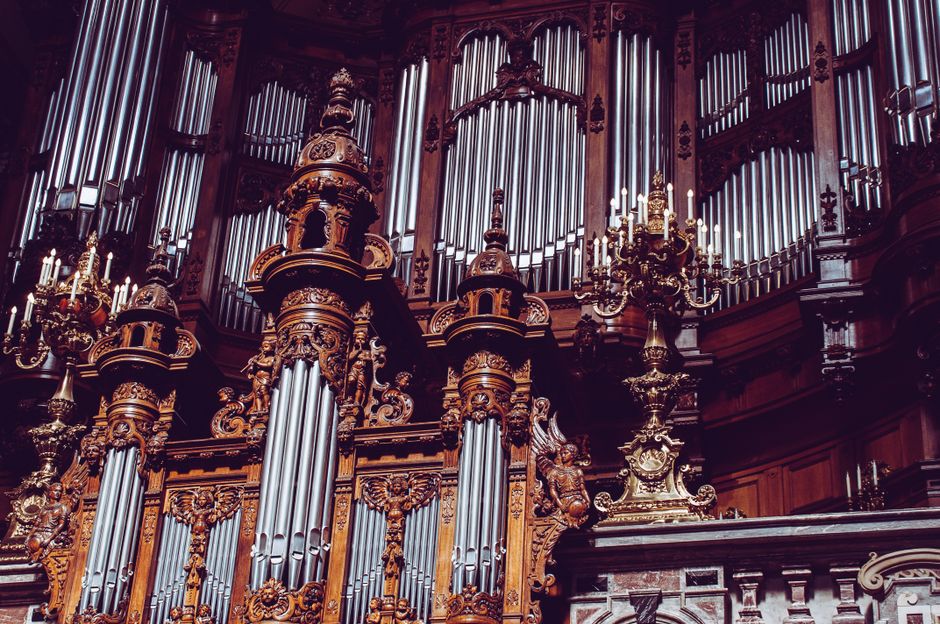
Few instruments can compare with a pipe organ. It is made up of hundreds or thousands of wooden and metal pipes, a wind supply and a mechanism. And it is built for one particular space. Stand before a grand organ case and you see the façade of an instrument whose sound takes shape through many stages of work.
How this assembly produces its sound is a matter of craftsmanship. Organ builders design, build and tune each instrument to suit its setting. In Germany, this knowledge has been recognised as part of the cultural heritage of humanity since 2017.
According to the organ overview every organ can be divided into three main parts: the pipework, the wind system and the action. The pipework produces the sound. The wind system supplies the air. The action connects the player’s hands and feet to the pipes.
At the console, the organist sits before several keyboards. Today, the manuals usually range from C to g³, while the pedalboard usually ranges from C to f¹. Small organs have one or two manuals, medium-sized ones two or three. Large instruments have three to five, or in rare cases six or seven. The movement of a key reaches the pipes through the action. This can be mechanical, pneumatic, electric or electronic, or even work through fibre optics.
In the past, wind came from bellows worked by the muscle power of up to twelve bellows operators. Today, an electric blower and a reservoir bellows usually do the job, keeping the pressure steady. The pipes themselves stand on the windchest, which distributes air to the individual pipes. Modern organs use almost exclusively slider chests for this purpose.
Dom St. Stephan in Passau shows just how large an organ can be. Its organ has 233 stops, four sets of chimes and 17,974 pipes, spread across five divisions. The Wanamaker Organ in Philadelphia, with 376 stops and 28,750 pipes, is regarded as the largest fully playable organ. With around 50,000 pipe organs, Germany has the highest density of pipe organs, measured by area and population.
Most organ pipes are flue pipes, also known to specialists as labial pipes. Their principle is explained in the organ pipe overview: Air flows upwards through the foot of the pipe and emerges through a narrow slit called the flue. There it forms a thin sheet of air. This strikes an edge, the upper lip, and is deflected, setting the column of air inside the pipe vibrating. The mostly rectangular opening above the flue is called the mouth or cut-up.
There are also reed pipes, known to specialists as lingual pipes. They make up a minority of the pipework. Inside them, a metal reed vibrates and sets the air in motion. Stops such as the trumpet and trombone belong to this type.
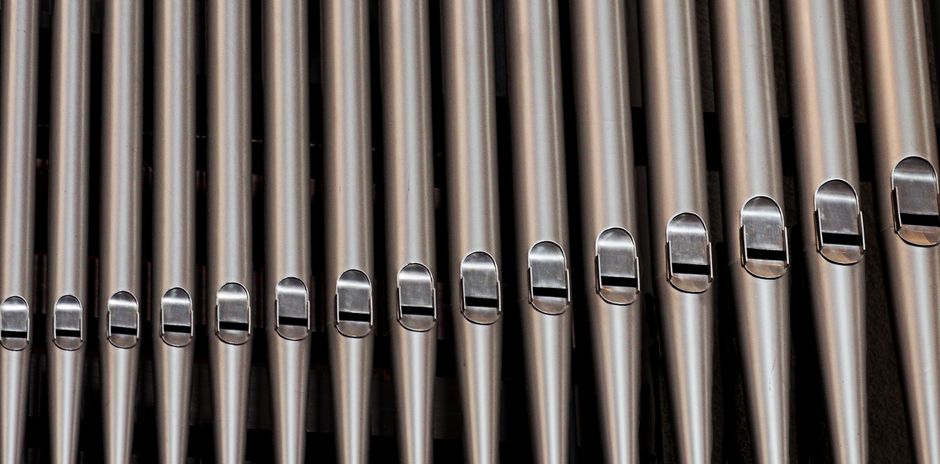
Pipes also differ in their materials. Metal pipes are often made from organ metal, an alloy of tin and lead, or from copper. Zinc was used mainly from the middle of the 19th century to the middle of the 20th century. Organ builders often make wooden pipes from oak, softwood or fruitwood. To make them airtight, they coat the inside with glue.
Pitch depends primarily on length. Organ builders measure in feet: one foot equals 30.48 centimetres. The lowest open pipe of a stop at the standard pitch of 8 feet is about 2.4 metres long. Large organs also have stops of 16 and 32 feet, and in exceptional cases even 64 feet. The lowest note of a 32-foot stop is about 16.35 hertz. Some of the lowest notes of such stops lie below the threshold of human hearing. At the other end of the scale are pipes just a few millimetres long.
Stopped pipes, which are closed at the top, have a special role. They sound an octave lower than open pipes of the same length. Their sound is considered warm and rounded. For organ builders, this brings a double benefit: a pipe only needs to be half as long to produce the same note, while the stop gains a distinctive tone colour.
Stopped pipes sound an octave lower than open pipes of the same length.
A single key can make many pipes sound at once. Stops make this possible. A stop is usually a rank of pipes of the same type, though sometimes it comprises several ranks. When the player draws a stop, that rank joins in. The selection of stops and playing aids is called the specification. Organ builders and clients decide on it together: it is the blueprint for the sound.
The player chooses the tone colour with the stops. Stops at different pitch levels can be layered. A 4-foot stop sounds an octave higher than an 8-foot stop, while a 16-foot stop sounds an octave lower. The pipes of a 16-foot stop are twice as long as those of an 8-foot stop; those of a 4-foot stop are half as long.
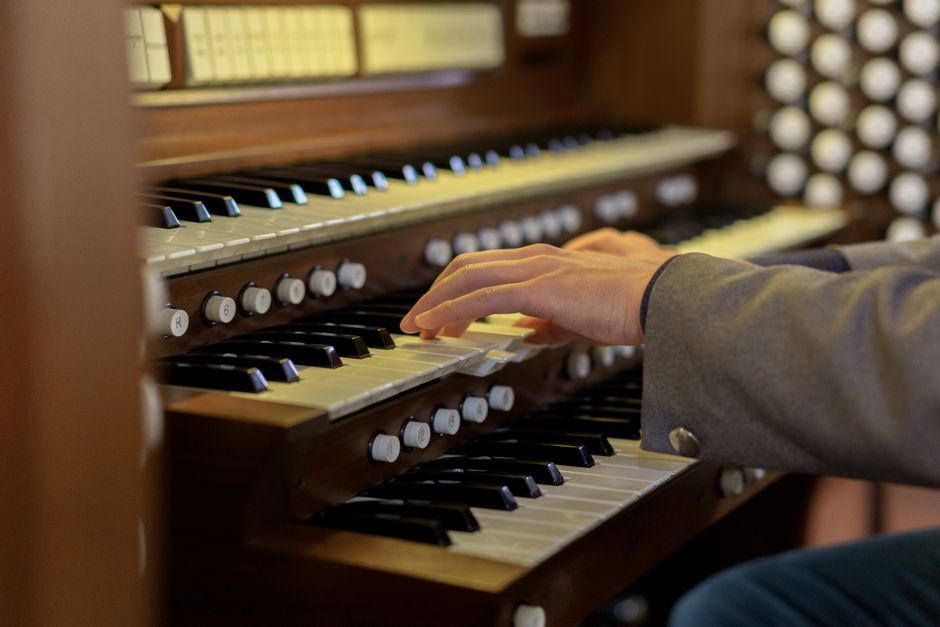
At the console, the player controls the stops using stop controls. On mechanical organs, the knobs are pulled out and pushed back in. On pneumatic or electric systems, the player operates them using buttons or switches. Some stops sit inside a swell box. Its shutters can be opened and closed, allowing the volume of those stops to rise and fall smoothly.
Behind all this lies a decision made early on. According to UNESCO each instrument is created specifically for the architectural space in which it is played. The room is therefore part of the planning from the very beginning.
Once an organ is built, it is far from finished. Now comes voicing: the fine adjustment of each individual pipe’s sound. This takes place mainly at the mouth. The voicer may alter the size of the toe hole, the height of the cut-up or the width of the flue. Small notches in the languid, known as nicks, are another means of adjustment. Each intervention changes how the pipe responds and how it sounds.
Voicing also follows a style. Pipes voiced in the Baroque manner are rich in overtones and clearly articulated. Pipes voiced in the Romantic style have a very homogeneous sound. The neo-Baroque voicing of the 20th century, by contrast, favoured a sharp sound rich in overtones. When you listen to different organs, you hear the decisions their builders made.
Even a fully voiced organ continues to change. The temperature of the room alters the tuning of the flue pipes by about 3.3 cents per degree Celsius. A difference of 30 degrees corresponds to roughly a semitone. A cold church in winter therefore sounds measurably different from the same space in summer.
Many workshops carry this knowledge forward. UNESCO lists 400 medium-sized craft businesses and several larger family workshops in Germany. Skills are passed on mainly from teacher to pupil, supplemented by vocational schools and universities. In 2017, UNESCO added organ building and organ music in Germany to the Representative List of the Intangible Cultural Heritage of Humanity.
At your next concert, listen closely. Behind every note are a pipe’s length, material, stop and voicing. And a workshop that built the instrument for this very space.
A stop is usually a rank of pipes of the same type. The selection of all the stops and playing aids is called the specification.
The measurement in feet describes the pitch of a stop. One foot equals 30.48 centimetres, and the lowest open pipe of an 8-foot stop is about 2.4 metres long. Stopped pipes sound an octave lower than open pipes of the same length. A 4-foot stop sounds an octave higher.
A voicer fine-tunes the sound of every pipe, mainly at the mouth. This involves altering, for example, the toe hole, the height of the cut-up and the width of the flue, or adding nicks to the languid.
More about the places and people behind remarkable things.