Collagen as a dietary supplement: what the studies really reveal
In 2021 we introduced the collagen hype around Glow/25, when the Berlin powder was just becoming the darling of the beauty world. Five years on, the brand is now a triple-digit-million-euro business, yet the evidence remains mixed. We take stock of what collagen can actually do and where marketing promises take over.
In April 2021 we introduced you to Glow/25, when collagen was shifting from niche topic to beauty darling. Today the Berlin brand is a phenomenon with triple-digit-million-euro sales and a community of tens of thousands of loyal customers. Time for an honest look: what does collagen actually do in the body, what do the studies say, and where does the evidence end and the marketing begin?
- Collagen is the most abundant structural protein in the body; from the mid-20s onward, natural production slowly declines.
- As a powder or capsule, the body breaks collagen down into amino acids; direct transport into skin cells is not proven.
- Individual studies show small effects on wrinkle depth and elasticity, yet consumer-protection agencies deem beauty claims inadmissible.
- Glow/25 launched in Berlin in 2021 and is now one of the largest collagen suppliers in the DACH region.
- If you try it, think of it as a possible extra, not a guaranteed fountain of youth.
Collagen is no buzzword-it’s biochemistry. The protein forms the scaffolding that holds skin, tendons, cartilage, bones and connective tissue together, giving them firmness and resilience. It is largely made up of the amino acids glycine, proline, hydroxyproline and arginine. Over time the body produces less of it: from the mid-20s onward, new collagen synthesis declines, and the consequences become visible decades later as finer lines and reduced skin elasticity. It is at this point that the idea of supplementation steps in-topping up the body’s supply from the outside.
What Really Happens in the Body
Here’s where it gets honestly complicated. When you drink or swallow collagen hydrolysate, ready-made skin protein doesn’t magically appear in your face. Your gut breaks it down first into short amino-acid chains and individual building blocks, which your body then distributes as needed-into muscles, bones, connective tissue, or indeed the skin. The good news: these building blocks are demonstrably absorbed. The uncomfortable truth: whether they specifically reach skin cells and visibly tighten skin is not conclusively proven by science.
The body of research is mixed, and that’s part of the story. A frequently cited 2014 study by Proksch and colleagues found, after twelve weeks of daily collagen-peptide intake, a measurable reduction in wrinkle depth and a stronger skin matrix. Other work points in a similar direction. At the same time, independent bodies like Germany’s Consumer Advice Centre stress that many of these effects are small, often funded by manufacturers, and it remains open whether you’d notice the difference with the naked eye.
Collagen isn’t a canned fountain of youth, but it’s also not pure marketing fluff. The truth lies in the measurable, modest middle ground.
Legally, the matter is clear-cut: claims such as “for firmer skin” or “works from within” count as impermissible health-related advertising for foodstuffs. Manufacturers may not make such statements, even though those promises keep surfacing in influencer posts. So if you expect a guaranteed anti-ageing effect, you risk disappointment. If you see it as a supportive extra to good nutrition, you’ll approach the topic more relaxed.
Glow/25: From Start-up to Collagen Phenomenon
When we reported on Glow/25 in 2021, the brand was freshly launched. Today it’s its own chapter in German beauty retail. What began as a classic direct-to-consumer play on the brand’s own site and marketplaces has grown into a high-retention brand with a large, loyal community now hailed across the industry as a textbook example of customer bonding. Industry reports put annual revenue in the triple-digit millions.
The range has broadened over the years. The two original bestsellers remain at its core.
Powder or Capsule: The Two Classics
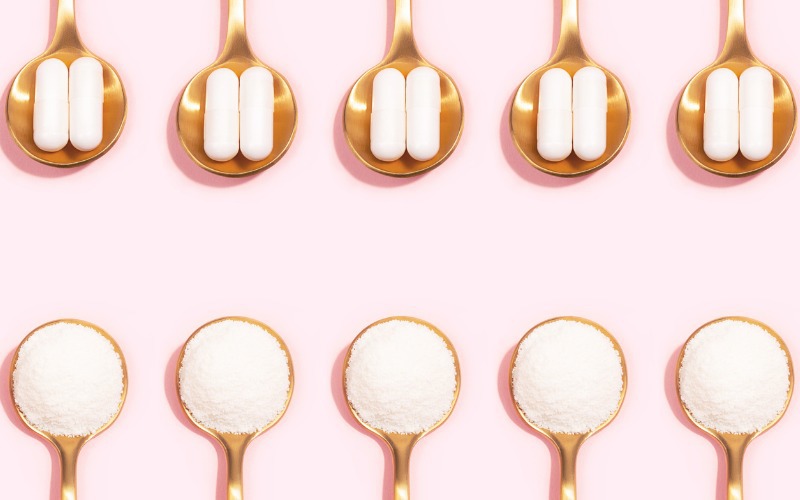
The collagen powder arrives as a neutral hydrolysate sourced from certified pasture-raised, grass-fed cattle. Because it’s already hydrolysed, the chains are pre-broken, improving bioavailability. In practice you stir one to two tablespoons into shakes, smoothies, coffee or soup; the neutral taste keeps it everyday-friendly. The collagen capsules are the compact on-the-go alternative and combine collagen peptides with hyaluronic acid, pomegranate extract and vitamin C. Vitamin C isn’t incidental: your body needs it for its own collagen synthesis. The recommendation is to take several capsules spread across meals.
Which format suits you better is a question of daily routine, not efficacy. Powder is cheaper per serving and flexibly dosed; capsules score on convenience. Neither replaces a balanced diet-protein-rich food, ample sleep and consistent sun protection remain the foundation for healthy skin. How to shield skin from the outside is laid out in our guide to sunscreen and UV protection, and why diet does more for your skin than any powder is shown in our feature Eat the Rainbow.
Does It Pay Off for You?
Honest answer: it depends on what you expect. Collagen is well tolerated, the building blocks are absorbed, and individual studies show small positive effects on skin, joints and connective tissue. It’s no miracle cure that erases wrinkles, and nobody may promise that. If you’re curious and the budget allows, you can test it for a few weeks and judge for yourself. If you’re waiting for ironclad proof, you’ll be waiting a while for collagen.
Quick Answers
▸Does collagen from powder or capsules really work against wrinkles?
The building blocks are absorbed by the body-this is proven. Whether they visibly reduce wrinkles is controversial. Individual studies show minor effects, while independent bodies like the German Consumer Advice Centre rate the evidence as thin. Beauty claims for food in Germany are therefore prohibited.
▸Powder or capsules-what’s better?
Both provide the same collagen peptides. The powder is flexibly dosed and usually cheaper per serving, while capsules are more convenient on the go. The choice is a matter of daily routine, not efficacy.
▸When does the body’s own collagen production start to decline?
As early as the mid-20s, the body slowly produces less collagen. This usually only becomes visible years later through finer lines and reduced skin firmness.
▸Why is vitamin C also included in the capsules?
Vitamin C is a necessary building block for the body’s own collagen synthesis. The combination is meant to support natural formation, which is why it appears as an accompanying ingredient in many beauty products.
▸Is Glow/25 a reputable brand?
Glow/25 was founded in Berlin in 2021 and is now one of the largest collagen providers in the German-speaking market with a large loyal customer base. The products are well-tolerated, but-as with all brands in this category-you should view the marketing promises about beauty effects with a critical eye.