Guide · Charter flights
Chartering a private jet: Which cabin suits your route
Chartering a private jet: which cabin suits which route, what a flight hour costs and how to recognise a reputable operator.

 Grand Touring
Chartering a private jet: which cabin suits which route, what a flight hour costs and how to recognise a reputable operator.
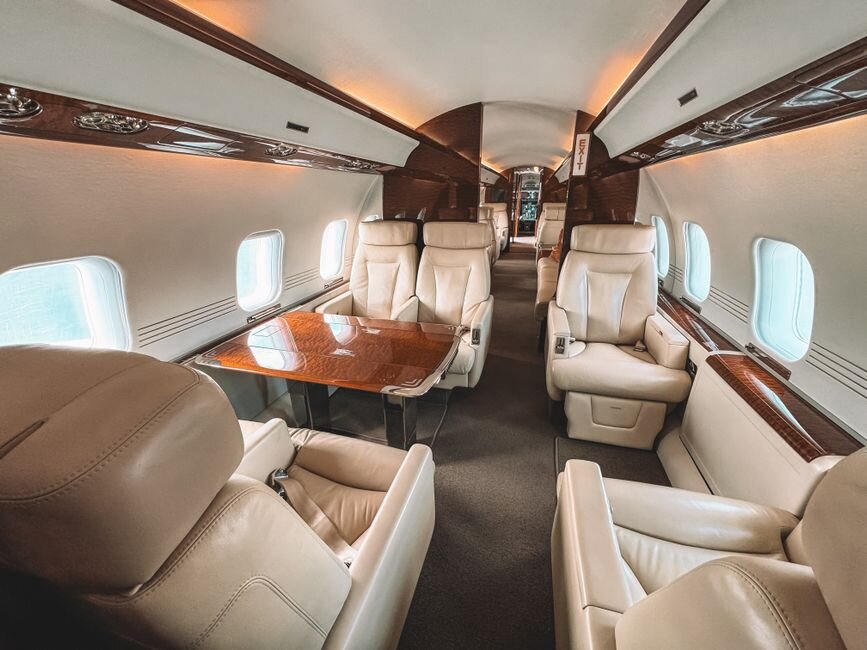
When you charter a private jet, you are booking a space. Four armchairs and a folding table are enough for the hop from München to Mailand. At the other end of the scale is a long-range jet such as the Gulfstream G700, with a range of 7,500 nautical miles and a cabin height of 1.91 metres. Between these two worlds lie several aircraft classes. Each has its own balance of range and hourly rate.
A look inside the cabin tells you a great deal about the flight. It shows you what kind of route a jet was built for, how rested you will feel on arrival and what an hour in the air will cost.
Charter providers divide their fleets into classes. At the lower end are Very Light Jets, followed by Light Jets, Midsize Jets and finally Heavy Jets, with large cabins for long routes. The cabin grows with each step up, as do range, luggage space and weight.
For your planning, this means the route determines your choice of aircraft. A small jet is fast and flexible on short hops. On a long flight, it might have to stop to refuel. A large jet can cover the same distance without stopping, but it also costs more per hour on a short route.
Then there is the number of people travelling with you. If you fly with family or a team, you need seats and space for suitcases. If you travel alone, a compact cabin will do. A good broker will therefore ask about your route, the number of passengers and your luggage before suggesting aircraft.
The cabin class determines the price per flight hour. The broker Global Charter quotes guide prices: Very Light Jets cost around €3,500 to €5,250 per flight hour, and Light Jets around €4,000 to €6,000. For Midsize Jets, the figures are around €5,750 to €8,750, and for Heavy Jets around €9,750 to €14,000. The guide from UAMR quotes around €3,500 per hour for typical Light Jets used for business travel.
These figures are a guide. According to Global Charter, approach fees, airport charges and other costs are added on top. The actual amount depends on the route, aircraft type and season. A flight to a popular destination in high season costs more than the same flight on a quiet weekday.
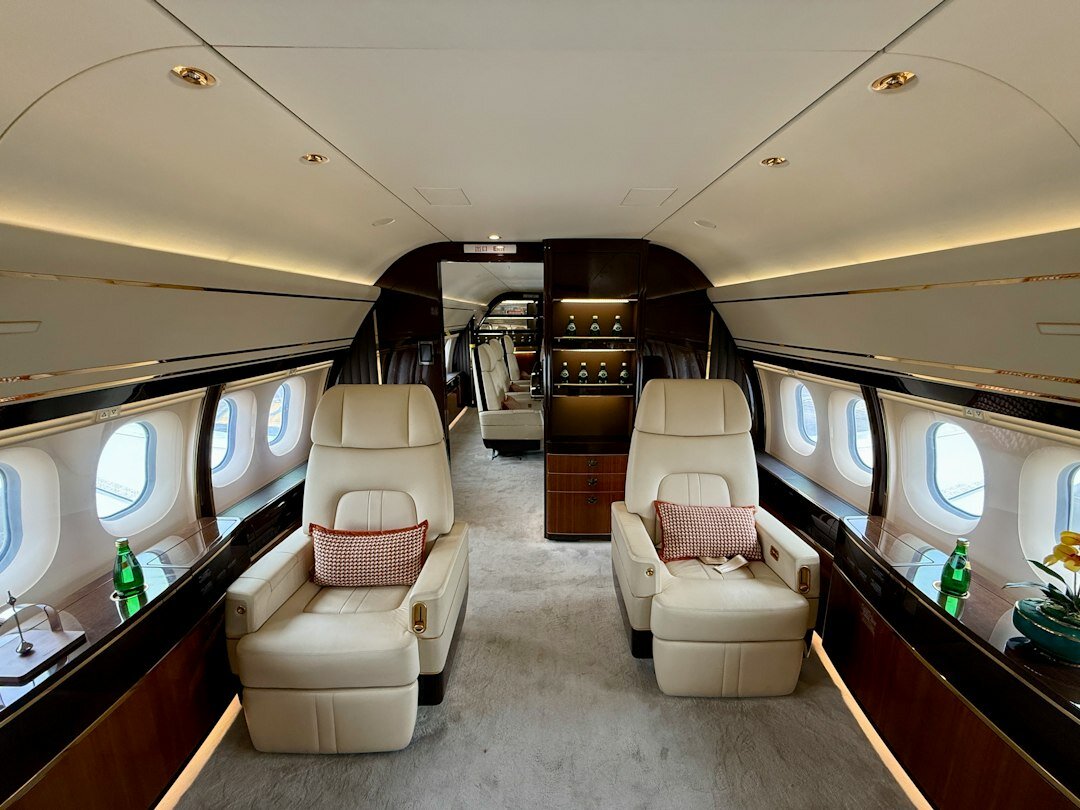
At the top of the scale are the large long-range jets. One example is the Gulfstream G700. Its cabin height, according to Aviator Insider is 6 feet 3 inches, around 1.91 metres. In a cabin like this, most adults can stand upright. According to AIN, Gulfstream gives its range as 7,500 nautical miles, around 13,900 kilometres. On a two-hour route, this height hardly matters. On a flight across the Atlantic, it makes a noticeable difference.
For you as a customer, the rule is simple: the largest cabin is rarely the best choice. The best cabin is the one that suits the route.
The best cabin is the one that suits the route.
Alongside size, manufacturers quote a second figure: cabin altitude. This describes the altitude corresponding to the air pressure inside the cabin. The lower the figure, the closer the pressure on board is to that near ground level.
US certification rules for transport aircraft set an upper limit. Under 14 CFR § 25.841 a pressurised cabin must maintain a cabin altitude of no more than 8,000 feet at maximum cruising altitude, around 2,440 metres. That is the permitted limit for a transport aircraft.
Large long-range jets can sit well below this limit. Gulfstream gives the G700 a cabin altitude of 2,840 feet, around 866 metres, at a flight altitude of 41,000 feet. This is reported by the aviation publication Airframer. According to AIN , the manufacturer had previously quoted 2,916 feet. The original figure announced was 3,290 feet. According to Gulfstream, as reported by AIN, the G700 has the lowest cabin altitude of any large-cabin business jet.
Windows play a part in the experience too. Large windows let more daylight into the cabin and make the space brighter. If you often fly long distances, ask your broker about the cabin altitude of the aircraft they suggest.
Empty legs offer another way to fly by private jet. These flights arise when an aircraft returns to base or flies on to its next assignment without passengers after a paid charter. According to Air Charter Service seats on these flights are sold for a fraction of the regular charter price. The operator is flying the route anyway.
The catch is that the flight depends on the original charter. An empty leg exists only as long as that charter goes ahead. If the original customer cancels or changes their flight, according to AeroCorner the empty leg can also be cancelled at short notice. That is a risk if you have a fixed appointment.
Empty legs therefore suit travellers with room to be flexible. If you can be flexible about the day and time, you can fly in a large cabin this way. If you need to be on time for a meeting, you are better off booking your own charter.
For all the pleasure of the cabin and its comforts, what ultimately matters is who operates the flight. Commercial operations require an air operator’s certificate, or AOC. It is the licence that allows an operator to carry passengers for payment.
According to the aviation publication aeroTELEGRAPH , anyone selling charter flights without this certificate is flying illegally. These flights are often called grey charters. The head of the charter association ACA considers even this term misleading, because it suggests that such flights may sometimes be permitted. aeroTELEGRAPH therefore advises checking the provider’s AOC and aircraft insurance before booking. The operator GlobeAir says it provides its AOC and proof of insurance on request.
At its core, this is about safety. According to aeroTELEGRAPH, licensed commercial operators are subject to strict rules. These set standards for aircraft maintenance, flight and ground operations, and crew experience and training. It is difficult to put a figure on how often illegal flights take place: according to the report, around 17,000 to 20,000 private jets are registered worldwide, but reliable data on illegal flights is scarce. The Air Charter Association has therefore set up a reporting channel on its website. According to aeroTELEGRAPH, suspected cases are reviewed and passed on to the relevant aviation authority. Alongside the AOC and insurance, the association also lists pilot qualifications among the documents you should check.
A reputable operator will provide these documents without hesitation. If you book through a broker, also ask for the name of the operator carrying out the flight. That way, before you step aboard, you know who is in the cockpit and who is responsible for the flight.
That brings us back to the cabin. It shows you what a jet was built for. The operator’s certificate shows whether it is permitted to fly that way.
That depends on the cabin class. The broker Global Charter quotes around €3,500 to €5,250 for Very Light Jets, around €5,750 to €8,750 for Midsize Jets and around €9,750 to €14,000 for Heavy Jets. The route, aircraft type and season affect the price.
A positioning flight without paying passengers, before or after a paid charter. Seats on these flights are sold at a lower price. If the original customer cancels or changes their flight, the empty leg can be cancelled at short notice.
Commercial operations require an air operator’s certificate, or AOC. Flights without an AOC are considered illegal and are often called grey charters. Before booking, ask for the operator’s AOC and aircraft insurance.
More about journeys behind the wheel, long stretches of road and cars built for long distances.