Champagne & Canned Soup
For nearly two years now, Düsseldorf has been home to what is arguably Germany’s most luxurious supermarket. We show you what makes the Zurheide Feine Kost Center so extraordinary.
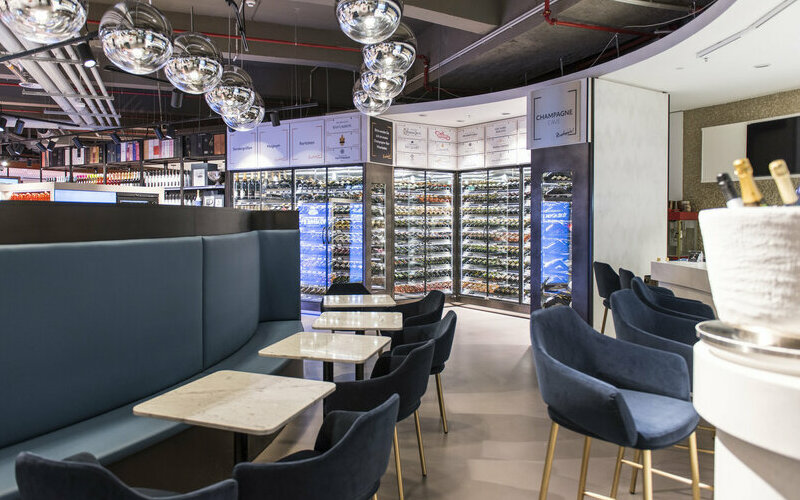
In 2020, we reported on Zurheide Feine Kost in Düsseldorf. The store on Berliner Allee had been open for almost two years at that point, showcasing across roughly 10,000 square meters how differently a supermarket can feel when shopping, bar, restaurant, and delicatessen counter are not conceived as separate entities.
- Zurheide Feine Kost was described in the alt text as an experiential supermarket spanning roughly 10,000 square meters.
- The store featured a champagne bar, chocolate and praline production, a vegetarian restaurant, and an Italian bakery.
- A grill specialized in Japanese Kobe beef.
- The basement housed a fine-dining restaurant with 16 points in the Gault-Millau guide.
- According to the article, the selection ranged from white truffles to EDEKA gut & günstig (good & cheap).
Why this supermarket must be read differently
The original article already featured a beautiful contrast in its title: Champagne and canned soup. That was the punchline. Zurheide didn’t just want to show how much gourmet food fits into a market. The venue posed the question: Does shopping have to be mere supply, or can it also be an evening program? Those who need milk quickly can get it. Those who want to stay are given reasons to do so.
Supermarkets were then trying to bring more experience into their floor space. The text cites EDEKA and Rewe as examples of chains that didn’t simply want to lose customers to online shopping. Zurheide was the grand stage for this idea. On roughly 10,000 square meters, a market emerged that read more like a culinary passage: bar, bakery, restaurant, grill, chocolate, shelves.
A good market doesn’t just sell goods; it sells a reason to slow down.
This isn’t just a matter of luxury. It’s a matter of time. A market that encourages you to linger doesn’t just sell products; it sells breaks. The champagne bar therefore doesn’t feel like an attached extra. It’s a signal: You are allowed to stay longer here than a shopping list dictates.
The details make the difference
The old text lists a whole series of stations: a champagne bar, its own chocolate and praline production, a vegetarian restaurant, an Italian bakery, and a grill specializing in Japanese Kobe beef. In the basement, there was also a fine-dining restaurant awarded 16 points by Gault Millau.
Such details are important because they show how precisely the market was staged. It wasn’t just about expensive goods on the shelf. It was about craftsmanship, scent, visibility, and movement. When chocolate is produced on-site, a product becomes a process. When bread comes from an Italian bakery, the shopping experience smells different. When an award-winning restaurant waits below, the venue gains depth.
The figure of around 60,000 products sounds large, but in the text, it wasn’t an end in itself. What mattered was the range: gourmet rarities like white truffles stood next to standard EDEKA private-label products (good & cheap). According to the report, the operators didn’t aim exclusively at well-off customers. It is precisely this mix that makes the venue more exciting than a pure gourmet showcase.
Luxury here doesn’t mean distance
A pure luxury market would quickly become boring. Zurheide was described more interestingly in the archived text: as a market for various budgets, where champagne and everyday products coexist. This simultaneity removes stiffness from the place. You can buy a special ingredient, have a coffee, wander through the aisles, or simply shop. Not every visit needs to be a grand gesture.
This is a good reminder for anyone who thinks too narrowly about enjoyment. A product doesn’t become better because it’s expensive. A venue doesn’t become more relevant because it’s intended only for a few. The appeal arises when quality remains accessible yet still feels curiously curated. Zurheide demonstrated exactly this tension in the old text.
Online competition thereby takes on a different meaning. A delivery basket is practical, but it doesn’t smell like bread, it doesn’t show a praline production, and it doesn’t give you a moment at a bar. Physical retail therefore doesn’t need to get louder. It needs to create reasons why making the trip makes sense.
How to use such a venue properly
If you visit a market like this, don’t just go by list. A good gourmet area thrives on letting yourself drift. Look first, then decide. Perhaps in the end it’s not the white truffle, but good bread, a chocolate, or a product you might otherwise have overlooked.
The archived text thus also works as a small guide: Luxury in shopping lies not in posing. It lies in selection, craftsmanship, and the feeling that a venue is putting in effort. Champagne and canned soup aren’t contradictory if both have their place.
Why this mix remains compelling
The article’s title works because it isn’t smooth. Champagne and canned soup represent two ends of the same shopping trip. In between lies everyday life. That is exactly where Zurheide became interesting: The market refused to decide whether it was a gourmet temple or a neighborhood grocer. It allowed both. This makes the place less aloof and significantly more useful.
A market like this thrives on contrasts. Showing only luxury creates distance. Showing only basic provisions makes you interchangeable. But when a truffle chocolate is made on-site, while a standard private-label product still sits on the shelf, the shopping experience gains a different quality. You can choose the special, but you don’t have to.
This is also the lesson from the archive piece: Experience in retail must not be mere decoration. A bar, a bakery, or a restaurant only works if it genuinely changes the visit. At Zurheide, they were described as part of the market, not as scenery. That is why the text remains interesting.
The IBL perspective
As an archive refresh, this text doesn’t need to pretend that old news is new. Its strength lies in reading the original observation more clearly. What was just an occasion, what remains as a stance, and what can you still draw from it today? Exactly this separation turns an old stock item into a piece that fits back into the page.
For you, this means: Take the concrete details seriously, but not every bit of past excitement. Good archive pieces work when they preserve a moment while simultaneously becoming calmer. They don’t show what you must buy, eat, wear, or book immediately. They show what to pay attention to when style, everyday life, and enjoyment are thought out a bit more carefully.
Good to Know
▸Where is the described Zurheide market located?
The article describes the Zurheide Feine Kost Market at Berliner Allee in Düsseldorf.
▸What size was the area stated to be?
The old text cites around 10,000 square meters.
▸What extras were there in the market?
Mentioned were, among others, a champagne bar, chocolate and truffle production, a vegetarian restaurant, an Italian bakery, and a Kobe grill.
▸Was the market intended only for gourmet food?
No. The article emphasized the range from gourmet rarities to EDEKA gut & günstig.