
White Gold: How Wind and Craftsmanship Turn Salt into a Spice
In the Petite Camargue, sun, the Mistral wind, and practiced hands transform seawater into Fleur de sel. A glimpse into the salt flats of Aigues-Mortes, where Michelin-starred kitchens source their most delicate seasoning.
A spice perfected over millennia needs no reinvention, only sunshine, wind, and someone who knows the exact moment the delicate crystal flower is ready to be skimmed from the water. In the Petite Camargue near Aigues-Mortes, the same craft has been practiced since the 4th century BCE; only the recognition is new.
- Since 2024, “Sel de Camargue / Fleur de sel de Camargue” has been registered as an EU Protected Geographical Indication
- Produced exclusively in the Petite Camargue across roughly 9,800 hectares, yielding about 6,600 tonnes of Sel and 560 tonnes of Fleur de sel annually
- Fleur de sel is hand-harvested at dawn from the water’s surface
A Craft Dating Back to Antiquity
Salt has been harvested in Aigues-Mortes since the 4th century BCE. The Roman engineer Peccius already organized production here. The modern Salin d’Aigues-Mortes was established in 1856 by merging several smaller saltworks, an industrial upgrade to a practice already two thousand years old. The site stretches 18 km north to south and 13 km east to west, covering 8,000 hectares with more than 340 km of pathways, making it the largest salt flat on the Mediterranean.
Since 2024, “Sel de Camargue” and “Fleur de sel de Camargue” have carried the official EU Protected Geographical Indication status. Production is permitted only in the Petite Camargue, across roughly 9,800 hectares of wild terrain. Each year about 6,600 tonnes of Sel de Camargue and 560 tonnes of Fleur de sel de Camargue reach the market, sold in 25 countries. Two area figures circulate: 8,000 hectares denote the entire salt-flat complex, while 9,800 hectares mark the protected production zone of the Petite Camargue overall.
When the Brine Reaches 360 Grams
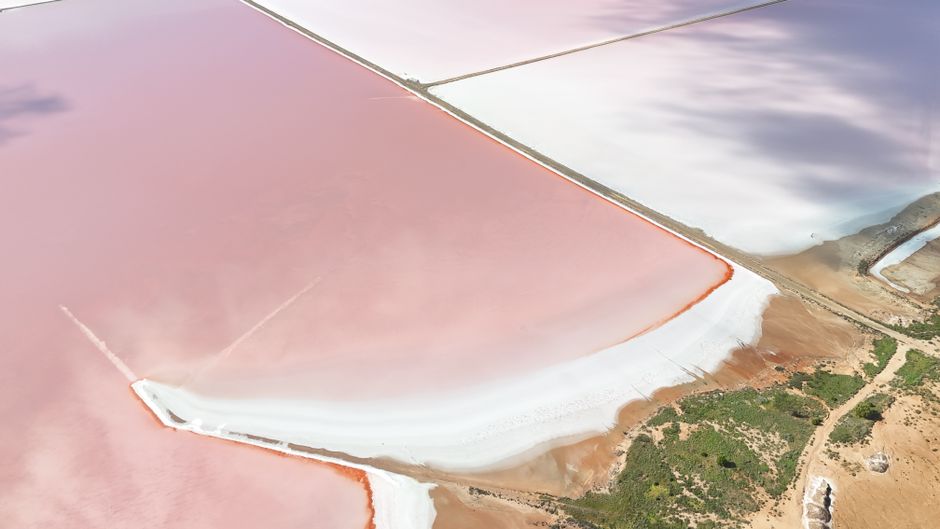
From March to August, the Sauniers channel Mediterranean water through a series of basins until the brine reaches a saturation of 360 grams of salt per litre. Over months, a naturally white salt layer builds up in the shallow crystallisation pans, eventually reaching about ten centimetres thick. Harvesting begins in September with heavy machinery that shapes the camelles, grey-white salt mounds visible on the horizon from the medieval city walls of Aigues-Mortes.
Fleur de sel follows a different path. The delicate crystal flower forms on the water’s surface and is skimmed by hand at dawn, a process that unites sun, wind, and sea in a single motion. No excavator, no machine, just a practiced eye that senses when the layer is ready. This very difference, industrial salt versus hand-harvested bloom, explains why one kilo of Fleur de sel commands a multiple of the price of coarse salt.
The crystals form where sun and wind share the labour. The hand arrives only at the end to harvest what the weather has prepared over months.
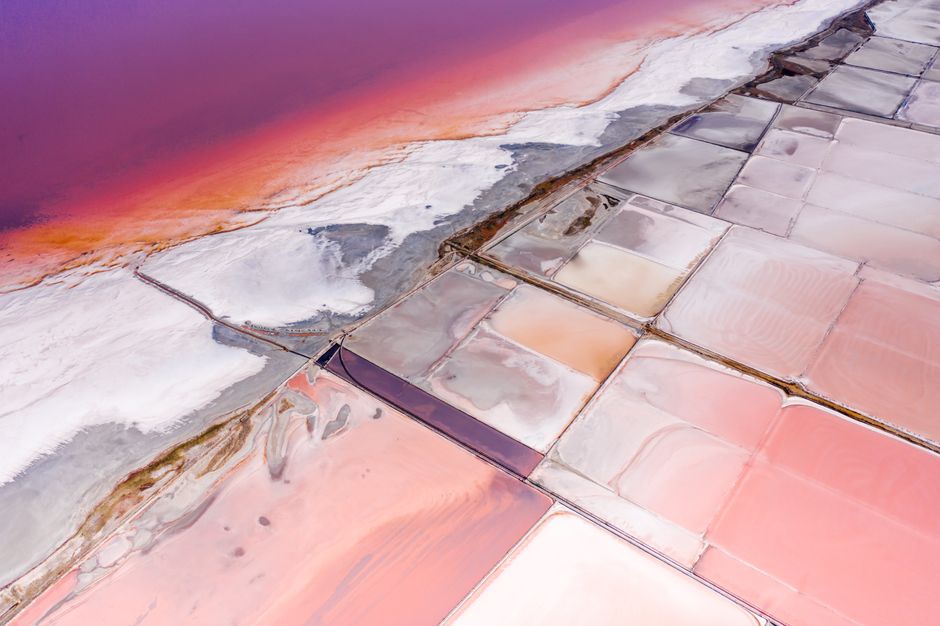
Why the basins glow pink
The striking pink hue of many salt pans comes from the microalga Dunaliella salina. It feeds brine shrimp, which in turn give the flamingos of the Camargue their signature colour, a food chain that runs from the water through the crustacean and into the birds’ feathers. The Salin d’Aigues-Mortes has been part of the Natura 2000 charter for Petite Camargue since 2005. More than 200 bird species and 300 plant species live in the adjoining lagoons and dunes, an ecosystem that depends on the same salt-water balance as the salt production itself.
Visitors can explore the salt flats from March to November, by Petit Train in about an hour, on foot or by mountain bike. The tours take you past crystallisation pans, salt mountains and the pink water landscape up close, not as a backdrop, but as a working operation that has been running for decades.

From basin to plate
Camargue Fleur de sel is prized in gastronomy as a finishing salt, sprinkled over a finished dish just before serving. According to France’s Ministry of Agriculture, chefs such as the Pourcel brothers, Roger Merlin and Michel Kayser use these salts in their recipes. The salt is not cooked in; it stays visible and crisp, a final textural decision rather than a base ingredient.
The brand Le Saunier de Camargue, founded in 1995, typically sells Fleur de sel in cork-lidded tins that keep moisture out and protect the crystal structure. This is no packaging nicety, it’s essential: Fleur de sel that absorbs moisture loses its signature crunch and reverts to ordinary salt with an expensive label.
A seasoning that doesn’t hide its origins
What sets Camargue salt apart from anonymous table salt is not merely its mineral profile. It is the traceability back to the individual basin and the precise weather window in which it was harvested. An IGP designation may not prevent taste-alike copies, but it forbids any false claim of origin. When you see “Sel de Camargue” on the label, you know that the 9,800 hectares of Petite Camargue are truly behind it.

What really matters
A salt you can buy on a global market need not have taken the same journey as one from Petite Camargue. The difference isn’t in the chemical formula, sodium chloride is sodium chloride, but in the texture, the crystal size and the story you taste when you know where it came from. That’s worth paying for, especially because it doesn’t shout about itself.
Good to know
▸What distinguishes Fleur de sel from ordinary sea salt?
Fleur de sel forms as a fine crystal layer on the water’s surface and is skimmed by hand, whereas coarse sea salt settles on the pan floor and is harvested mechanically. The manual skimming makes Fleur de sel rarer and more expensive.
▸Why are the Camargue salt pans pink?
The colour comes from the microalga Dunaliella salina, which thrives in highly saline water. It is also why the region’s flamingos display their characteristic pink hue.
▸Can you visit the salt flats?
Guided tours run from March to November, by Petit Train, on foot or by mountain bike. They take you through the crystallisation pans and past the iconic white salt mountains.
Image credits: Cover photo Pexels / Mikhail Nilov; article photos Pexels / Jan van der Wolf and Pexels / Castorly Stock.


