What a Goodyear-Welted Shoe Tells You About Time
Goodyear welt construction joins upper, lining and welt in a way that keeps everything repairable and lets the sole be replaced without touching the upper. What that says about the working time built into a shoe.
A shoe can last many years or a few months. The difference rarely lies in the design and almost always in the method used to build it. Goodyear-welted construction is one of those methods: complex, laborious and proven for almost two centuries. It joins upper, lining and sole in a way that leaves the shoe open to later repair. Once you have understood what happens in this process, you see shoes differently.
- The Goodyear welt joins upper, lining and welt to the insole rib in a first stitching step
- The welt is then stitched to the outsole separately
- The sole can be removed and replaced without damaging the upper
- Charles Goodyear Jr. patented a stitching machine for this joint in 1871
The construction of a Goodyear-welted shoe begins on the inside, in a place you will never see later. A narrow strip of leather is attached to the insole: the insole rib. This rib is the first anchor of the construction. Upper and lining are stitched firmly to it, together with the welt, a band of leather running once completely around the outside of the shoe. This first stitching step joins three elements: the leather that touches your foot, the lining that sits between, and the welt that faces outwards.
Layer by layer: how a shoe is built
The second step brings the outsole. It is not attached directly to the upper but to the welt. That sounds like a small shift, yet it is a fundamental difference in the architecture of the shoe. Because upper and sole remain separated by the welt, they can be treated independently. Two complete, self-contained joints, one clear internal logic. That is the core of the Goodyear welt method.
When the sole of a glued shoe has worn through, in most cases the shoe can no longer be saved, at least not in any economically sensible way. Goodyear-welted construction is different: the sole can be removed and replaced with a new one without damaging the upper. This is not a bonus you might claim someday. It is a design principle that thinks about the life of the shoe differently from the start.
What repairability really means
The upper of a well-made shoe is built for decades, not for seasons. It gives, adapts, carries the creases that form as you walk. A new sole does not return the shoe to new condition, but it extends its use by years. Counting on two or three soles over its lifetime is not an unrealistic scenario. It is the normal case for any Goodyear-welted shoe that is cared for regularly.
In 1871 Charles Goodyear Jr. patented a stitching machine able to perform the first stitching step mechanically, making a technique accessible that until then had been pure handwork. Shoemakers in towns such as Northampton passed this method on through generations. Northampton remains a centre of Goodyear-welted shoe production to this day, not because of particularly favourable site conditions, but because the craft knowledge is deeply rooted and has held its place in local workshops and family businesses for more than a century.
Northampton and the origin of the method
Goodyear’s machine did not make the process simpler, only somewhat more scalable. The effort per shoe remained high: precise cutting, repeated assembly, careful stitching, work on the last, laborious finishing. Crockett & Jones still describes the Goodyear welt method as expensive, time-consuming and demanding in craft. That description is not advertising. It is a sober assessment of a process none of whose steps can be accelerated without a loss of quality.
Goodyear-welted shoes do not work through volume, but through the patience with which they are built and later cared for.
This is where the difference between owning and choosing begins. One accumulates things; the other asks whether they match your own sense of quality.
The Look at the Detail
A good purchase does not grow louder as you come closer. It grows more precise: in the surface, in the documentation, in the way material and provenance fit together.

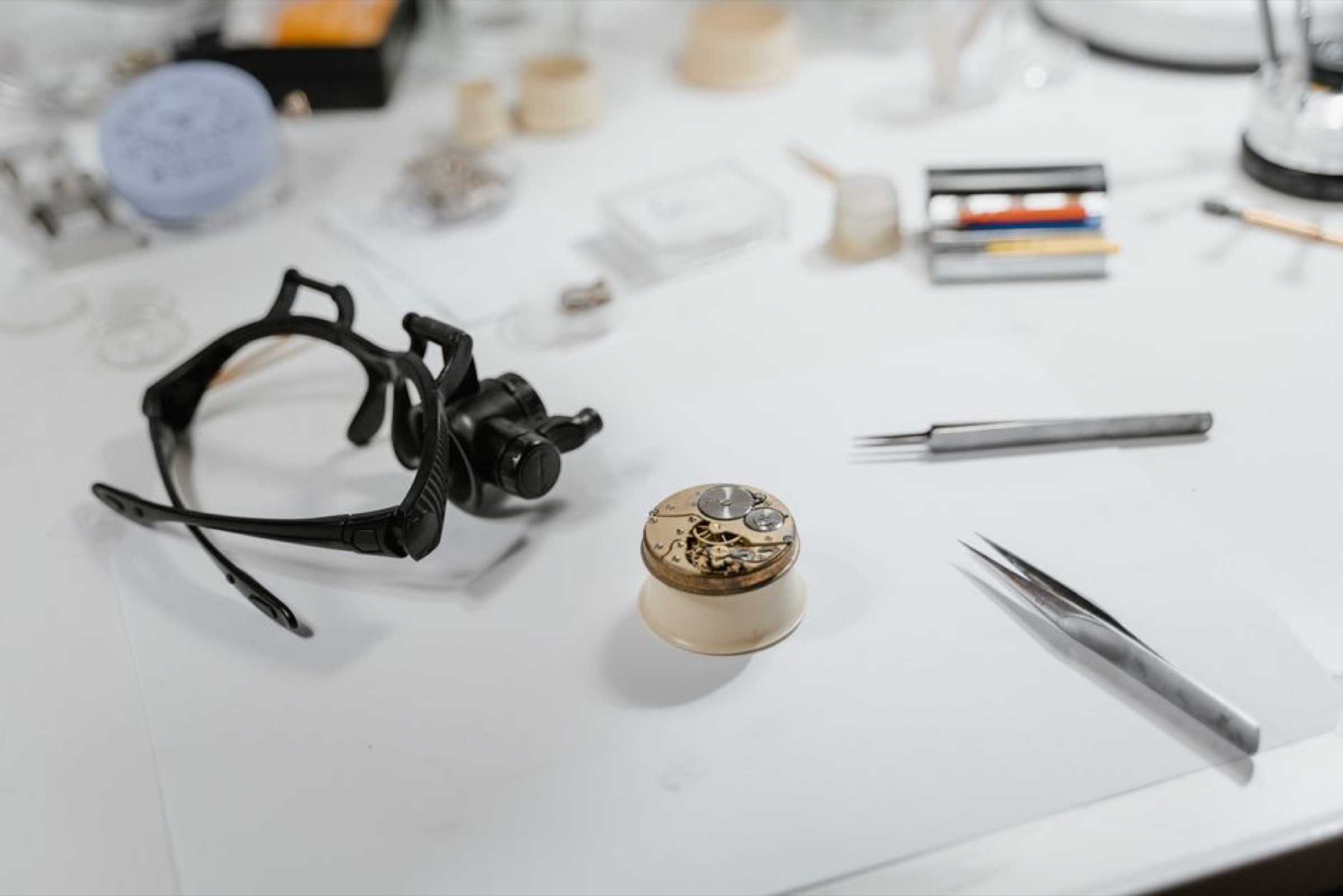
When you hold a Goodyear-welted shoe in your hand, you are holding working time. Not as an abstract category but as something concrete: the hours in which someone cut leather, joined it, stitched it and shaped it on a last. The construction itself is a quiet report of what happened before you wear the shoe for the first time. You cannot see the quality of the work directly, but you can feel it: in the fit, in the stability, in the weight, and in the way the shoe has already changed after a few weeks of wear.
Time as a Material
Leather that adapts to your foot over months. A sole you can replace when the time has come. A shape that still holds after years, given a good last. These are not properties printed on a label. They lie in the construction. And they do not show at the moment of purchase but in wear, at the second sole replacement, in the moment you notice that a shoe has become better, not worse.
Choosing this way is not a search for the loudest signal. It is a search for a piece that still convinces once the first impulse has passed.
The Final Check
In the end what counts is whether an object can carry its story quietly: not as a pose, but as quality you can trace.
What Remains
Luxury reads stronger when you read it more slowly. Then the focus shifts from price to coherence.
Briefly Explained
What is the difference between a Goodyear welt and glued construction?
In the Goodyear welt method, upper and sole are joined through a welt, not directly. This allows the sole to be removed and replaced without damaging the upper. In glued shoes the sole is permanently bonded to the upper. Repair is barely possible without fundamentally altering the shoe.
How often can the sole of a Goodyear-welted shoe be renewed?
Several times, as long as upper and welt are in good condition. How many replacements are possible depends on the quality of the leather, the care and the state of the welt. Two to three renewals over the lifetime are realistic, more with very well kept examples.
Why is Goodyear-welted construction more laborious than other methods?
Because two separate stitching steps are needed and each demands precision. Crockett & Jones calls the method expensive, time-consuming and demanding in craft. The process cannot be meaningfully shortened in any of its steps without risking the structural integrity. That is why a Goodyear-welted shoe embodies more working time than a glued one.
Placing It in Context
This article belongs to the new InspiredByLuxury way of reading: less a quick list, more material, provenance, use and editorial taste.
Image sources: Pexels / Carsten Ruthemann; Pexels / Quang Nguyen Vinh; Pexels / Umar Ali. Sources and further information: Crockett & Jones.