

The Wiener Werkstätte Forged Modern Design in Vienna
June 20, 2026
It doesn’t start with a piece of furniture or a painting, but with an act of sheer audacity. In 1903, a small group of Viennese decided there was no logical reason a door handle should be designed any less beautifully than a painting on the wall. That single conviction birthed a style that still reaches into your living room today, even if you’ve never heard the name behind it.
- The Beginning: Founded in Vienna in 1903 by Josef Hoffmann, Koloman Moser, and Fritz Waerndorfer, inspired by the Vienna Secession movement starting in 1897.
- The Concept: A cohesive style applied consistently across furniture, metalwork, jewelry, textiles, ceramics, and graphic design. Nothing is too small to be crafted well.
- The Masterpiece: The Palais Stoclet in Brussels, built between 1905 and 1911. A total work of art by Hoffmann featuring a frieze by Gustav Klimt. Designated a UNESCO World Heritage Site in 2009.
- The Legacy: Dissolved in 1932, today its most significant collection resides at the MAK in Vienna. The original vision, however, continues to shape modern luxury design.
By the turn of the century, Vienna had grown tired of itself. Historicism was everywhere, along with plasterwork pretending to belong to another era. A younger generation found it all less festive than hypocritical. In 1897, the Vienna Secession broke away from the academic art establishment, bringing a fresh promise to the city: art needed to reconnect with everyday life, not just the salon.
Six years later, the Wiener Werkstätte emerged from this climate. Josef Hoffmann, an architect and teacher; Koloman Moser, a painter and graphic artist; and Fritz Waerndorfer, an industrialist’s son with both capital and taste, joined forces. Hoffmann and Moser provided the vision and form, while Waerndorfer brought the funding and the nerve. What they founded was neither a gallery nor a traditional workshop, but a collaborative production house aimed at shaping the entirety of living space.
An Idea That Took Shape in Vienna
The core idea sounds almost self-evident today, but was radical back then: There is no low and no high design. A salt shaker deserves the same attention as a façade. The workshop draws the uncompromising conclusion from this and works across disciplines, in furniture, metal, jewelry, textiles, ceramics, and graphics. Whoever designs a service also thinks about the cutlery, the tablecloth, the room – and sometimes even the whole house.
This is the point where craftsmanship becomes an idea. It is not the individual beautiful object that is at the center, but the consistency across everything. A line should be recognizable whether it is in a chair curve, in the engraving of a spoon, or in the pattern of a fabric. This consistency was both the program and the selling point. Those who bought from the workshop did not buy a piece, but an idea of consistency that could be traced through every detail.
It’s worth pausing for a moment to consider what this meant in practice. A workshop of this kind had to bring together carpenters, silversmiths, bookbinders, weavers, and graphic designers under one common vision. Not each according to their own taste, but all following the same idea of proportion, material, and calm. That it worked was due to the unusual dual talent of the founders and to a Viennese bourgeoisie willing to spend money on good design.
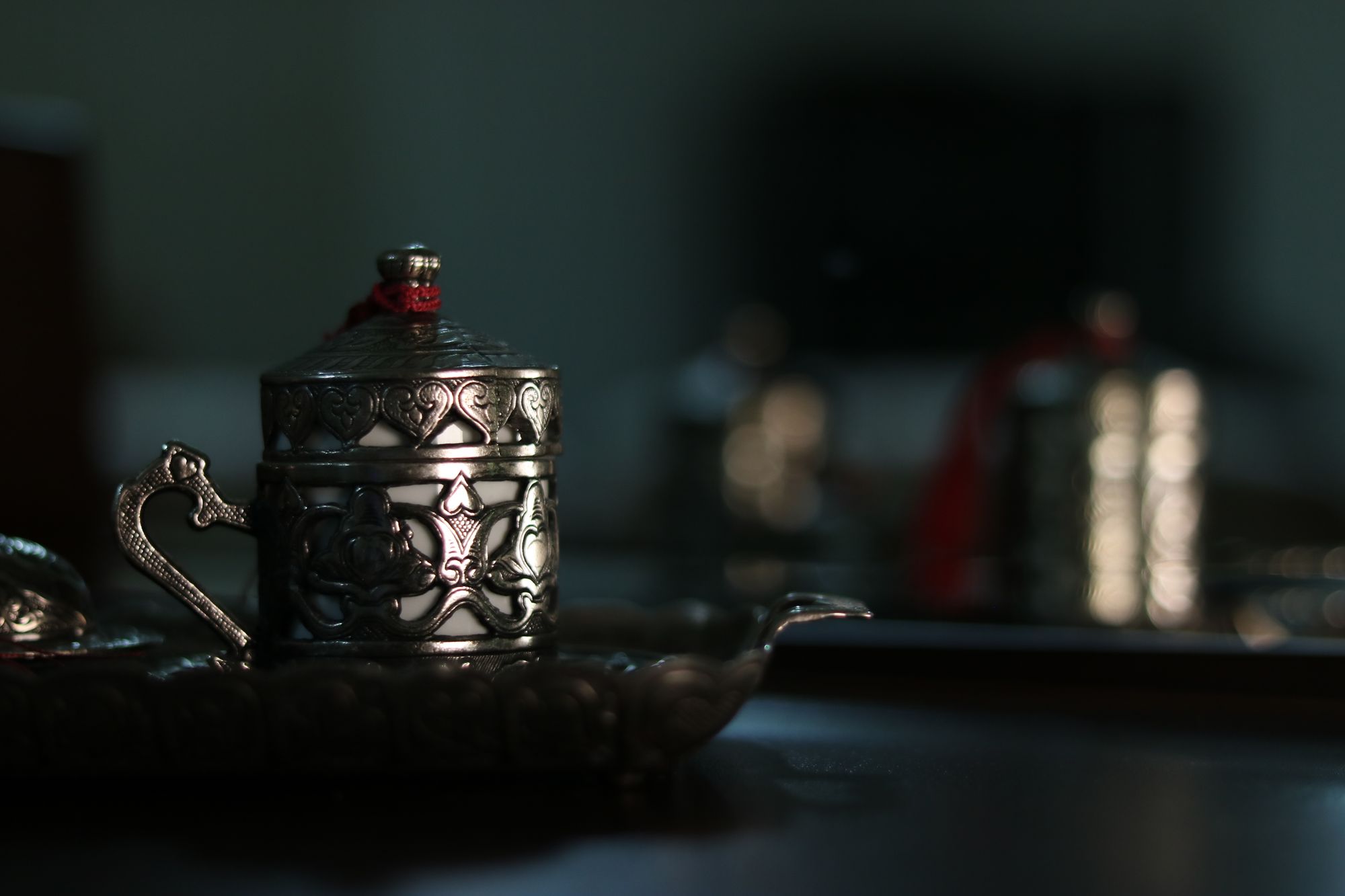
The principle is clearest in the metalwork. A silver service by the workshop avoids the overdone pomp of historicism and instead focuses on clear geometric fields, hammered surfaces, and a play of light and shadow in the engraving. The object does not boast. It shows its quality only to those who look closely – and that is exactly the tone good design still strikes today.
From Furniture to Door Handles
The workshop did not invent the term Gesamtkunstwerk (total work of art), but it made it livable. Instead of treating it as a sentimental theory, it translated it into floor plans, handles, and wardrobes. A Hoffmann interior is not a room into which you place beauty, but a fully composed whole in which the lamp, the chair, the hardware, and the glass speak the same language.
This idea has its price and its tension. Whoever designs everything leaves little room for the inhabitant. Some contemporaries found this too much control, a home as a work of art in which life is merely a guest. Yet precisely this radicalism is what makes it appealing. The workshop took seriously the idea that environment shapes us, that a person thinks and moves differently in harmonious spaces. It granted everyday life a dignity no one else gave it.
It was not the individual beautiful object that was the invention, but the demand that a style can be carried through consistently, from the house down to the spoon.
One must keep in mind that this claim worked against the market. Handcrafted work at this depth is expensive, small series are hard to justify financially, and a public that appreciates the difference is always smaller than one that reads only the price. The workshop never sugarcoated this conflict. It would rather make fewer things right than many mediocre ones. From today’s perspective, this was an astonishingly modern decision, long before anyone spoke of conscious consumption.
The Stoclet Palace as a Testimonial
When a single work embodies the whole idea, it is the Stoclet Palace in Brussels. Between 1905 and 1911, Hoffmann built a private house for the Belgian banker and collector Adolphe Stoclet, which is still regarded as the purest example of the Werkstätte’s total art. Here, for the first time, everything came together without regard for budget or convention: architecture, interior, garden, tableware, textiles, every door and every light switch from one hand.
The extraordinary aspect is the completeness. From the volume of the building to the fork on the table, everything follows the same line. Hoffmann could here demonstrate what happens when a design will finds no resistance. The result appears strict and sensual at the same time, cool in its geometry, warm in its materials. It is architecture that feels like furniture, and furniture that behaves like architecture.

The emotional center is not set by Hoffmann, but by Gustav Klimt. For the dining room, he designs a frieze that belongs to his most famous works from his golden period. The painter, the architect, and the craftsmen of the Werkstätte all work toward the same goal, and this is the real proof that the division between free and applied art could be overcome. In 2009, the Stoclet Palace becomes UNESCO World Heritage, a late, official confirmation of what the Werkstätte had claimed from the beginning.
Failure as Part of the Lesson
It would be a beautiful, smooth story if it ended here. It does not. In 1932, the Wiener Werkstätte is dissolved. The reasons are as obvious as bitter: A business model based on expensive craftsmanship, small quantities, and a wealthy clientele is not prepared for war, inflation, and the Great Depression. What had carried Vienna at the turn of the century collapses in the years of crisis.
This failure is not a flaw, but part of the lesson. The Werkstätte was never fully able to meet its economic times, because its aspirations went beyond what could be calculated. For almost three decades, it worked against the logic of mass production and set a standard that outlasted commercial defeat. Some ideas are precisely valuable because they do not pay off immediately. They leave behind a benchmark against which later generations must measure themselves.
Today, the most significant collection of the Werkstätte is housed at MAK, the Austrian Museum of Applied Arts in Vienna. As you walk through the holdings, you see not only beautiful objects, but also the tangible proof of a thesis: that design concerns the entire living space and that the care you give to a building also belongs to the smallest object.
The Thread That Runs Through Modern Luxury Design
The real reason the Wiener Werkstätte is more than just a chapter in art history today lies in its method. It demonstrated that a brand, a house, or an atelier can maintain a distinct visual thread across all its products. This is precisely the core concept behind any serious luxury design today. You recognize a consistent house not by its logo, but by the fact that the watch, the bag, the chair, and the store all share the same design DNA.
This idea of harmony across materials and categories is the Werkstätte’s quiet legacy. When a fashion house aligns its cuts, fabrics, architecture, and window displays, or when a furniture maker exudes the same sense of calm from the hinges to the catalog, a Viennese idea from 1903 is at work there, whether consciously or not. The difference between mere merchandise and true design lies exactly in this discipline.
There is a second thread that leads into the present. The Werkstätte defined quality not through gloss, but through care, material, and longevity. A hammered piece of silver ages differently than a cast one; a handwoven fabric wears differently than a printed one. This appreciation for things that endure and improve over time is more relevant today than ever before. Anyone looking for a piece to keep rather than replace is essentially thinking the way they did in Vienna over a hundred years ago.
In the end, an almost defiant realization remains. The Werkstätte failed economically but became immortal in terms of design. It lost where money was concerned, and won where standards were set. The next time you stand before an object whose design language holds up down to the smallest detail, and you sense that someone truly thought of everything here, you are hearing an echo from Vienna. Quiet, but unmistakable.
Frequently Asked Questions
▸Why is the Wiener Werkstätte considered the cradle of modern design?
Because it was one of the first to assert the claim that good design applies to every object, from buildings to cutlery, and that a style can be consistently maintained across all categories. This idea of harmony across furniture, metalwork, textiles, and architecture remains the core of any serious understanding of design to this day.
▸Who founded the Wiener Werkstätte?
It was founded in Vienna in 1903 by Josef Hoffmann, Koloman Moser, and Fritz Waerndorfer. Hoffmann and Moser brought a dual design talent in architecture and graphics, while Waerndorfer provided the capital. The entire endeavor was inspired by the Vienna Secession, which began in 1897.
▸What makes the Stoclet Palace so special?
The Stoclet Palace in Brussels, built by Hoffmann between 1905 and 1911, is considered the Werkstätte’s purest Gesamtkunstwerk. Here, everything follows the same line, from the architecture and the garden to the tableware, complemented by a famous frieze by Gustav Klimt. It has been a UNESCO World Heritage site since 2009.
▸Where can I see works by the Wiener Werkstätte today?
The most significant collection is housed in the MAK, the Museum of Applied Arts in Vienna. There, you can trace the entire spectrum, from furniture and metalwork to jewelry, textiles, ceramics, and graphic design.


