The Jaguar E-Type: Lines That Belong in MoMA
Beyond horsepower, the E-Type invites endless debate. More intriguing is why this car landed in the design collection of an art museum – and what that reveals about form, proportion and drag.

 //DRIVE
Beyond horsepower, the E-Type invites endless debate. More intriguing is why this car landed in the design collection of an art museum – and what that reveals about form, proportion and drag.
Some cars are judged by their performance; the Jaguar E-Type is judged by something else entirely. You can reel off its specs-the inline-six, the later V12, the Coventry years – but the moment you stand in front of one, the numbers fade. The eye locks onto that long, flat bonnet, that single line that almost kisses the ground at the front and tapers serenely to the rear. It is precisely this line that earned the E-Type its place in a museum of art.
You can write about the E-Type as you would a sculpture-no exaggeration, just the classification the car has earned. Its story is the rare tale of an everyday object that stopped being merely transport and became something else. To understand it is to start at the surface: the line, the airflow, the proportions. The mechanics come later. Few cars put this hierarchy in such sharp relief.
The debut took place at the Geneva Motor Show in March 1961, and, by Jaguar’s own account, the impact was immediate. The car on display didn’t look like a logical next step; it looked like a rupture. Rivals were building sports cars with upright stances, exposed mechanics and sharp edges. The E-Type lay flat on the road as though someone had set it in the slipstream and let it set.
That impression wasn’t happenstance. Behind it stood Malcolm Sayer, an aerodynamicist whose roots were in aircraft design. Sayer didn’t think in aesthetics; he thought in airflows. He calculated bodies that offered the least resistance and translated that logic from racing to the street. The E-Type’s beauty is therefore not mere styling. It is the visible outcome of a technical problem solved cleanly.
This is the point where the E-Type rises above the usual sports-car fare. A shape designed merely to please ages with the taste of its era. A shape dictated by physical necessity ages more gracefully because necessity endures. Air behaves today as it did in 1961. That is why the E-Type’s line still feels right, while many flamboyant designs of the same vintage now read as museum pieces in the wrong sense-old rather than timeless.
Anyone approaching the E-Type first approaches its bonnet. It is absurdly long, almost unreasonably long, and it carries that gentle curve that defines the entire car. Beneath it sits the real reason for the length: the XK inline-six, a long, heavy engine that needs space. What appears to be a purely design-driven gesture-the endless front-thus has a mechanical core. Here, beauty follows form, not the other way around.

This engine came from a Jaguar tradition that had earned its spurs in long-distance racing. By the time of the E-Type, the XK six-cylinder was no experiment, but a mature, proven powerplant. It began with 3.8 litres of displacement, later grew to 4.2 litres, and with the third series came the big leap: a V12. That one and the same body line could accommodate both the slender six-cylinder and the wide twelve-cylinder for nearly a decade and a half speaks volumes about the generosity of the basic design.
Yet it would be a mistake to reduce the E-Type to its powertrains. The figures are solid, but they are not the reason for the myth. Other manufacturers built faster or quicker cars in those years. What the E-Type could do-and most others could not-was combine speed, elegance and a price that did not render the whole thing utterly unattainable. It brought a kind of desirability onto the road that had previously been reserved for a handful of hand-built exotics.
Other cars of the era were faster. None looked so much like speed, even at a standstill.
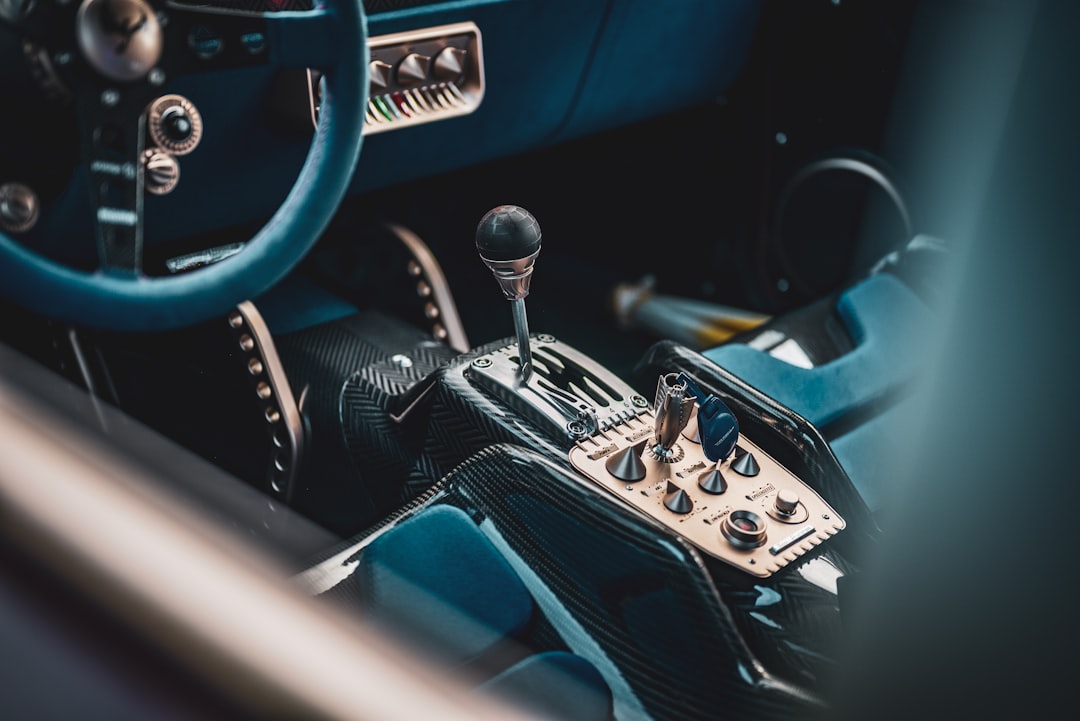
Climb inside and it becomes clear this car hails from another time-and a good one at that. In front of the driver sits a wooden steering wheel, behind it a row of round, easily read instruments, and in the centre the little leaping cat on the horn button. Nothing in this cockpit tries to impress. It simply works, with a matter-of-fact ease that today’s screen-filled landscapes lack.
The defining sentence about the E-Type isn’t a technical one. It goes like this: a 1963 example belongs to the design collection of the Museum of Modern Art in New York. That’s more than a footnote. When an art museum places a Picasso beside a Charles Eames chair, it isn’t merely adding a pretty car to its holdings. It’s making a statement about what counts as design of lasting significance. The E-Type stands there not as a fast car, but as a successful object.

What qualifies a car for such a collection? Not market value-otherwise the priciest cars in the world would fill the galleries. The test is whether a design distills a principle to its essence. The E-Type distills the principle that function, pursued uncompromisingly, can generate its own beauty. The line follows the air, the bonnet follows the engine, the proportions follow the task. Out of pure necessities emerges something you simply enjoy looking at, with no ulterior motive.
This recognition by the art world has given the E-Type a dual existence. On the road it remains a car you can-and should-drive, complete with the quirks of a classic that demands care and rewards patience. In the museum it becomes proof that industrial design can rise to the level of painting or architecture. Both readings coexist without contradiction; they complement each other, and that very tension is what keeps the car eternally fascinating.
There’s an anecdote as inseparable from the E-Type as its bonnet and its steering wheel. Enzo Ferrari is said to have called it the most beautiful car in the world. The quote isn’t documented, it’s attributed to Ferrari, and it probably sounds too neat to be true. Yet the story’s persistence speaks volumes. We’re willing to believe the sentence. Even those who suspect it’s apocryphal rarely dispute its sentiment.
In the end, what remains is a car whose importance doesn’t derive from a spec sheet, but from an idea: the idea that a road car can embody the discipline of a race car and the composure of good form at once. Coventry built this car for fourteen years, across three series, with shifting engines, and the line endured it all. When you stand before an E-Type today, you don’t see an old car. You see a solution so right it never needed improving.
A museum sees it as a piece of design of lasting significance – not merely a means of transport. What matters is not market value, but whether a design clearly embodies a principle. With the E-Type, that principle is the idea that a form rigorously developed from function and aerodynamics possesses its own, enduring beauty. That’s precisely why a 1963 example belongs to the design collection of the Museum of Modern Art in New York.
According to Jaguar, its debut took place in March 1961 at the Geneva Motor Show. The presentation remains one of the most impactful sports-car introductions of its era because the car looked dramatically more advanced than the competition.
At launch, the XK inline-six displaced 3.8 litres; it later grew to 4.2 litres. The third series introduced a V12. That the same body could accommodate everything from a lithe six-cylinder to a burly twelve-cylinder underscores how generously the original design was conceived.
Built in Coventry from 1961 to 1975 across Series 1, 2 and 3, the E-Type rolled off the line for fourteen years. During that time, engines, details and regulations evolved, yet the fundamental line remained unmistakably the same.
Perhaps the most honest way to meet the E-Type is not through top speed or auction prices, but through its long bonnet and the single, unbroken line beneath. An aerodynamicist laid it into the wind, a six-cylinder filled it, and a museum consecrated it. What remains is a car that became beautiful because it had to work.