Route Notes: Graubünden to Valais
The Glacier Express: Slowness Is the Whole Point
Why the slowest express route in the Alps isn’t a design flaw, but the entire point of the journey.

 Slow Travel
Why the slowest express route in the Alps isn’t a design flaw, but the entire point of the journey.
There are trains that want to get rid of you as quickly as possible. And then there is this one, which intends to do exactly the opposite. The Glacier Express takes eight hours to cover a distance a car could manage in significantly less time, and that is no engineering oversight. It is the whole point.
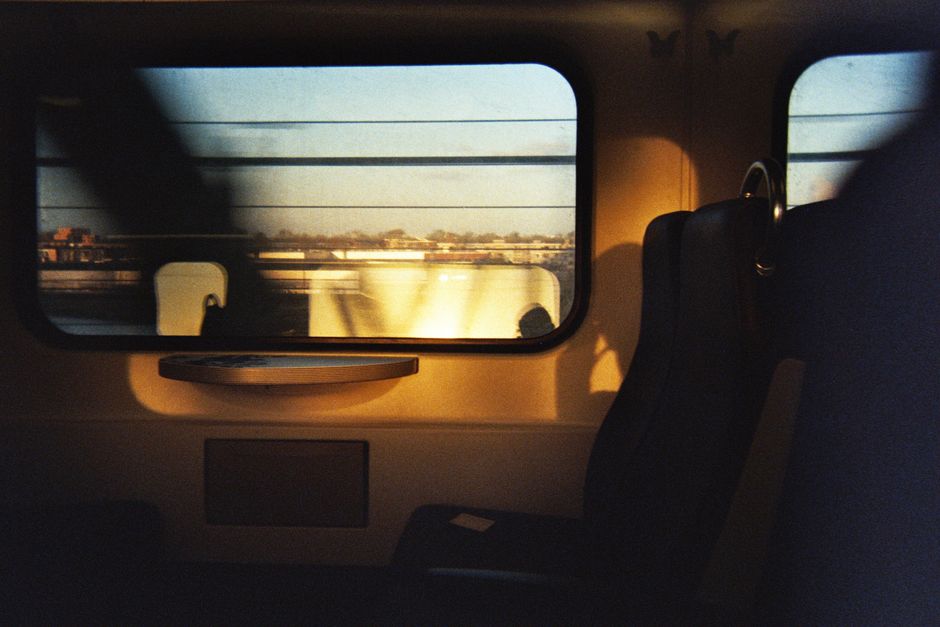
I board in St. Moritz, just after the morning light, which has a distinct sharpness here in the Engadin. The air smells of snow and of coffee from the dining car, and on the platform stands a train that makes no pretense of being in a hurry. You notice it immediately. The windows are larger than those on a regular train, curving up into the vaulted ceiling of the carriage, and that is exactly where you will be looking for the next few hours, time and again, almost against your will.
They call it the slowest express train in the world, and while the phrase sounds like an advertising slogan, it is remarkably precise. It’s an express train because it crosses the great Alpine valleys and connects two worlds: the cosmopolitan Engadin and the Matterhorn region of Valais. It’s slow because it takes its time with everything in between. Both are true simultaneously, and this contradiction holds the entire appeal. You don’t board to arrive. You board to be en route, and that is a distinction you only truly grasp on this journey.
Slow Travel sounds like an invention of recent years, a reaction to too many budget flights and too little patience. The Glacier Express refutes this with dates. Its first train ran on 25 June 1930, at a time when speed was actually the great promise of every new technology. While records were being celebrated elsewhere, a connection was forged here whose purpose was never speed, but rather reaching places that were previously difficult to access.
The continuous journey only became possible shortly before, with the connecting line between Visp and Brig, which opened on 6 June 1930 and closed the final gap. A few weeks later, the first through train rolled out. You have to keep this in mind: for decades, engineers had worked their way forward valley by valley, until finally a single line connected two worlds that are geographically close yet separated by mountains.
Knowing this changes how you ride. You aren’t sitting in an event train that has invented a tradition for itself, but on a route that has had a clear mission for nearly a century: to connect two remote Alpine regions through terrain that must have driven every engineer to despair. That changes the view from the window. What you see isn’t a backdrop, but a consequence. Every curve, every tunnel is an answer to a question posed by the mountain.
The numbers of this route are one thing, its impact another. On the journey from St. Moritz to Zermatt, the train crosses 291 bridges and passes through 91 tunnels. Its highest point is the Oberalp Pass at 2033 meters, an altitude where vegetation thins and light sharpens. You don’t sense this pass height as a date on a sign, but in the landscape that opens above and closes below.
What impresses me most about this route is the rhythm. A viaduct, then a tunnel, then light, then a valley, then rock again. The train breathes to this rhythm, and after a while, you breathe with it. It’s not a standstill, but rather a slow progression through images, each one worth stopping for yet none allowing a pause. That’s precisely what makes it so strangely beautiful. You can’t hold onto anything, so you learn to look.
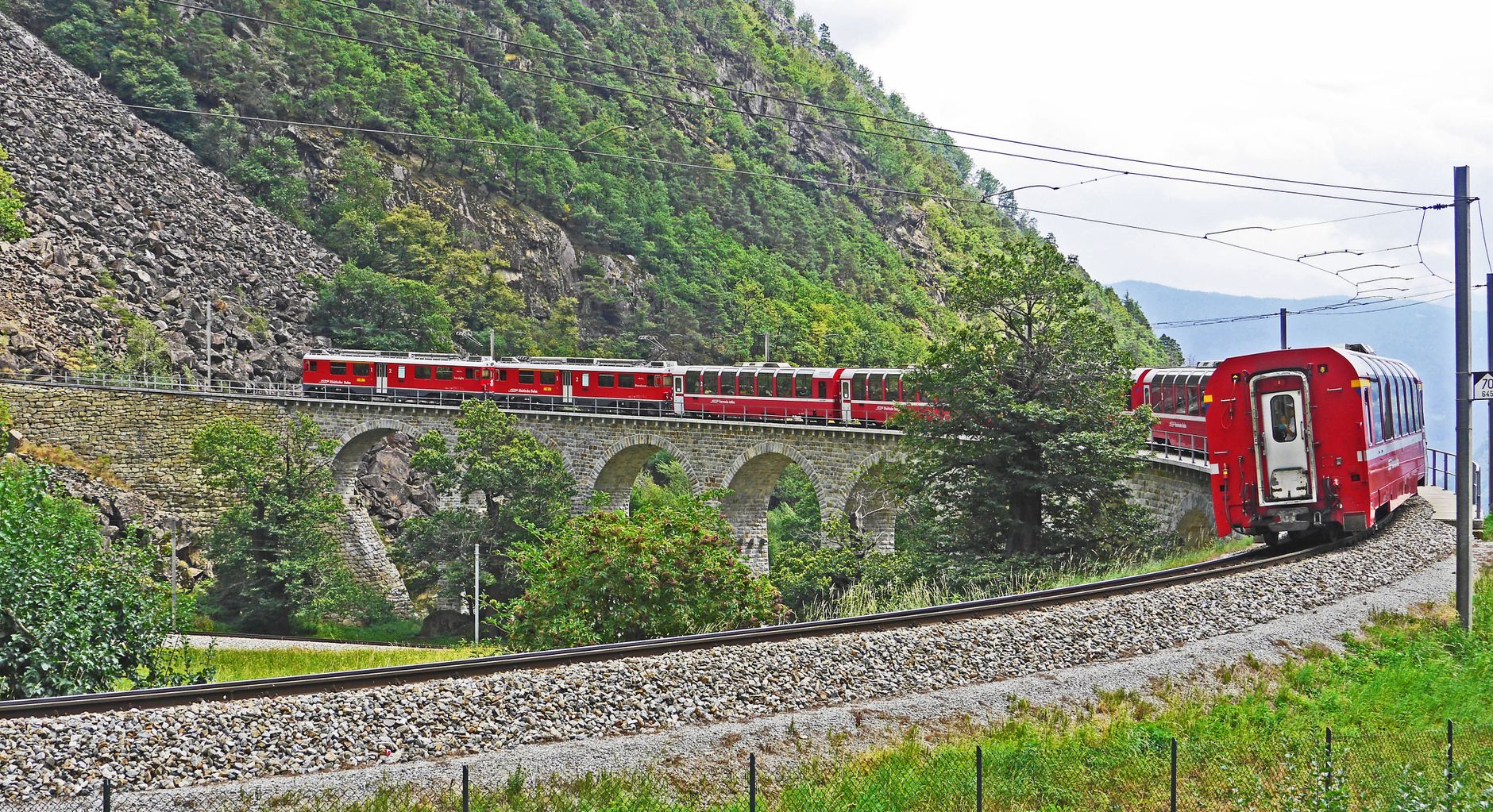
The bridges are more than just crossings. When the train stands on a high viaduct, suspended for a few seconds above a valley, your sense of balance shifts briefly. You sit warm behind glass while rock falls away beneath you. It’s not fear, but rather a moment of pause. In these moments, it becomes clear what it meant to build this line. No one constructs 291 bridges for convenience, but because there was no easier path.
Yet there’s no heroism here, just quiet stubbornness. The route takes the detour when the detour is the only way, doing so without fanfare. Perhaps that’s the true luxury of this journey: that no one celebrates the effort embedded in every meter.
The Rhythm of the Journey
You can’t hold onto anything here, so you learn to look again.
The allure of this journey also lies in the contrast between the two endpoints. St. Moritz in the Engadin is cosmopolitan, polished, a place that has welcomed guests wanting to make an impression for generations. Zermatt in Valais at the other end thrives on a single, unmistakable mountain and the silence surrounding it. Between them lie valleys that are neither one nor the other-simply Switzerland in cross-section, from polished surfaces to barren highlands.

This very span makes the route so complete. You start in one world and arrive in another without ever transferring, without moving your luggage. The train handles all the logistics that usually fragment travel. What remains is an unbroken view for eight hours, through a country slowly transforming outside your window.
Along the way, the dining car brings warm meals, and this too belongs to the pace. On a slow journey, you don’t eat on the side. You take your time, look up, set down your fork because something’s happening outside. Anyone who’s traveled this way understands why people journey by train even when they could go faster. It’s not hunger being satisfied here, but a particular kind of attention.
Behind the Glacier Express are two companies: the Rhaetian Railway and the Matterhorn Gotthard Railway. The official train category is Panorama Express, and the name is not a marketing phrase but a description. The train is built to showcase the landscape, not to devour distance. The high windows, the smooth ride, the timed service – everything serves that same purpose.
That two railways share a continuous line is invisible in everyday operation yet crucial. It means this route has never belonged to just one region but has always been a joint project, from Graubünden to Valais. On the train itself, you notice nothing of that, and that is precisely the art. You sit continuously, look continuously, and the engineering behind it all stays discreetly in the background.
It is this unobtrusiveness that makes the difference. A good hotel never lets you feel how much work goes into a quiet evening. A good train works the same way. The handovers between the railways, the timetable, the maintenance – all run behind the scenes so that you, up front, have only one thing to do: look out the window.
For a long time, this journey was a summer affair. That changed in 1982 with the opening of the Furka Base Tunnel. Since then, continuous operation has been possible year-round, even when the old mountain route lies under snow. For you as a traveler, that means you can cross the Alps in winter without a snowed-in summit cutting the connection.
Winter is, in any case, the most honest season for this route. When the Engadin lies deep in snow and the valleys fall silent, the railway shows what it was made for. It keeps a line open that would otherwise be closed for months. That is not a romantic claim – it is infrastructure, and it becomes more beautiful the rougher it gets outside. The snow-covered version has its own dignity. Colors recede; everything becomes white, rock, and the deep red of the cars – and suddenly very little is enough to see a great deal.
Travel today is mostly about getting from one point to another. You want to go from A to B, and everything in between is lost time, to be filled with screens. The Glacier Express turns that logic around. Here, the in-between is the real destination, and A and B are just the bookends. Eight hours sounds like a lot – until you have experienced them. After that, they sound exactly right.
You do not need to book anything you do not need. There are more comfortable and more expensive classes, and they have their appeal. But the landscape that carries this journey reaches you in every class through the same large window. The mountain does not ask for your ticket. What counts is that you give yourself those eight hours and do not see them as a punishment but as what they are: a rare permission to be slow.
At the end, when the train enters the Mattertal and Zermatt draws closer, it is not the arrival that lingers. It is that one moment somewhere on the pass summit when you stopped looking at the clock. That is what you take with you, long after you have stepped off.
Yes. The route itself is the star, and it remains the same in every class: 291 bridges, 91 tunnels, the Oberalp Pass at 2,033 meters, plus the large panoramic windows. Higher classes offer more comfort and service, but you get the view of the Alps through the same window in standard class. If you’re traveling for the scenery, you miss nothing essential without premium cars.
The continuous journey from St. Moritz to Zermatt takes eight hours. Both directions show the same route, just with reversed drama. Starting from St. Moritz, you begin in glamorous Engadin and end at the Matterhorn Wallis. If you want to experience Zermatt as the climax, choose this direction.
Yes, year-round. Since the opening of the Furka Base Tunnel in 1982, continuous operation has been possible even in winter, when the old pass route would be closed. The snowy variant is considered by many to be the most impressive, as the valleys are particularly still and clear then.
The Glacier Express is jointly operated by two railways: Rhaetian Railway in the east and Matterhorn Gotthard Railway in the west. The official train category is Panorama Express. The continuous connection became possible in 1930 after the opening of the route between Visp and Brig.