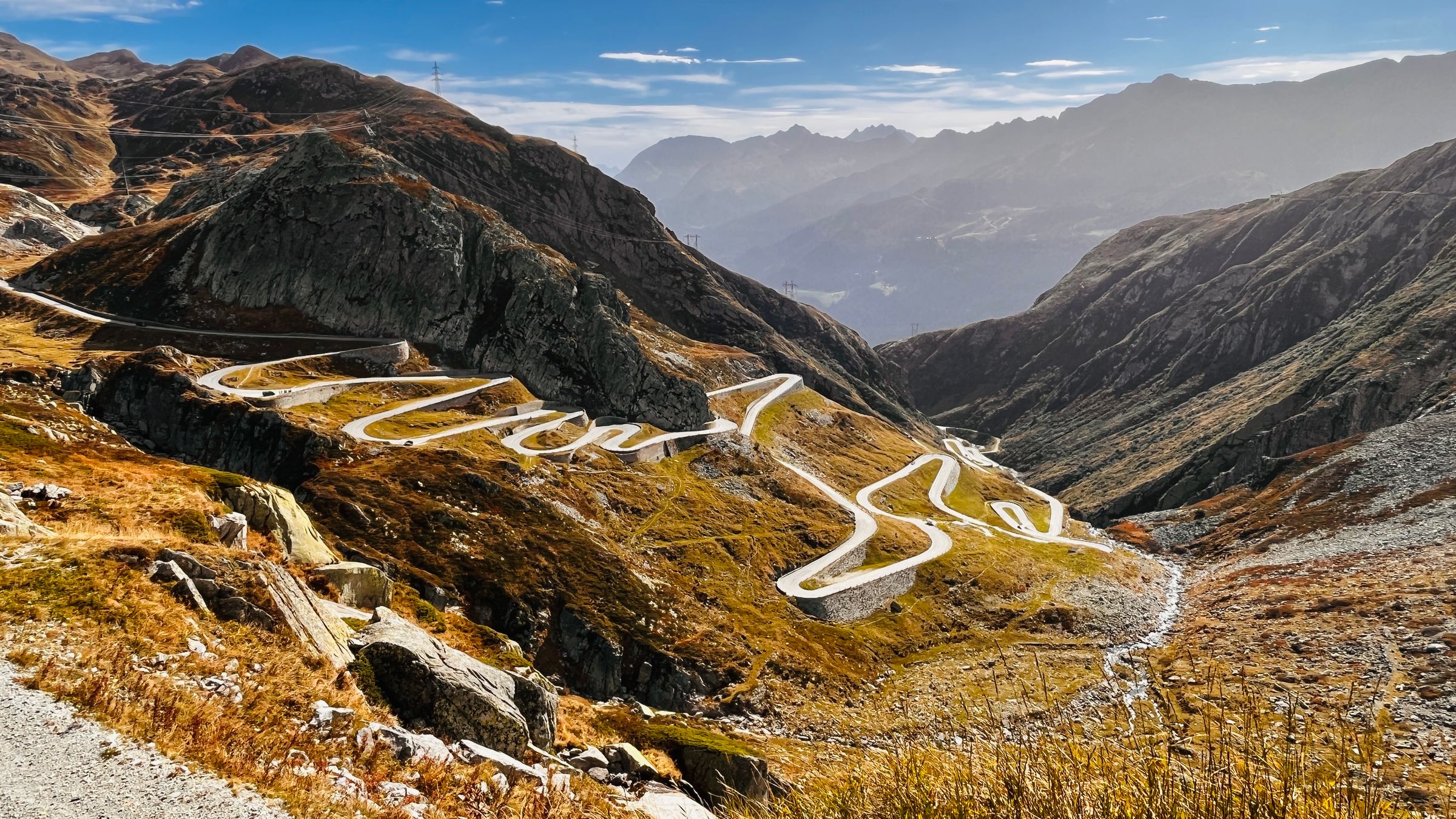
No racetrack hype, no lap-time obsession. This road measures itself in hairpins, in elevation gain, and in the way the air grows thin at the summit. An imperial route that still does exactly what it was built for.
There are passes you cross because the valley beyond calls to you. And then there’s the Stelvio Pass, which you drive because the road itself is the destination. Forty-eight numbered hairpins on the South Tyrolean side, a sign at each one keeping count, and finally a ridge where the air sits differently in your lungs than down in the Vinschgau. You could reduce it to a toll and a view. But you’d miss the point entirely.
Quick Facts
The pass sits at 2.757 meters and, according to Wikipedia, is the highest mountain pass in Italy accessible by paved road.
The roughly 50-kilometer road was built between 1820 and 1825 in the Austrian Empire under the direction of Carlo Donegani.
The South Tyrolean ramp from Prad is 27,5 kilometers long and features 48 numbered hairpins.
The pass area has been part of the Stelvio Pass National Park since 1935.
The road is generally passable from late May to November; the rest of the year belongs to the snow.
Most mountain roads are a compromise between two places that want to be connected. The Stelvio Pass is more of a statement: proof that you can lay a road where there’s really only rock, scree, and a vast sky. It links the South Tyrolean Vinschgau in the north with the Lombard Valtellina in the south, and it does so in a way that never feels purely utilitarian. Anyone driving up here realizes within minutes that this route was never designed for haste. It’s built for those who set aside half a day for it and never regret it.
An imperial line, laid into the mountain over five years
The road was built between 1820 and 1825, in the Austrian Empire, under the direction of engineer Carlo Donegani. Five years to create a drivable connection of about fifty kilometers across one of the highest Alpine passes. You have to imagine this without the machines that are taken for granted today. No hydraulic excavators, no modern blasting techniques, no weather forecast that deserved the name. Instead, hands, black powder, pack animals, and planning that had to work with the mountain, not against it.
What was created was not just a utilitarian structure that happened to be beautiful. It was a deliberately drawn line that followed the slope rather than cutting through it brutally. You can still feel this in every single curve today. The route from back then still dictates how you drive, where you turn, when you can accelerate again. Two-hundred-year-old engineering art that meets you at the steering wheel as a very tangible presence.
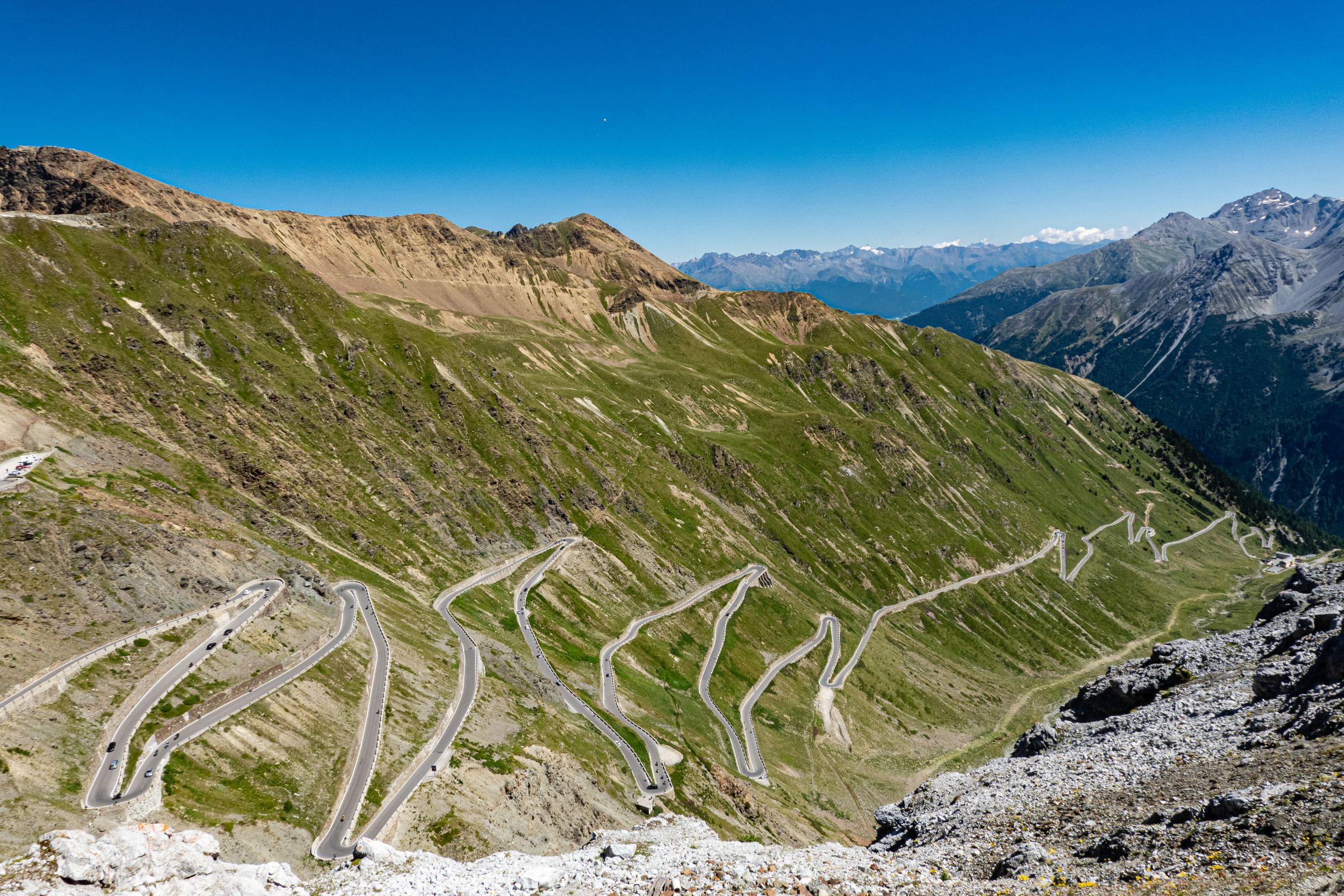
On the South Tyrolean side, at the Prad ramp, this line is most impressively visible. Seven and a half kilometers, forty-eight numbered curves, each with its own small sign. At first, this sounds like statistics, but behind the wheel, it translates into something very physical. You end up counting them whether you want to or not. Curve thirty, curve thirty-one, and with each number, not only does the road rise, but so does the feeling of being part of something bigger than your own drive.
From above, what disappears in detail while driving becomes visible: how the road loops along the slope rather than confronting it head-on. Image source: Pexels / Abdelhaq Naggay.
The northern side, descending toward Prad and into the Vinschgau, is the more famous, the photographed, the one you have in mind when someone mentions Stilfser Joch. But the pass has two faces, and the second, the descent toward Bormio and into the Valtellina, is just as impressive. It’s simply less staged. Those who drive both sides in one day understand the transition between two worlds better than any map could explain: here, the German-speaking north with its apple orchards far below, there, the Italian south with a different light, a different tone.
The Mechanics of a Summer Drive
A drive over the Stilfser Joch is a ritual, and rituals have a fixed sequence. It begins with the season, for this road is not a permanent offering. Usually, it is open between late May and November, the rest of the year belongs to the snow. Already, this makes every drive something limited. You cannot simply head up in February on a whim. You have to wait until the season reopens, and this waiting is part of the allure.
Then the start at the valley bottom. Down in the Vinschgau, it is often warm, almost southern, harmless. You set off and know that this will not last. With each gained altitude meter, the air changes. It becomes thinner, clearer, cooler. The vegetation shifts, from orchards to larches to alpine meadows to bare rock. And eventually, at 2,757 meters at the pass height, you stand in a world that has nothing more to do with the warm valley from earlier. Up here, even in high summer, snow can lie, and it is completely normal to put on the jacket you thought unnecessary down below.
The pass height itself is no quiet place, which belongs to the honesty of this story. Above, motorbikes, racing bikes, campers and everything in between gather, along with stalls, flags and the smell of bratwurst in thin mountain air. It is a strange mix of alpine grandeur and fairground atmosphere, and one must decide whether it bothers or amuses them. It amuses me. This road was never a secret tip, it was always a stage, and it stands open to its own audience.
This road does not want to be conquered. It wants to be driven, slowly enough to understand it.
Exactly this commotion makes the contrast to the approach only noticeable. Below, you quietly count your curves, above you are suddenly greeted by a small crowd, and both belong to the same day. Anyone who expects the Stilfser Joch only as a lonely mountain idyll experiences a more honest, purer version of it, and that is not worse, just different.
Anyone who wants to enjoy the height knows the trick that every pass driver knows: come early, on a weekday, outside the big holiday weeks. In the first week of July, it is already hopeless, for according to Wikipedia, hundreds of motorcyclists gather here annually for an international meeting. That is its own spectacle, a pilgrimage on two wheels, and those who want to experience it ride exactly then. Those who seek empty curves ride exactly then not.
What makes the drive at the end is the sum of all these things, not a single highlight. It is putting on the jacket at the summit, even though you were sweating down below. It is the smell of cold mountain air and warm asphalt in the same curve. It is the hand on the steering wheel, which after the thirtieth bend knows how much lean the next one needs before the head has decided. All of this is in no data sheet and cannot be replaced by any drone shot. You have to drive it.
Exactly in this repetition lies the allure that no single shot can capture. Each of the numbered bends is the same as the next and yet never quite the same, sometimes tighter, sometimes with oncoming traffic, sometimes with a view that makes you briefly forget to shift. It is this mixture of routine and surprise that separates a mountain drive from an autobahn leg.
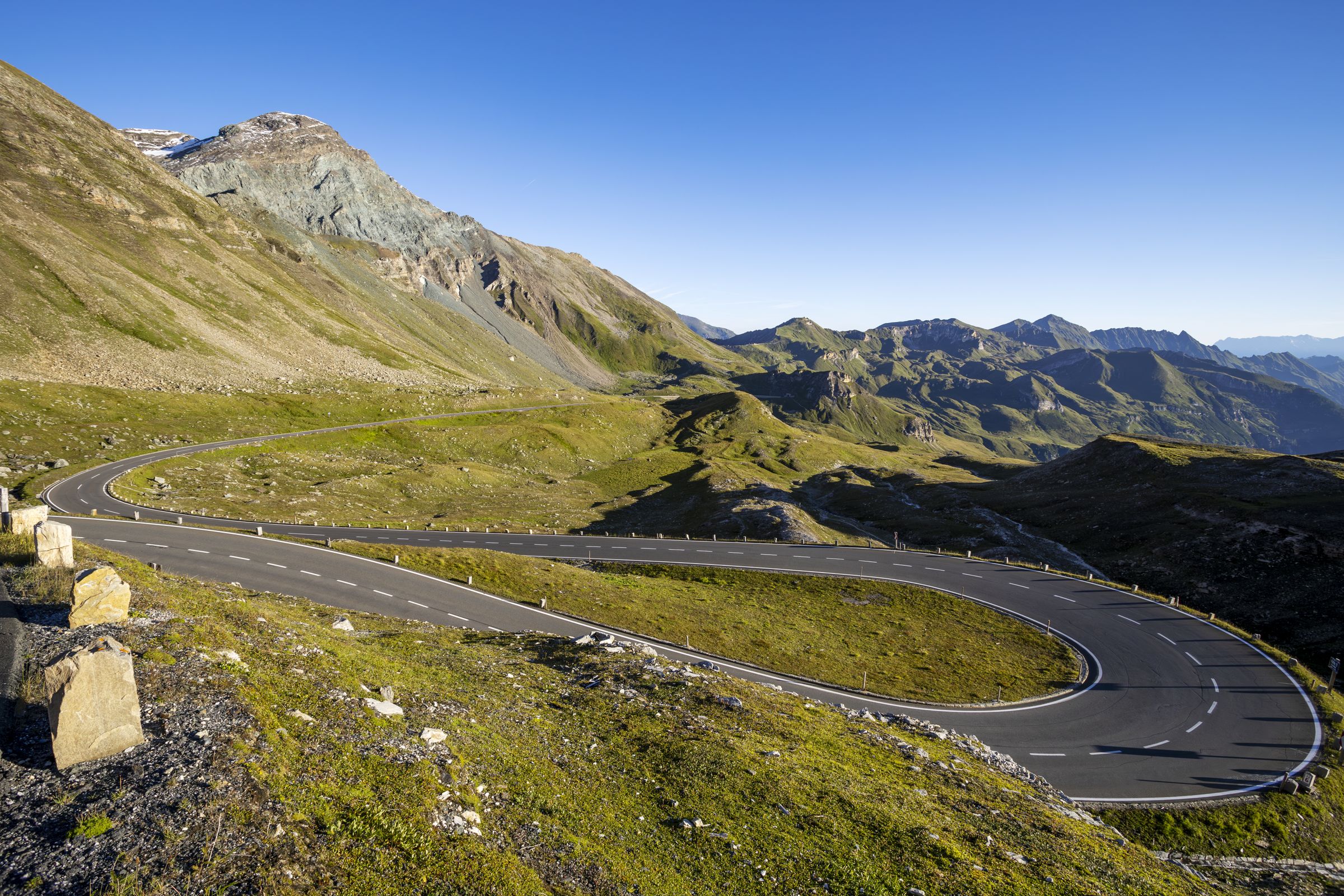
In detail, the tight curve remains the scale of this drive: small radii, light stones along the edge as waymarkers, beyond that immediately the terrain. Image source: Pexels / Alan Kabeš.
A pass that became a protected area
There is a difference between a road that cuts through a landscape and one that is an integral part of a protected whole. The Stelvio Pass belongs to the latter category. The pass area has been part of the Stelvio National Park since 1935, one of the largest protected areas in the Alps. This changes how you drive here, or at least it should. You are not moving through just any backdrop, but through a space that is protected because it is worth preserving.
This aligns perfectly with what this road is at its core. It is not just a strip of asphalt you consume and forget. It is a two-hundred-year-old structure set in a protected high-alpine landscape, and together they create a route that demands more than just a lead foot and courage. It demands that you yield to it-to its pace, its altitude, and its weather. Those who do are not simply driving over a mountain pass. They are driving through a piece of history that never intended to be merely functional, and still isn’t today.
The Details
▸When is the Stelvio Pass expected to open in 2026?
There are never any firm guarantees with a high-alpine road, because ultimately, the snow decides. As a rule, however, the Stelvio Pass is passable between late May and November, remaining closed during the winter. The same seasonal window is expected for 2026, depending on snow conditions and weather. Anyone planning to drive should schedule their trip within this timeframe and keep an eye on the latest opening updates.
▸How many hairpin turns does the South Tyrolean ramp really have?
Forty-eight, and they are numbered. The ramp from Prad is 27.5 kilometers long and winds through 48 numbered hairpin turns, each with its own sign. This makes the ascent from this side so unmistakable: you can count them as you drive, and that is exactly what most people end up doing.
▸Why is the Stelvio Pass considered such a special mountain pass?
Because several factors come together. The pass summit sits at 2,757 meters and, according to Wikipedia, is the highest mountain pass in Italy accessible by a paved road. Then there is its age: the road was built between 1820 and 1825 in the Austrian Empire under Carlo Donegani. Altitude, history, and the protected location within the national park combine to create a route that stands out significantly from ordinary mountain roads.
▸When is the pass busiest?
During the first week of July. According to Wikipedia, hundreds of motorcyclists gather here every year for an international meet, turning the pass summit into a two-wheeled pilgrimage site. Those who want to experience this come exactly then. Those seeking empty hairpins and peace and quiet avoid this week, preferring to drive early on a weekday outside the peak holiday season.
In the end, a drive over the Stelvio Pass rarely leaves you with a single image, but rather a feeling in your forearms and the back of your neck. The chill at the summit, the glance back at the stacked hairpin turns, the rhythm of steering that keeps playing in your head long after you are back in the warm valley. That is exactly why this road is not just a mere connection between Vinschgau and Valtellina. It is one you drive and keep with you.
Image source: Cover image: Pexels / Jose Rodriguez Ortega. Additional images: Pexels / Abdelhaq Naggay, Pexels / Alan Kabeš.

 //DRIVE