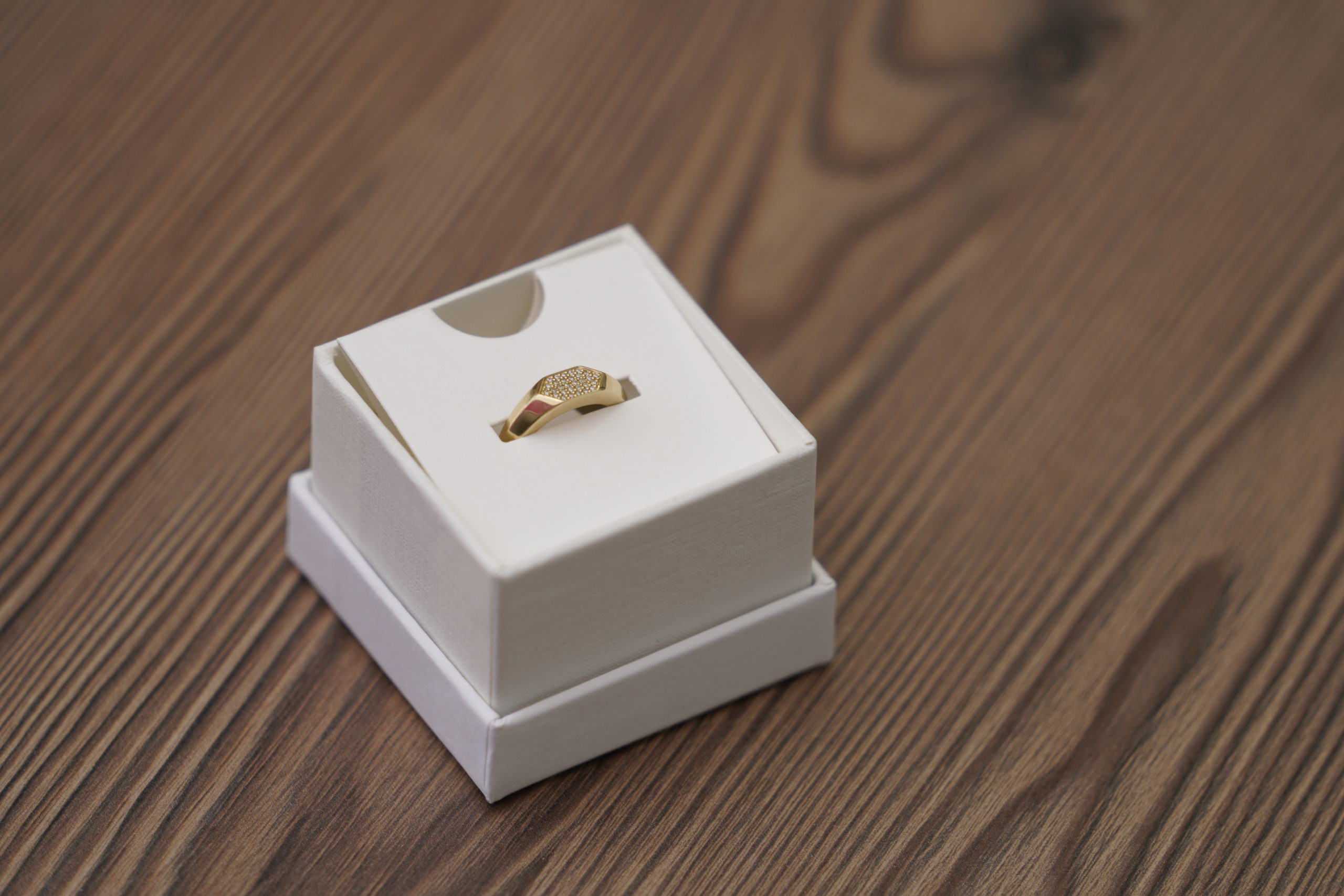
The Signet Ring: Initials Instead of a Logo
The signet ring is back, quietly, without the frat-boy aura. Not as a fashion accessory, but as a personal piece with a long history. On material, engraving, and the proportions of a statement that needs no volume.
There’s jewelry that demands to be explained immediately. And there’s jewelry that waits until someone looks closely. The signet ring belongs to the second category. From a distance it’s just a golden band. Up close, the flat engraved surface reveals itself, the true heart of the piece, along with a story deeper than any passing trend.
- The origins of the signet ring trace back to around 3500 BCE in Mesopotamia, where cylindrical seals were rolled over wet clay
- Classic motifs are cut as intaglio in reverse, so the impression in wax appears legible to the viewer
- A signet ring is not the same as a pinky ring: it’s defined by the flat, seal-like engraved surface, not the finger it adorns
A Ring That Once Was a Signature
Before the signet ring became jewelry, it was a tool. Its origins reach back to around 3500 BCE: in Mesopotamia, cylindrical seals were rolled over wet clay before the seal stone migrated onto the finger as a ring. The ring authenticated, it identified, it replaced the handwritten signature.
In the 14th century, King Edward II decreed that official documents had to be signed with the royal signet ring. At the time, the ring was considered more authentic than a handwritten mark. That also explains why, in the Middle Ages, many signet rings were destroyed upon the death of their wearer, to prevent forgeries. The ring was a unique identity medium, not a disposable accessory.
Why the Engraving Sits Upside Down
The most beautiful detail of a classic signet ring is only visible when it’s used. The motif is cut as an intaglio, engraved in reverse into the surface. The reason is functional: only then does the impression in wax or clay appear upright and legible to the viewer. The ring on the finger shows the mirror image; the impression reveals the truth.
This logic is at the core of what makes a true signet ring different from a mere pinky ring. A pinky ring is simply any ring worn on the little finger. A signet ring is defined by its flat engraved surface capable of producing an impression. That’s not a label, it’s a construction.

Material Built to Last
A signet ring is a piece meant to be kept. Accordingly, the material matters. During the European Renaissance, demand for personalized signet rings surged among the rising merchant class: traders, craftsmen, and landowners had initials, seals, or guild symbols engraved. In ancient Rome, senators wore gold rings as insignia of office, while those of lower status wore iron. Later, carnelian, garnet, and agate became popular seal stones.
Today the spectrum ranges from simple yellow, white, or rose gold to colored stones. Parisian maison Victor Mayer, for instance, crafts classic chevalières with an oval lapis-lazuli stone measuring 12 by 9.5 millimetres, set in 18-karat yellow gold, topped with an intaglio engraving that functions like a tiny, unyielding canvas. The dimensions may sound technical, yet they decide whether a ring feels right on the finger or clumsy.
The ring on the finger shows the mirror image. The impression in wax shows the truth. That’s where the ancient intelligence of this piece resides.
Heirloom, Not Trend
The signet ring is experiencing a quiet renaissance in the present day. It is being worn again, from classic family crests to minimalist initials, by men and women alike. Despite an overall decline in men’s jewellery, it remains one of the most popular ring styles for contemporary wearers, alongside wedding bands and college rings.
The key lies in the tone in which it is worn. A signet ring does not function as a loud statement but as a subtle reference. King Charles III’s Prince of Wales signet ring, crafted from Welsh gold and worn on the little finger of his left hand for 64 years, was passed to Prince William when he became Prince of Wales in 2022. A ring that sits on the same finger for decades and is then handed down tells a story no logo ever could: that something endures.
Proportion Over Prestige
Anyone acquiring a signet ring should prioritise proportion over symbolism. The engraved surface must suit the hand, the material the daily routine, and the motif the wearer. A family crest is beautiful if it is authentic. A simple initial is more honest than an invented emblem. Traditionally, the crest faces the wearer, not outward, but this is a custom, not a rule.
There are places where the weight of such pieces can be felt physically. In the Metropolitan Museum of Art, Byzantine gold signet rings from 900–1300 bearing Greek inscriptions rest in quiet display. Viewing them quickly reveals that their purpose was never ostentation, but permanence. A good signet ring is not jewellery for one evening, but for the next several decades.
Quick Answers
▸What distinguishes a signet ring from a pinky ring?
A pinky ring is any ring worn on the little finger. A signet ring is defined by its flat, seal-like engraved surface capable of leaving an impression in wax. The finger is secondary; the surface is the essence.
▸Why is the engraving cut in reverse?
Classic signet rings carry their motif as an intaglio in mirror image. Only then does the wax or clay impression appear upright and legible to the viewer. The ring shows the reflection; the impression shows the result.
▸Which material works best for a signet ring?
Traditionally gold, in yellow, white or rose hues, often paired with engravable stones such as carnelian, garnet, agate or lapis lazuli. What matters most is that the surface and proportions suit the hand and the piece can be worn for years to come.
Image source: Cover image and article images Pexels.