
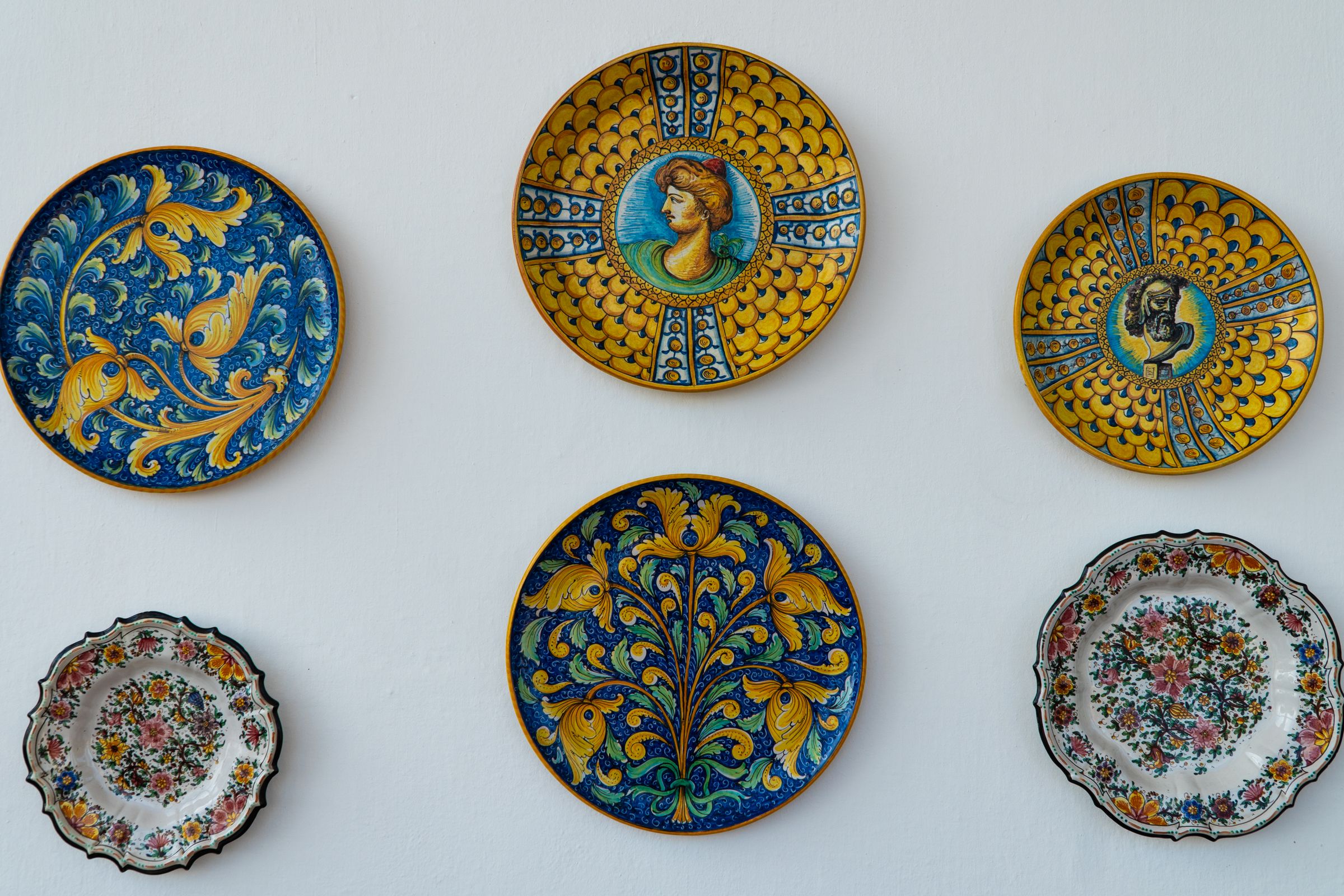
Renaissance Maiolica: Why It Still Captivates
June 20, 2026
Some things only reveal their true nature when you get close enough. A painted Renaissance plate is one of them. From two meters away, it’s bright and pretty. From thirty centimeters, it becomes something else entirely: a brushstroke set into wet, chalky glaze more than four hundred years ago, with no room for correction. It’s this irreversibility that keeps maiolica on display in glass cases and commanding top prices at auction.
- What it means: In art-historical terms, colorful painted tin-glazed Italian ceramics from the 15th and 16th centuries.
- Where the name comes from: It traces back to the Spanish term obra de málica for goods from Málaga.
- The technique: opaque white tin glaze over the first firing, then four high-temperature colors, followed by a second firing that fuses glaze and pigment.
- Why it endures: Apothecary jars, ceremonial plates, and painted scenes turn these pieces into tangible design history in collections and museums today.
I like objects that don’t hide how they were made. Maiolica is one of them. It’s never just tableware and never just decoration; it’s a frozen work step. Once you grasp how narrow the window for painting was, every old plate reads differently. It’s the difference between an object you own and one you read.
This isn’t a catalog and it isn’t buying advice. It’s an attempt to show you why a particular kind of fired clay made the leap from pharmacy shelf to palace table to museum vitrine – and why it belongs there.
What Maiolica Strictly Means
The word is often used loosely for any brightly painted ceramics. Art historians keep it precise. They mean the colorful, tin-glazed Italian ceramics of the 15th and 16th centuries. That time and place aren’t pedantry; they mark a brief, intense flowering separate from everything that came later under the same name.
The name itself reveals the origin of the confusion. It derives from the Spanish obra de málica-goods from Málaga. Through trade, metallic-shimmering Spanish imports reached Italy, and the name traveled with them. Only there, in Italian workshops, did the imports become a distinct genre with its own visual language.
Crucial to these Italian beginnings were imports from Islamic Spain that arrived in Italy from the 13th century onward. Without that precedent and the technique of opaque white glaze, the later pictorial painting on plates and bowls could never have existed. The Renaissance didn’t invent from nothing; it took what was already there and drove it into a new art form.
From Vessel to Picture Carrier: the Istoriato
The real leap forward in Italian workshops was a conceptual one. They no longer treated the glazed surface as the surface of an everyday object, but as a canvas. This narrative painting bears the name Istoriato, from storia, meaning history. On the mirror of a plate, an entire scene unfolds: mythological subjects, biblical episodes, ancient battles, riders, architecture, landscapes.

This demanded a different kind of painter. Workshops in Urbino, Castel Durante, and Faenza employed people who worked with templates from printmaking, often after engravings of famous compositions. The plate thus became a vehicle for education and taste. Whoever displayed it showed not merely wealth, but erudition. That is a subtle yet decisive difference, and it explains why these pieces ended up in princely collections rather than being worn out in daily use.
Not every workshop painted alike. Deruta became known for its warm, often golden-yellow luster, a second, tricky firing stage with metal oxides that rarely succeeded. Faenza even gave the entire genre its European name: from the place name came the word faience. Whoever distinguishes between the centers can read on a plate where and roughly when it was made.
The Four Colors and the Single Moment
Technically, maiolica is a high-wire act. The shaped clay body first undergoes a bisque firing. It is then coated with an opaque white tin glaze, a mixture that turns a covering white during firing and conceals the reddish shard. This white surface is the ground on which painting begins, before anything is fired.
Painting was done with four overglaze colors that withstand the high firing temperature: copper green, antimony yellow, cobalt blue, and manganese violet. The chemistry of high-temperature firing allows little else, and it is precisely this limitation that shapes the unmistakable tone of the pieces. The palette is limited, yet the effect remains rich because the painters learned to say much with little.
The critical moment is the application of color itself. The pigments are set onto the still-unfired, powdery glaze, which absorbs like blotting paper. A stroke too hesitant blurs, a misstep cannot be wiped away without damaging the glaze. There is no overpainting, no glazing, no second chance. In the subsequent glaze firing, glaze and colors fuse into a single glassy layer. What was once separate becomes one.
In the Fire
The painter works on a surface that absorbs like blotting paper. Every stroke either sets immediately or is wrong forever.
This condition changes everything. It explains the particular freshness of fine maiolica, a certain swiftness in the line that later, more cautiously made ceramics rarely achieve. And it explains the high reject rate that historical workshops had to endure. A failed firing could not be salvaged, only smashed.
Once you grasp this, you look at the seemingly naive painting with respect. What appears easy was high-risk. The appeal of these pieces lies not in perfection, but in the successful mastery of a process that brooks no mistakes.
Albarello Jars: Beauty Meets Function
Before majolica ended up in display cases, it had a job to do. A large share of production served the pharmacy trade. The most iconic vessel was the albarello-a cylindrical jar with a gentle waist in the middle. That indentation wasn’t decoration; it was ergonomics: you could still grip it when an entire shelf was packed tight with jars. Lids were usually tied on with parchment and twine, and the contents were identified on a painted band.
Inside these jars lay dried herbs, salves, electuaries, and theriac. The smooth, glassy interior stayed hygienic and odor-free-an advantage over unglazed, porous clay. Here, beauty and purpose merged. A well-stocked dispensary doubled as a calling card; the painted rows on the wall told the knowing customer, “This apothecary takes its craft seriously.”
The intimate link between healing and painted ceramics still resonates today. The German Pharmacy Museum in Heidelberg showcases prized majolica and faience from the 16th to 18th centuries, including pieces from the Betty-Rath bequest. There, the vessels aren’t displayed as art beside medicine; they’re shown for what they were: tools that also spoke.
What the Workshop Still Teaches
The historic centers haven’t vanished. In Deruta, Faenza, and other towns, artisans still follow the old methods-tin-glazing, high-fire colors, the same uncompromising firing cycle. This isn’t folklore; it’s the only way to create the distinctive surface that an industrial process can’t replicate.

For collectors, this continuity is an invaluable teacher. Once you’ve watched a hand guide a brush across the chalky surface, you spot the difference between skill and routine on an antique piece faster. The gesture can’t be faked. A confident, fluid line differs from one nervously retraced – and that difference survives centuries.
That closes the circle between past and present. The technique that produced the finest pieces in the 16th century is the same one that today separates honest craftsmanship from decorative mass-ware. Choosing to buy, keep, and care-rather than replace-isn’t nostalgia; it’s a vote for objects that endure because they demanded time to make.
These four steps lie behind every serious piece. They explain why a fine Renaissance plate isn’t a fluke but the outcome of a chain of decisions, each one capable of going wrong.
In the end, majolica proves that utility and beauty aren’t opposites. The pieces weren’t made for the display case; they ended up there because someone recognized that a pharmacy jar or a painted plate held more than function-history, craft, and a moment that can never be repeated.
Quick Clarification
▸What technically distinguishes art-historical maiolica from later European faience?
Both use an opaque white tin glaze over an earthenware body. Strictly speaking, maiolica refers to the colourfully painted, tin-glazed Italian ceramics of the 15th and 16th centuries, whereas faience is the broader term often applied to later Northern European production. The word “faience” itself derives from the Italian town of Faenza. Technically the kinship is close; the separation lies mainly in time, place and pictorial tradition.
▸Why could no mistake be made while painting?
Because the pigments were applied to the unfired, powdery tin glaze, which absorbed them like blotting paper. Once a stroke was laid down, it could not be wiped away or overpainted without damaging the glaze. Only the second firing fused glaze and colours into a single layer. This irreversibility explains both the freshness of fine pieces and the high reject rate in the workshops.
▸What is an albarello?
An albarello is a cylindrical pharmacy jar with a slightly indented waist. The narrowed middle made it easier to grasp from a crowded shelf. It was usually sealed with parchment and twine, and the contents were identified on a painted band. The glazed interior did not absorb odours, making the vessels ideal for herbs, ointments and medicines.
▸Where can one see historical maiolica in the original?
Painted apothecary ware is best viewed in the context of its function. The German Pharmacy Museum in Heidelberg, for example, displays important maiolicas and faiences from the 16th to 18th centuries, including holdings from the Betty Rath bequest. Such collections show how painted ceramics and medicine remained closely linked for centuries.


