
Murano: The Island That Made Glass an Obsession
20 June 2026
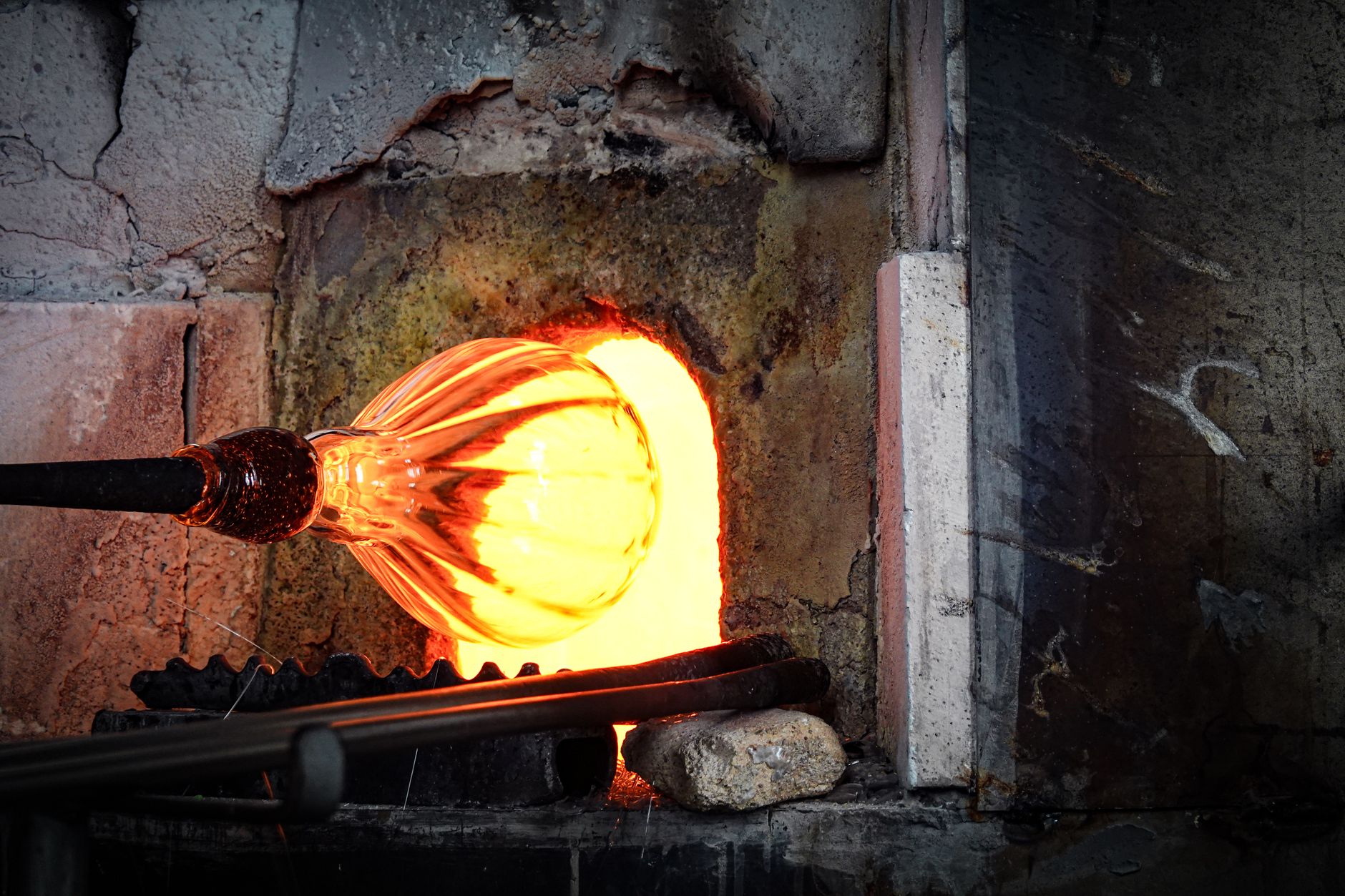
There’s a moment when molten, viscous paste suddenly becomes a shape. The blob clings to the end of the pipe, orange as liquid metal; the glassblower turns it, breathes into it, and for an instant it’s unclear whether this is craft or promise. That fleeting instant has made a tiny island in the Venetian lagoon famous for centuries – and it’s why Murano glass remains a collector’s obsession, not a souvenir.
- The Beginning: In 1291, all glass furnaces were moved from Venice to Murano island to reduce fire risk. A safety measure became the heart of glass art.
- The Depth: As early as 982, Dominicus Phiolarius is documented as Venice’s first master glassmaker. The tradition predates almost everything we now call luxury heritage.
- The Memory: The Museo del Vetro on Murano, founded in 1861, tells the story in seven chronological chapters from antiquity to today.
- The Collector’s Question: Authentic Murano is identified by technique, provenance, and craftsmanship – not by price or a stall-side keepsake.
Imagine Venice at the close of the 13th century: a city of wood, packed tight, canal to house to canal, with workshops where furnaces burned day and night at temperatures above 1,000 °C. It wasn’t a romantic picture; it was a tinderbox. In 1291 the Republic drew the logical conclusion and relocated every glass furnace to the nearby island of Murano. Officially the move was about fire safety. Unofficially it created a closed workshop where knowledge pooled, passed on, and stayed protected.
That concentration is the real reason behind the quality. When the finest glassmakers of a great power live and work within a few square kilometres, they rub shoulders, push each other, and guard their methods like family silver. Murano was never just a production site; it was a closed society of skill – and that’s exactly what still makes a piece from there more than blown glass.
A Venetian vault of craftsmanship
The depth of this tradition can be measured by a single figure. As early as 982, a glass master by the name of Dominicus Phiolarius is documented in Venice. We are not talking about a few centuries here, but an almost thousand-year-old, uninterrupted engagement with a single material. In today’s luxury market, the term “heritage” is often bandied about. Here, it is meant literally.
From this long lineage have emerged the techniques that collectors use to identify an authentic piece. Millefiori-“a thousand flowers”-assembles the finest glass rods into mosaic-like patterns so that tiny blossoms appear in cross-section. Sommerso layers colored glass so that a form seems to glow from within, one hue suspended in another. Latticino draws milky-white threads through clear glass, arranging them into spirals and nets so precise they look drawn rather than spun.
None of these techniques tolerates haste. They demand years at the blowpipe, an intuitive feel for temperature that cannot be written down, and the willingness to discard an almost-finished piece if it cracks in the final breath. That is precisely where the value lies. A Murano object carries not only color and shape, but the trace of a hand that knew when to stop.
How seriously the Republic took this knowledge is shown by the treatment of the masters themselves. The glassmakers of Murano enjoyed privileges denied other craftsmen, yet their expertise was forbidden to leave the lagoon. Whoever took the process away took a state secret with them. What began as a fire-safety measure became a guarded treasure, and it is this secrecy that explains why Venetian glass was long regarded as the benchmark across Europe. You could buy it, but you could not reproduce it-for a long time.

Standing in such a workshop once, you understand why it cannot be replicated industrially. The heat presses in from the sides, the blowpipe feels heavier than you expect, and every motion is precise because it has been repeated a thousand times. The colored rods on the bench are not decoration; they are half-finished stock, the vocabulary from which patterns will later be formed. Here it becomes visible that Murano is a system, not a trick: material, tool, furnace, and human interlock, and only in that interplay does what the island stands for emerge.
It is this very interplay that explains why the market today is split in two. On one side sits honest work in which each piece has consumed time, training, and risk. On the other is quick merchandise that borrows only the surface-the colorful look without the costly skill behind it. To the casual eye, both may look similar at first glance. To anyone who knows the processes, however, the gulf is vast, and reading that gap is the true art of collecting.
The cheap copy borrows the colorful look, not the costly skill, and it is this gap that the true art of collecting must read.
That second look can be learned. It rarely arrives in the first second of observation, but in the uniformity of a thread, the depth of a hue, the cleanliness of an edge, the weight in the hand. What cannot be abbreviated are the years of training embedded in an honest piece, and those, willingly or not, always show through.
How Craftsmanship Became a Museum Subject
That Murano glass is now considered art rather than mere trade owes much to a pivotal moment. In 1861, the Museo del Vetro was founded on the island, housed in the Palazzo Giustinian. Behind this initiative stood two figures: mayor Antonio Colleoni and abbot Vincenzo Zanetti. With this move, glass gained a place where it would be taken seriously, catalogued, and preserved.
A museum reframes how we see a material. What was once mere merchandise becomes a documented work, complete with provenance, dating, and context. In 1932, the collection was reorganized and expanded with glass objects from other Venetian collections. What had begun as a local display grew into a historical record tracing centuries of development. Collectors need precisely this kind of benchmark to contextualize their own pieces.
Today, the Museo del Vetro is part of the Fondazione Musei Civici di Venezia-MUVE for short-joining institutions like the Doge’s Palace and the Museo Correr. This is more than an administrative detail. It places island glass alongside the city’s greatest cultural treasures. Walking through its halls, visitors trace seven chronological chapters from antiquity to the present, confirming that Murano never stood still.
This sequence tells an unusual story. First, exile concentrates the craft. Then, over centuries, it forges its own language. Finally, society decides not merely to exploit this skill but to safeguard it. Collecting, in essence, is the private continuation of that decision: a piece deserves more than to be consumed.
What collectors look for: how value is decided
To a trained eye, Murano is not a single style but a vast landscape with clear tiers of quality. The first thing to assess is technique. A cleanly drawn lattice of latticino, a sommerso with genuine depth of colour, a millefiori whose petals are evenly spaced and sharply defined-these reveal the hand of a master. Uneven threads, murky transitions and sloppy cut edges reveal the opposite. The market contains both, and the gap between them is wide.
Equally important is provenance in the strictest sense. A piece that can be traced to a specific workshop, period or identifiable maker stands apart from anonymous stock. Here the fact that the tradition is so well documented pays off. Buyers can compare, classify and verify instead of buying blind. A museum visit is therefore not an afterthought; it is an education of the gaze.

Then there is the sobering part that serious collectors never skip: condition. Glass is both honest and unflinching. A hairline crack, a worn rim, a later-smoothed fracture can drastically alter a piece’s value even if the technique was flawless. When you hold an object, turn it to the light, run your fingers along the edges and check whether later interventions have rewritten its history. That care is not distrust; it is respect for what the piece once was and is meant to be.
What remains is the simplest and most honest test: how it feels in your hand. Good glass has the right weight, a surface that is not cloyingly slick, a colour that seems embedded rather than applied. It need not be expensive to be good. But it must be right. That is the difference between a souvenir you soon forget and a piece you keep because, every day the light falls on it, it feels a little more justified.
Perhaps that is the loveliest quality of this island art: it forces you to look closely and rewards you for doing so. Once you learn to take that second look, you are no longer collecting objects but skill. And without noticing, you join a line that began in a burning city at the end of the 13th century and still burns today at a furnace on Murano.
Quick Clarification
▸How can a collector distinguish authentic Murano glass from mass-produced tourist items?
It’s about technique, provenance, and craftsmanship – not price. A genuine piece features clean, even execution of classic methods like Millefiori, Sommerso, or Latticino, carries credible workshop or period attribution, and reveals depth of color, uniform threads, and satisfying weight on closer inspection. Mass-produced items usually fail on all three counts: uneven patterns, murky transitions, and sloppy edges.
▸Why did glassmaking end up on Murano instead of in Venice itself?
In 1291, to reduce fire risk in the densely built city, all glass furnaces were relocated to the nearby island of Murano. What began as a safety measure became the crucible where Venetian glass knowledge concentrated, evolved, and was guarded. Exile turned Murano into the true heart of Venetian glass art.
▸How far back does the Venetian glass tradition actually go?
Very far. The first documented Venetian glass master, Dominicus Phiolarius, appears in records as early as 982. That places the craft’s roots nearly a thousand years before the 1291 move to Murano.
▸Where’s the best place to trace Murano glass history?
At Murano’s Museo del Vetro, the glass museum in the Palazzo Giustinian. Founded in 1861, reorganized in 1932, and expanded with additional Venetian holdings, it now belongs to the Fondazione Musei Civici di Venezia-alongside the Doge’s Palace and Museo Correr. Its seven chronological galleries span antiquity to today and train the eye every collector needs.


