
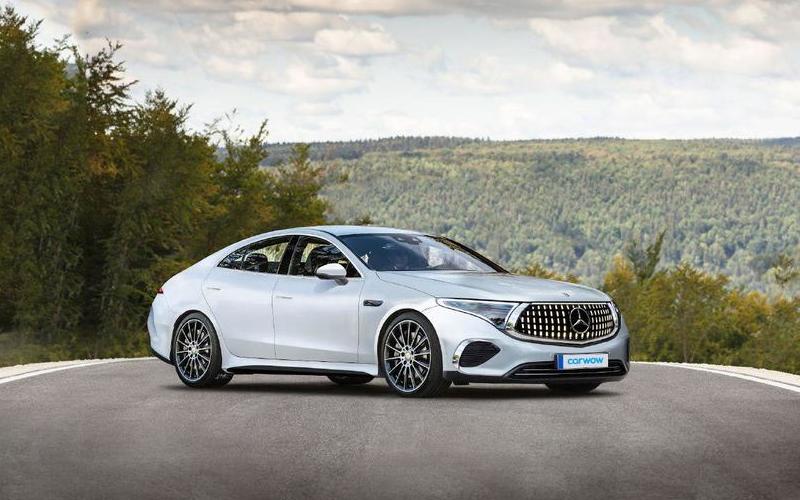
Mercedes EQS: What became of the luxury electric car planned for 2020
In 2019 we reported that Mercedes planned to launch an electric flagship model called EQS from 2020. Six years later, we now know what became of it, why the launch was delayed, and why the brand’s own design chief now believes the car arrived too early.
When we wrote about Mercedes’ plans for an electric flagship in summer 2019, the message was clear: from 2020, the EQS would arrive as the top model of an all-new electric family. Today, nearly seven years later, we don’t just know the car-we know its story: a delayed launch, record-setting range, mixed sales figures, and a design chief who openly admits the car arrived too soon. Here’s what became of the vision.
- Planned for 2020, unveiled in April 2021, delivered from August 2021. The EQS arrived a year later than promised.
- Not an electric S-Class, but a standalone flagship on a dedicated electric platform with up to 770 kilometres WLTP range.
- Signature feature: the Hyperscreen, a seamless 141-centimetre glass surface spanning the entire dashboard.
- Launch price from just under €98,000, AMG top model beyond €152,000.
- In 2026 a brand-new generation arrives with 800-volt architecture and up to 926 kilometres range, market launch early 2027.
The original briefing was crystal clear. Michael Kelz, then head of EQ development, told us in 2019 that the car would sit at the level of an S-Class but would not be an S-Class. That’s exactly what happened. The EQS shares neither platform nor body with the combustion S-Class. It rides on a bespoke electric architecture that later also underpinned the smaller EQE model.
Why 2020 Became 2021
The announced production start for 2020 simply couldn’t be met. Mercedes unveiled the production version only in April 2021, with deliveries beginning in August of the same year. A one-year delay for an all-new drivetrain and fresh platform isn’t surprising, but for a technology showcase flagship it sent a clear signal.
At launch, the EQS delivered exactly what had been promised for years: class-leading range. The base EQS 350 rolled in with a 90.6 kWh battery good for about 626 km, while the EQS 450+ with its 107.8 kWh pack reached up to 768 km under WLTP. At the time, those figures set a benchmark in the luxury segment and stayed there for a while. Early-2022 pricing started just under €98,000, while the AMG variant climbed past €152,000.
We will have an electric car that is undoubtedly on the level of an S-Class, but it will not be an S-Class.
The Hyperscreen and the Question of True Luxury
Inside, Mercedes staked everything on an idea that still defines the car today: the Hyperscreen. A seamless glass ribbon 141 cm wide stretches across the entire dashboard, merging three displays under a single pane. In 2021 that was a bold statement and helped position the EQS as a digital luxury sedan.
Yet the sense of space didn’t win over everyone. Many prospective buyers felt the pronounced One-Bow curve-despite the “S” badge-never quite matched the proportions or generosity of a classic S-Class. The EQS feels more like a giant liftback than a stately notchback limousine, and that perception shaped its sales trajectory.
Mixed Results and a Remarkable Admission
The big breakthrough never arrived. The EQS sold steadily, yet never matched the combustion S-Class at its peak. In 2025 the entire top-end Mercedes lineup-EQS sedan, EQS SUV and the classic S-Class models combined-delivered around 268,000 units, roughly 15 % of the group’s total sales. Overall Mercedes volume slipped about ten percent in the same year.
In July 2025 the truth came out. Mercedes’ design chief publicly conceded that the electric luxury sedan in its original form had arrived about ten years too soon. An unusually candid remark for an ongoing model, it explains why the next generation is steering a markedly different course.
What 2026 and 2027 Hold
Mercedes has already refreshed the EQS. The facelift brings a redesigned front end, an upright illuminated star on the hood and power domes on the bonnet-visual cues that pull the car closer to classic brand language.
The bigger leap comes next. For the next generation Mercedes promises an all-new 800-volt architecture that enables faster charging and more efficient energy management. The EQS 450+ is projected to hit up to 926 km WLTP range and charge at up to 350 kW, translating to roughly 320 km in ten minutes. The official unveiling is expected no sooner than mid-2026, with market launch in early 2027 and a starting price around €94,000.
What began as a 2019 vision has become a real car: technically impressive, commercially divisive. The real question is whether the next generation-with its more classical styling and record range-finally hits the audience the first EQS missed. If electric dreams steeped in heritage intrigue you, also check out the Bentley EXP 100 GT and its grand-touring vision for 2035, and how radically the Jaguar Type 00 in Miami Pink is redefining the luxury EV space.
The Details
▸When did the Mercedes EQS actually hit the market?
The original launch was planned for 2020. The production version was unveiled in April 2021, with deliveries beginning in August 2021. The initial timeline was therefore delayed by about a year.
▸Is the EQS an electric S-Class?
No. The EQS is built on its own dedicated electric platform and represents a standalone top model in the EQ lineup-not an electrified version of the existing S-Class. The former head of development made that distinction clear at the time.
▸How far can the EQS go on a single charge?
The first generation delivers up to around 770 kilometres according to WLTP, depending on the variant. The 2027 refresh featuring 800-volt architecture is expected to reach up to 926 kilometres.
▸What does the EQS cost?
At launch in early 2022, the entry price started at just under €98,000, with the AMG top trim exceeding €152,000. The upcoming generation is projected to begin at around €94,000.


