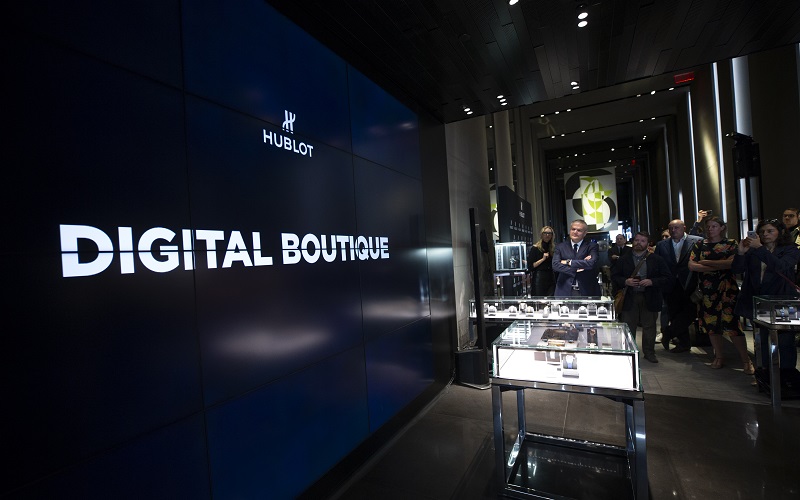
A New Shopping Experience with Hublot: The Digital Boutique
With the Digital Boutique, Hublot presents a novel online concept – personal service from New York’s Fifth Avenue straight to your living room!
In 2018, we reported on Hublot’s Digital Boutique, an online store concept featuring personal consultation from the boutique. What became of it? This article highlights an early attempt not just to sell luxury watches online, but to bring the conversation, presentation, and decision-making process into the digital space.
- Hublot aimed to combine real boutique consultation with an online store.
- Customers could contact sales associates in real time.
- Product presentations were conducted via FaceTime or Skype, regardless of distance from the boutique.
- The purchase was intended to be completed with a single click after careful consideration, in coordination with the boutique.
You don’t buy a watch like you do a charging cable
The original article formulated the core message very clearly: Buying a watch is an emotional process. Precisely because of this, a standard online shop was not enough for Hublot’s narrative. A luxury watch isn’t just added to a shopping cart. It is admired, explained, compared, sometimes desired, and sometimes put back. Trust lies between the customer and the brand.
The Digital Boutique was designed to transfer this relationship into the digital space. This may seem obvious today, but it remained challenging in 2018. Luxury thrives on proximity, materiality, weight, and that special moment on the wrist. If the customer isn’t standing in the boutique, the brand must find other ways to show attention.
Hublot opted for personal service from its New York 5th Avenue store directly into the living room. Even this image clarifies the goal. It wasn’t just any chat window or an anonymous product page, but a conversation with people who could demonstrate and explain the product live. The online store thus became less of a shelf and more of a stage.
The Digital Boutique was not an attempt to replace the physical boutique. It was an effort to preserve its attentiveness through the screen.
Digital thinking here was not cold
The text at the time spoke of fusing the real world with the digital one. The crucial aspect was not the technology itself. FaceTime and Skype were not mysterious tools. What mattered was that Hublot used them as a bridge. The customer should receive top-tier attention regardless of location or time, without ever sitting alone in front of a product page.
Through the website, customers could be connected in real-time with a staff member upon request. The watch was presented live, details discussed, and questions answered directly afterward. No immediate purchase was required. The customer had time to make a calm decision. Once made, the purchase could be confirmed with a click and finalized together with the boutique.
This calmness is vital. Especially with expensive items, digital pressure feels cheap. Countdowns, pop-ups, discount shouting: none of this fits a watch sold on trust. Hublot’s approach was quieter. It said: You can buy from afar, but you don’t have to feel abandoned. The boutique remains present, just differently.
Service is the actual luxury
The article quoted Hublot CEO Ricardo Guadalupe expressing his desire to show customers they matter to the brand on a very personal level. That quote carried the idea then. Because in the luxury segment, service is not an accessory. It is part of the product.
A watch can be technically impressive. It can have strong design. But if the buying process feels arbitrary, it loses something. Hublot wanted to close exactly this gap. The Digital Boutique shouldn’t pretend online is the same as in-store. It should combine the strengths of both spaces: digital availability and human advice.
The concept launched in the US according to the article and was intended to expand globally afterward. This sequence alone shows the ambition. First a controlled market, then the bigger stage. One senses this wasn’t about a simple shop relaunch, but a new form of customer relationship.
Today, reading the article feels like a preview of many later service models. But the more beautiful insight remains simpler: If a product requires explanation and emotion, the digital purchase must not be dry. It needs voice, gaze, patience. Exactly what Hublot aimed to deliver with the Digital Boutique.
What the online purchase must not lose
The interesting point about Hublot’s concept is balance. Digital comfort must not cause an expensive product to suddenly look like any ordinary item. A watch needs context: How does it look on the wrist? Which details only become apparent in conversation? Which questions arise when you look longer? The Digital Boutique was meant to open exactly this space.
This way, the screen was understood not as distance, but as a window. This is a beautiful thought, provided the advice remains truly personal. A video call doesn’t replace the weight of the watch in your hand, but it can remove initial uncertainty. It can show, explain, and slow down the purchase. For Hublot, this was the decisive point: being online without giving up the boutique character.
Why the Concept Aligned with Brand Identity
In the original text, Hublot is not portrayed as a quiet manufactory, but rather as a brand that integrates service and technology. The Digital Boutique therefore fit seamlessly into this positioning. It was not a sober substitute for the physical store, but another format to demonstrate attention to detail.
For customers, it was particularly important that distance did not equate to anonymity. Those living far from a boutique or lacking time for a visit should still be able to have a conversation. This is the true luxury of the idea: no need to travel everywhere, yet never buying alone.
The Idea Thrives on Trust
Especially since the customer cannot hold the watch in their own hands, advice must be precise. Every movement in the video, every detail on the case, and every answer regarding availability becomes part of the experience. Hublot’s Digital Boutique made this not a side issue, but the core of the concept.
Quick Answers
▸What Was Hublot’s Digital Boutique?
An online store concept where customers were connected in real-time with sales staff and watches were presented live.
▸How Did the Consultation Work?
According to the article, FaceTime or Skype could be used. Staff presented the product, answered questions, and guided the purchase process.
▸Why Was This Interesting for Luxury Watches?
Because buying a watch is an emotional decision. Hublot wanted to combine digital availability with personal advice, rather than sending customers through a shop alone.