Glaciers, Fjords & Volcanoes – The 5 Most Beautiful National Parks in New Zealand
Can an entire country be placed under nature protection? In the case of New Zealand, the answer seems almost obvious: vast stretches of the country are now part of national parks!
In 2023 we asked whether an entire country could be placed under nature protection. In the case of New Zealand, the answer feels almost self-evident: the national parks tell the story of a land of beaches, rainforests, glaciers, volcanoes, and fjords.
- New Zealand’s first national park was established in 1887 on the North Island, according to archival records.
- Abel Tasman is famed for its bays, golden beaches, ancient forests, and the 51-kilometre Coastal Track.
- Westland combines glaciers, rainforest, and ocean in a compact space.
- Tongariro, the country’s oldest national park, is also known as the filming location for Mordor.
- At 12,500 square kilometres, Fiordland is larger than all of Germany’s national parks combined.
Abel Tasman: the small park with the long view
New Zealand is described in the old text as a land of diversity: majestic mountains, lakes, rainforests, golden beaches. To ensure these landscapes do not become mere backdrops for ever-growing tourism, large parts of the country are protected. As early as 1887, the first national park was established on the North Island. The archival article selects five parks that together illustrate why New Zealand is such a draw for nature travelers.
The Abel Tasman National Park lies at the northern tip of the South Island. It is the country’s smallest national park, yet the old text makes it anything but insignificant. Countless coves, golden beaches, ancient trees, and a mild climate averaging 2,200 hours of sunshine a year give it an almost Mediterranean ease. It is named after Dutch explorer Abel Tasman, the first European to drop anchor in these waters.
Many visitors come for the 51-kilometer Abel Tasman Coastal Track, which can be hiked in multiple day stages. Those who prefer less strenuous travel can take a boat into one of the coves-hardly a poor choice. From the water, more than 70 native bird species can be spotted, from the white heron to the little blue penguin, as well as a colony of New Zealand fur seals.
New Zealand’s national parks are not lists of sights. They are five ways to slow down and look.
Westland and Tongariro: ice, rainforest, and volcano
The Westland National Park on the South Island’s west coast is, in the archival text, the place of short distances. Glaciers, rainforest, and sea lie just a few kilometers apart. The area spans roughly 1,300 square kilometers and includes the nearly 3,500-meter Mount Tasman. At its heart stands the Franz Josef Glacier, named after Emperor Franz Josef of Austria, though he had nothing to do with the natural wonder himself. A German surveyor bestowed the name in the 19th century.
A tour of the Franz Josef Glacier, including a helicopter flight, may be costly according to the old text, yet remains a powerful experience. That makes sense. It is not merely about standing on ice. It is about seeing a landscape where glacier, rainforest, and sea coexist. Such contrasts feel less like postcards and more like benchmarks.
The Tongariro National Park is the country’s oldest. Founded in 1887 on the initiative of a Māori chief, its volcanoes are still revered by the indigenous people as sacred sites. For fans of the Lord of the Rings film trilogy, the park holds a second, pop-culture layer: it served as the backdrop for Mordor, with Mount Ngaurhoe as Mount Doom.
The Tongariro Alpine Crossing ranks among New Zealand’s most popular hiking routes in the old article. Nearly 20 kilometers, roughly 1,000 meters of elevation gain, and about a day’s walking time. The “Alpine” qualifier is no joke. The old piece notes that up to 700 intrepid hikers set out each summer. Beauty here is not automatically comfortable.
Fiordland and Mount Cook: the grand gesture
The Fiordland National Park occupies the far southwest of the South Island and covers 12,500 square kilometers-larger than all of Germany’s national parks combined. It is shaped by 14 fjords, deep coastal inlets carved by glaciers over millennia. The most famous is Milford Sound.
Milford Sound is the only fjord reachable by car. According to the old text, this has spawned a tourist infrastructure-ferry terminal, airport, campground-in the middle of nowhere. Still, a boat tour through Milford Sound is, in the article, a must on any New Zealand trip. Rainforests, waterfalls, and dozing New Zealand fur seals provide ample reasons.
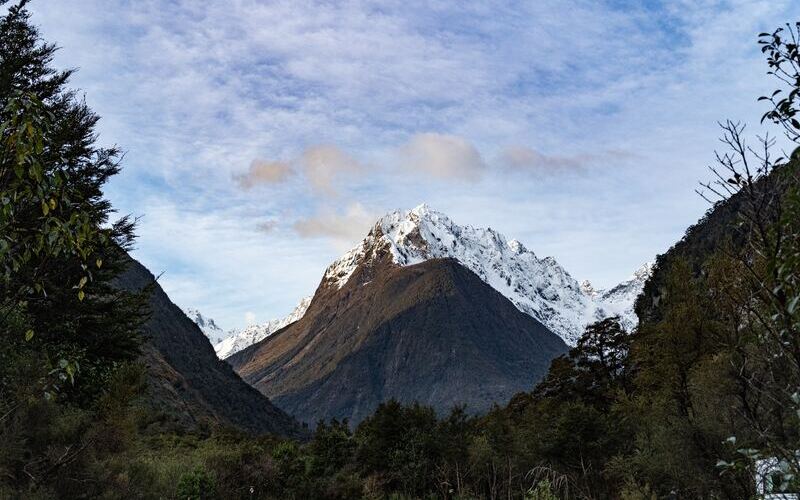
The Mount Cook National Park leads into the New Zealand Alps. Aoraki / Mount Cook, at 3,724 meters the country’s highest peak, towers over the park on the eastern side of the alpine divide. Roughly 40 percent of the area is covered by glaciers, and since 1986 the park has been a UNESCO World Heritage Site. Many routes begin at the Sir Edmund Hillary Alpine Centre, named for the conqueror of Mount Everest.
The ten-kilometer Hooker Valley Track crosses three suspension bridges to a glacial lake. This is exactly the kind of route New Zealand does so well: accessible enough to imagine, impressive enough not to mistake for a stroll. Words, the old text insists, barely suffice to describe the scenery. You have to see it. Sometimes that is not a cliché, but simply the limit of language.
Why These Five Parks Make Perfect Sense Together
The selection in this archived article is strong because it doesn’t just show five variations of the same landscape. Abel Tasman brings coast and light. Westland brings the juxtaposition of ice, forest, and sea. Tongariro brings volcano, myth, and cinematic history. Fjordland brings scale. Mount Cook brings altitude and glaciers. Together, they don’t form a ranking, but rather a small map of New Zealand’s natural diversity.
The way you travel changes from park to park as well. In Abel Tasman, you can hike or have a boat drop you into a secluded bay. In Westland, the glacier takes center stage, complete with the option of a helicopter flight. Tongariro demands stamina and respect for alpine terrain. In Milford Sound, you’re more likely sitting in a boat, taking it all in. On the Hooker Valley Track, you walk across suspension bridges toward a glacial lake. That’s five encounters with nature, each with a different mindset.
Perhaps that’s exactly why New Zealand feels so vast in stories like this. Not because everything is untouched, but because these protected spaces allow for such varied experiences. The article reminds us that national parks don’t just preserve-they also guide our gaze.
Good to Know
▸Which five national parks does the article mention?
Abel Tasman, Westland, Tongariro, Fjordland, and Mount Cook National Parks.
▸Which park is the oldest?
The Tongariro National Park, established in 1887 on the initiative of a Māori chief.
▸What’s special about the Abel Tasman Coastal Track?
It’s 51 kilometers long and can be hiked in multiple day stages.
▸Why is Fjordland so impressive?
The park covers 12,500 square kilometers, includes 14 fjords, and is larger than all of Germany’s national parks combined.