The fruit that ends up in the glass often hung on a tree no one planted to sell. Traditional orchards provide the produce the market doesn’t want, and it’s precisely from this that a distillate is crafted, tasting distinctly of its origin. A brief account of the spirit, the tree, and why they need each other.
It smells of warm copper, of mash, and of a day that began before sunrise. A thin, clear stream trickles from the spirit tube into the bowl-barely more than a trickle – and the distiller stands beside it, sniffing, tasting, waiting. What’s being made here has little to do with the label on a shelf. It’s hot, high-proof, and raw. And it comes from trees standing miles away from any plantation, on a meadow you might stroll past in spring for the blossoms, or in autumn for the windfall fruit lying in the grass.
Quick Facts
Fruit brandy is a spirit made from fermented and subsequently distilled fruits. The legal minimum alcohol content is 37.5% by volume.
The fruit used often comes from traditional orchards. It’s commercial produce, not flawless table fruit from a display case.
Right after distillation, the spirit often sits between 60 and 90% by volume. Only water brings it down to drinking strength.
The minimum alcohol content for fruit brandy is regulated at the European level, originally under EU Regulation 110/2008.
In Austria, Obstler is listed in the Register of Traditional Foods and must consist of at least 85% apples and pears.
I like this spirit because it’s honest. A good fruit brandy can’t fake anything. It has no barrel aging to mask a mediocre distillate, no color to feign depth, no caramel to pretend sweetness. It stands clear in the glass, and everything the fruit had to say must be present in that moment, or it’s gone forever. That makes it one of the most unvarnished products you’ll find at a good bar or in a distiller’s cabinet.
What Fruit Brandy Actually Is
The definition sounds dry, yet it’s revealing. Fruit brandy is a spirit produced from fermented and subsequently distilled fruits, with a legal minimum alcohol content of 37.5% by volume. In just a few words lies the entire dividing line between a serious spirit and a sweet liqueur. Fermented means the fruit sugar is first converted into alcohol by yeast. Distilled means the alcohol, along with its aromas, is drawn off from this mash. No extraction, no infusion, no post-distillation flavoring.
This minimum threshold isn’t set by a single distillery, but at the European level. The original foundation was EU Regulation 110/2008, which defines what many spirit categories must be to legally bear their names. So these 37.5% by volume aren’t a stylistic choice, but a baseline every fruit brandy must meet. Anything lower can’t call itself that.
The second, often underestimated part of the definition concerns the fruit’s origin. The fruit used to make a classic fruit brandy typically comes from traditional orchards and is rarely classified as table fruit. This isn’t a weakness, but its true appeal. Here, they don’t distill flawless, calibrated supermarket produce, but what grows on old, tall-trunked trees-fruit that would be too small, too crooked, or too spotted for a display shelf.
The Meadow That Makes the Brand Possible
A scatter orchard is not a fruit garden in the modern sense. The trees are scattered, spaced far apart, often in several varieties and age groups next to each other, and under them grows grass where animals sometimes graze. It has low yield and high input, and exactly for this reason it has been disappearing from the landscape for decades. What remains are remnants of a cultural form that almost incidentally belongs to the most species-rich habitats in Central Europe.
The fruit of these trees is economic fruit. It is not bred to look beautiful in the shell, but rather to provide juice, cider, and brandy. Exactly here a circle closes that makes the spirit interesting beyond its taste: whoever buys brandy made from scatter orchard fruit gives these trees an economic reason to remain standing. An elegant distillate from old varieties is thus also a quiet contribution to the fact that the meadow will bloom again next spring.
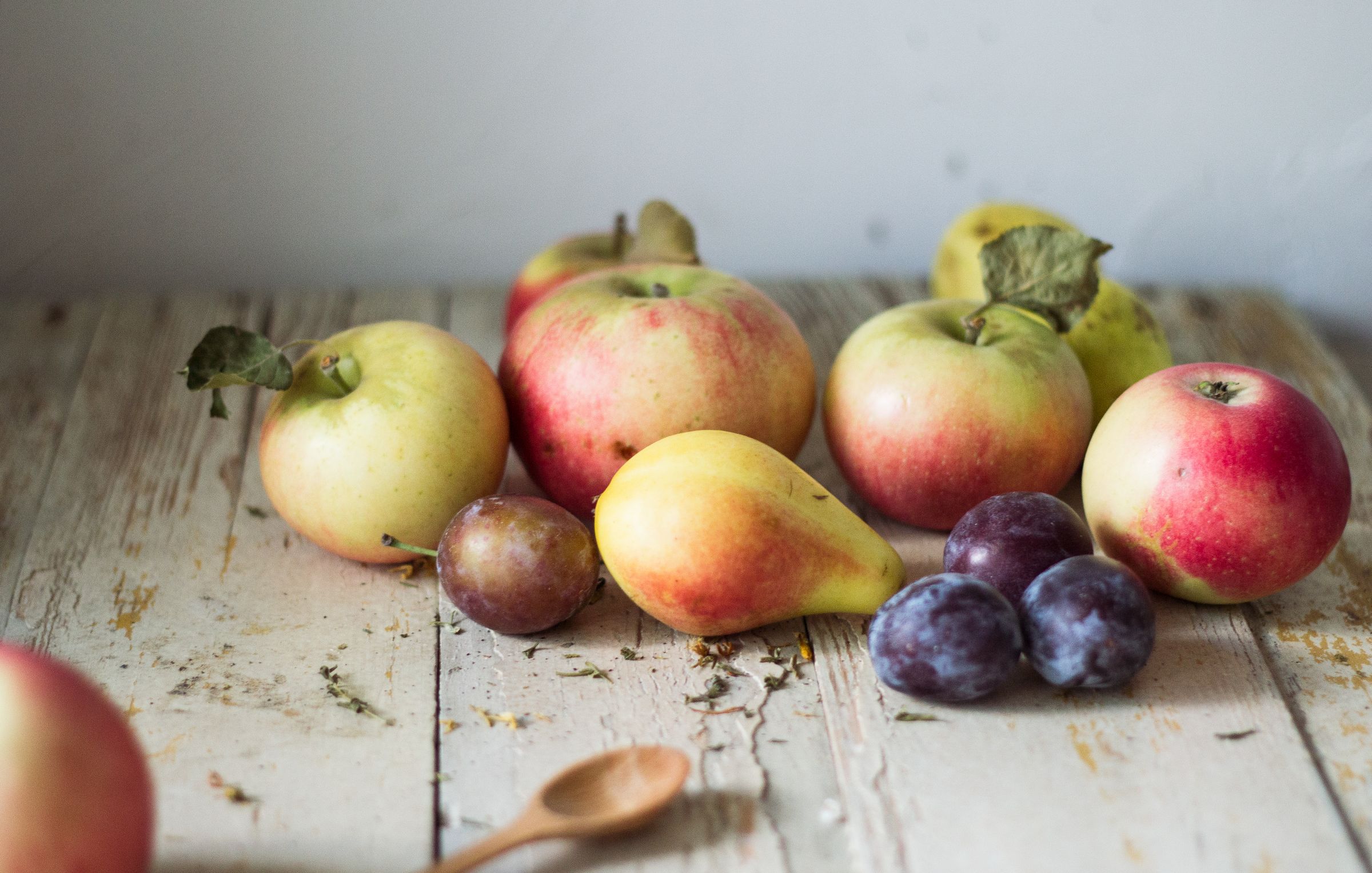
Apples, pears, plums, unsorted, unpolished: The fruit of the scatter orchard is economic fruit and rarely suitable for display. In the still, it’s not the shape that counts, but the ripeness. Image source: Pexels / Vladimir Gladkov
This connection between enjoyment and landscape is something you wouldn’t need to print on the label. It’s embedded in the product itself. A well-managed scatter orchard requires care, pruning, mowing, and patience, and it only pays off if the fruit ultimately has value. Brandy is one of the few ways in which crooked, small, variety-appropriate fruit becomes something for which people are willing to pay a decent price.
From Tree to Glass
The path there is shorter than romanticism suggests, and more demanding than the clear content in the glass shows. The ripe, fully ripe fruit is crushed and fermented until the yeast converts the sugar into alcohol. This mash then moves into the still. What comes out of the distillation is initially anything but drinkable.
Freshly distilled apple brandy typically ranges between 60 and 90 volume percent. That is raw brandy, highly concentrated, sharp, and too strong for enjoyment. Only by adding water is it carefully brought down to the legal minimum content or the desired drinking strength. This reduction is not dilution in a derogatory sense, but a craft in itself. Whoever adds too much water too quickly destroys the aromas. Whoever does it carefully opens them up.
In the end, what stands in the glass is not a high-proof spirit trying to impress, but a fruit that cannot deny its origin.On the Honesty of Clear Brandy
Exactly in this final step, much is decided. An industrially diluted brandy can be technically correct and yet silent. A brandy adjusted by hand from a small distillery carries the decisions of its distiller within it: when he separated the heads, when he cut off the tails, how long he let the distillate rest before bringing it down to drinking strength.
Obstler, the Legally Protected Classic
Among the many fruit brandies, there is one whose name falls so casually that we rarely question its exact meaning: Obstler. Yet it is more precisely regulated than the pub language might suggest. In Austria, Obstler is registered in the Register of Traditional Foods under number 225. It is therefore not a vague collective term, but a documented part of a food culture.
In addition, there is a clear European regulation regarding its composition. According to EU Regulation 2019/787, Obstler must consist of at least 85 percent apples and pears. This firmly anchors the fruits in the term, which form the basic stock on almost all scatter orchards. The remainder may come from other fruits of the meadow, but the character remains that of apple and pear, of stone fruit, of trees that are allowed to grow old.
Once you understand this, you drink an Obstler differently. Behind the simple word lies an agreement about what must be inside, and behind that again a landscape that produces exactly these fruits. This is the kind of depth I appreciate in good, unpretentious things: they don’t explain themselves, but they stand up to every question.
The Difference That Reveals the Connoisseur
There is a term that is constantly confused with brandy and yet means something entirely different: the spirit. Whoever can distinguish between the two has grasped the principle behind both. Brandy is created by fermenting sugar-rich fruits and then distilling them. The spirit, on the other hand, is created without its own fermentation.
Helm, body and the curved spirit tube: through the same still runs brandy as spirit, the real difference is decided before that. With brandy, the fruit ferments; with spirit, it borrows the alcohol. Image source: Pexels / Joel Zar
With spirit, the fruits are instead placed in pure, flavor-neutral alcohol, which then absorbs their aroma and is later removed. This is typically done with fruits whose sugar content isn’t sufficient for their own fermentation, especially berries. The most well-known representative is the raspberry spirit. There is no raspberry muscat that would have enough sugar for a real brandy, so the shortcut is taken via neutral alcohol. Both are high quality, both require skill, but they are two different paths, and the difference stands out for good reason on the label.
If you hold the next clear bottle in your hand, it’s worth taking a close look. If it says “brandy,” the fruit had enough sugar to ferment on its own. If it says “spirit,” it was too weak for that and had to borrow its alcohol. In both cases, the same applies, which makes these spirits so appealing: they have nothing behind them to hide. What the fruit was, that is it in the glass, and what the distiller did wrong, you would taste immediately. Exactly this unflinching honesty is the reason why a good fruit brandy deserves more respect than the quick shot glass at the bar often gives it.
Good to know
▸What is the difference between fruit brandy and fruit spirit?
Fruit brandy is made by first fermenting and then distilling sugar-rich fruits. The alcohol therefore comes from the fruit sugar itself. Fruit spirit, on the other hand, is made by macerating the fruits in finished, neutral-tasting alcohol, which absorbs their aroma and is then distilled. This method is chosen primarily for fruits with too little sugar for their own fermentation, such as berries. Raspberry spirit is the best-known example.
▸How much alcohol does a fruit brandy contain?
The legal minimum alcohol content is 37.5 percent by volume, regulated at the European level, originally in EU Regulation 110/2008. Directly after distillation, however, the distillate is significantly stronger and often lies between 60 and 90 percent by volume. It is only brought to drinking strength by adding water.
▸Why does the fruit come from traditional orchards?
The fruit for classic fruit brandy often comes from traditional orchards and is mostly not considered table fruit. It is processing fruit, meaning fruits that are too small or too irregular for display, but perfectly suited for juice, cider, and brandy. The sale of the brandy gives these old, often threatened meadows an economic reason to exist.
▸What exactly is an Obstler?
Obstler is a specific type of fruit brandy. In Austria, it is registered in the Register of Traditional Foods under number 225. According to EU Regulation 2019/787, Obstler must consist of at least 85 percent apples and pears. Behind the simple name lies a clear requirement for its composition.
❖
Fact sources: Wikipedia, articles on fruit brandy and fruit spirit, as well as the Austrian Register of Traditional Foods (bmluk.gv.at). Cover image source: Pexels / Tiago Antonio.
//Taste
More from //Taste
What belongs on the plate and in the glass. Craftsmanship, origin, and the art of good taste. Stay in //TASTE.

 //TASTE