
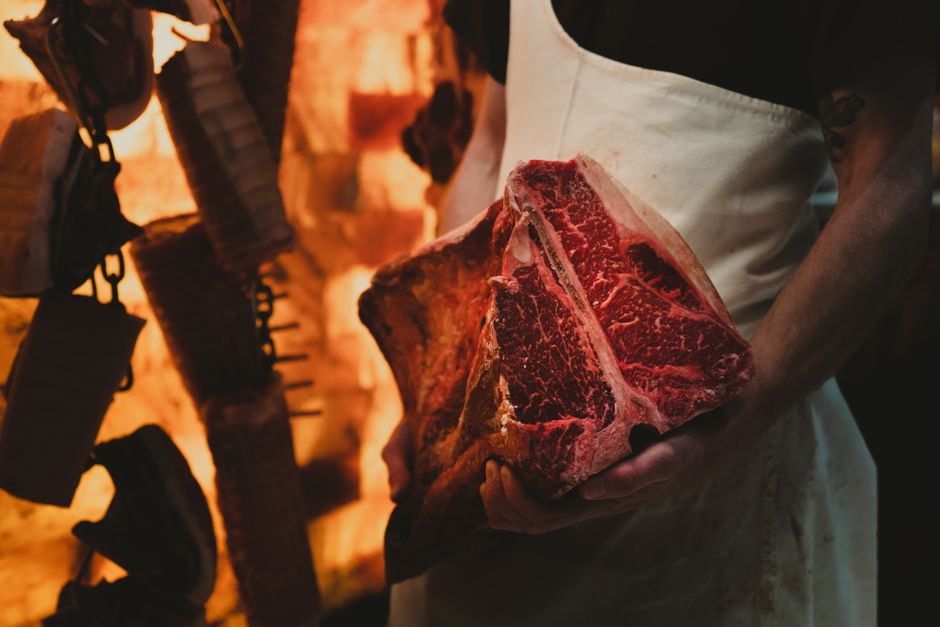
28, 45 or 60 days: What dry-aging really costs
Dry aging isn’t a status symbol on the menu, it’s a physical decision. How temperature, time and cut determine what ends up on your plate.
A number on the menu, 28 days, 45 days, 60 days, feels like a marketing gimmick. In reality, it describes a physical process with strict rules: temperature, humidity and time jointly decide how much meat remains and how it tastes.
- Dry-age chambers typically run at 1–3 °C and 80–85 % humidity
- Over weeks, evaporation can cost 10–15 % of the meat’s weight
- From about 28 days, nutty, tender notes appear; after 45 days, umami-rich, concentrated flavours intensify
What actually happens inside the chamber
Dry aging means controlled storage of whole beef primals at chilled temperatures, letting moisture evaporate, the surface dry out and endogenous enzymes break down collagen and muscle fibres. That’s fundamentally different from wet aging in vacuum bags, where no water escapes. Professional practice usually keeps temperatures between 1 °C and 3 °C. Too warm encourages bacterial growth; too cold nearly halts enzymatic activity.
Relative humidity is usually held at 80–85 % to allow controlled surface drying without over-drying the meat. Airflow and circulation are critical: steady airflow across the surface promotes the signature crust and prevents mould hotspots where moisture lingers. These conditions aren’t accidental; they’re a tightly controlled system that professional operations must document.

Why weight equals money
During aging the meat loses weight through evaporation. Industry reports and tests often cite 10–15 % loss over several weeks, a direct daily cost driver in the chamber. The outer, heavily dried and darkened crust is trimmed off after aging. The longer the time, the thicker the crust and the higher the trim loss, a physical reason why sixty days costs more than twenty-eight.
That also explains why long aging times are rarely offered on small, lean cuts. Large primals with bone and fat caps, such as rib rack or strip loin, age more stably and aromatically than small portions, because mass and fat protect the surface and regulate moisture. A thin fillet aged sixty days would leave almost nothing usable.
Sixty days isn’t a status number on the menu. It’s a calculation of trim loss, chamber time and how much meat is left at the end.
The Three Thresholds
In professional kitchens, around twenty-eight days is the threshold at which typical nutty, buttery notes and a softer texture become noticeably distinct from unaged beef. Shorter periods often alter the flavour only marginally, which is why many restaurants use this mark as their entry point for “aged.” At around forty-five days, concentrated, umami-heavy and faintly cheesy aromas intensify. Many steakhouses position forty-five days as the balanced sweet spot between flavour depth and trim loss, a compromise that works both economically and gastronomically.
From about sixty days onward, intensity and character increase markedly. This level of ageing is polarising in taste and, due to higher trim and shrinkage losses, only makes economic sense for specific cuts and guest profiles. If you’re trying a sixty-day-aged cut for the first time, prepare for a more intense, almost mushroomy-cheesy aroma that won’t appeal to everyone.

No Fridge Experiment
Dry-ageing under controlled conditions is governed by strict requirements. Commercial operations must document temperature, hygiene and shelf-life without gaps, a legal framework that explains why professional ageing chambers are not improvised fridge experiments. This oversight is the real difference between a safely aged steak and spoiled meat that merely looks similar.
Visible ageing chambers in restaurants, often placed behind glass, are therefore more than décor. They reassure guests that the process is monitored, every piece is traceable, and the crust that will later be trimmed is not a sign of spoilage but visible proof of the care happening behind the scenes.

The Number Is a Choice, Not a Ranking
When you next choose between twenty-eight, forty-five or sixty days at a steakhouse, you’re not picking a prestige level, you’re selecting a distinct flavour profile. More days don’t automatically mean better; they mean more intense, concentrated and expensive because of the greater loss. Seek mild nuttiness? Twenty-eight days is your target. Want concentrated umami? Stick with forty-five. Only if you actively crave polarising intensity should you reach for sixty.
Why It’s Worth It
The physics behind dry-ageing is straightforward: water evaporates, enzymes do their work, time costs weight. It’s precisely this matter-of-fact process that separates a steakhouse that can explain its numbers from one that merely prints them on the menu.
Good to Know
▸Why does aged meat lose weight?
During ageing, moisture evaporates from the meat while a dry outer crust forms and is trimmed away before serving. Over several weeks this typically results in a weight loss of ten to fifteen percent.
▸Which ageing time is right for me?
It depends on the flavour profile you want. After twenty-eight days you’ll notice nutty, softer notes; at forty-five days, concentrated umami-rich aromas; at sixty days, markedly more intense and polarising flavours.
▸Why are only large cuts aged for long periods?
Large primal cuts with bone and fat cap protect the surface and better regulate moisture than small, lean pieces. A thin cut would virtually disappear into trim loss during extended ageing.
Image credits: Hero image Pexels / Dana Sredojevic; inline images Pexels / Boys in Bristol Photography, Pexels / Betül Üstün and Pexels / marbel riyad.


