
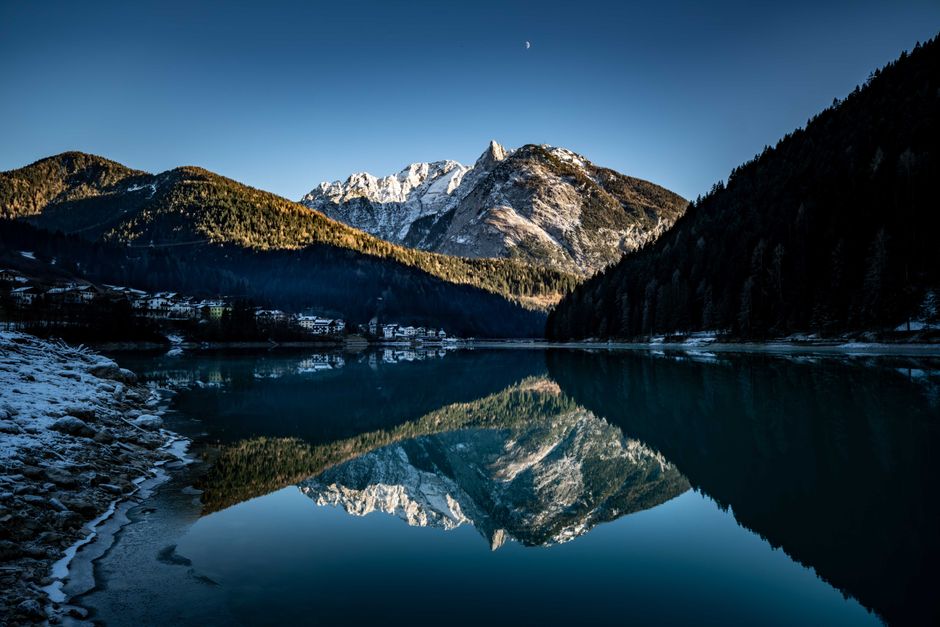
When the stage rises from the water
In Bregenz this summer, Lake Constance becomes a stage. For its 80th anniversary, the festival stages Verdi’s La traviata on water for the first time, backed by a backdrop that pushes technology to its limits.
Most opera stages are anchored to the floor of a theatre. In Bregenz, the stage juts out into Lake Constance. Behind the singers is not a wall but the open expanse of water, sky and the mountains on the far shore. This lake stage is the largest of its kind anywhere. This summer it gains a backdrop that, even by Bregenz standards, is spectacular.
- The Bregenz lake stage is the largest of its kind worldwide
- For its 80th anniversary, Verdi’s La traviata is performed on water for the first time
- The central element is a 700-square-metre mirror wall weighing around 195 tonnes
- The premiere is scheduled for 22 July and will be performed without intermission
A jubilee on the water
The Bregenz Festival celebrates its 80th season in 2026, founded in 1946. To mark the milestone, it has chosen something extraordinary: Verdi’s La traviata will be staged on the lake stage for the first time in festival history. The premiere is set for 22 July, starting at 21:15. The anniversary is accompanied by an open-air exhibition along the lakeside promenade, presenting 80 years of lake-stage imagery in pictures. Eight decades on, Bregenz has earned a permanent place in the European festival calendar. What began in 1946 as a post-war idea is now a magnet for hundreds of thousands of visitors drawn to Lake Constance every year.
Behind the production is a star-studded team. The staging is by Damiano Michieletto, the set design by Paolo Fantin. The Vienna Symphony Orchestra plays in the orchestra pit. The story is relocated to the Roaring Twenties and performed in Italian with German and English surtitles. The entire opera runs for about two hours without a break. On a stage in the middle of a lake there is, after all, no curtain behind which to change scenery. Everything happens in full view of the audience, forcing a clarity of staging that would not be necessary in a closed theatre.
A wall of mirrors
The real marvel is the backdrop. The centrepiece of this year’s stage is a 700-square-metre mirror wall of steel and timber weighing around 195 tonnes. It consists of 86 mirror-clad timber segments, nearly half of which can be moved hydraulically.
The dramatic climax is a staged mirror break. What looks like an accidental shattering is actually a precisely timed implosion: the wall is programmed to collapse into twelve large sections. Above the lead character Violetta hovers a six-metre-diameter black sphere, built not from mirrored glass but from robust plastic and technology borrowed from cable-car engineering. The set is less a stage picture than a machine that gives visible form to the music. On shore, the wooden mirror shards clatter; the largest measures several metres, the smallest only centimetres. From a distance the whole effect resembles a constructed metaphor: a gleaming façade that shatters during the evening, mirroring the heroine’s crumbling life.
Technology That Takes Four Years
Anyone who thinks such a stage can be created in a few months underestimates the effort involved. A new Seebühne production requires a lead time of around four years. Dozens of external companies are involved in a single stage work. It’s a project at the intersection of opera and engineering, where statics, water, weather and music must all function in unison.
A prime example of this ingenuity is the handling of water. The basin between stage and auditorium, originally built for an earlier production, is transformed into an infinity pool for La traviata. Over an area of 1,400 square metres, larger than an Olympic swimming pool, it is fed directly with lake water under strict environmental regulations. During the opera’s party scenes, the audience literally wades in the pool while the melodies rise above the lake. It’s precisely this kind of idea that sets Bregenz apart from a conventional opera house. Here, water isn’t merely scenery; it becomes a co-performer into which the characters literally plunge.
The set is less a stage design than a machine that gives visible action to the sound. Along the shore, wooden mirror shards clatter; the largest measures several metres, the smallest only a few centimetres. From a distance, the whole resembles a constructed metaphor: a gleaming façade that shatters over the course of the evening, mirroring the collapse of the protagonist’s life.
What the Open Water Adds
One might ask why go to such enormous lengths when a conventional opera house would be so much simpler. The answer lies in the experience. A performance on Lake Constance is fundamentally different from an evening in a hall. The sky shifts colour during the overture, the water reflects the stage lights, and in the distance the lights of the opposite shore flicker. No stage set can replicate that expanse.
Of course, there’s a price. In the rain, a performance may be delayed or played under weather risk, because above the Seebühne there’s no roof. Yet it’s precisely this unpredictability that defines the character of the event. You sit outdoors, feel the evening breeze from the lake and know this particular evening will never be repeated. This blend of high culture and natural force makes Bregenz unique. Where else can you sit in evening dress on the shore of a lake, listening to Verdi, as the last sliver of daylight vanishes behind the mountains? Such images burn themselves into memory long after the final curtain has fallen.

A Fleeting Experience
The Seebühne follows a two-year model. After the premiere season this summer, a revival is planned for the following year; after that, the elaborate set is dismantled to make way for a new production. Anyone wanting to see this La traviata on the water therefore has a limited window of two summers before this intricate mirror wall disappears from public view forever.
For those eager to glimpse behind the scenes beforehand, the festival offers stage tours. These let you examine the floating structure up close before the performances begin. It’s a good way to grasp the scale of the edifice, because from a distance one easily underestimates how large, and heavy, this stage on the lake truly is. Only when you stand before it do you grasp the relationship between performer and construction. A singer on this stage is a tiny figure against a vast, mobile wall. That his or her voice still carries across the lake is itself a technical marvel.
Good to know
▸What’s playing on the Lake Stage in 2026?
For the 80th anniversary of the Bregenz Festival, Verdi’s La traviata will make its Lake Stage debut. The premiere is scheduled for 22 July, performed in Italian with German and English surtitles and without an intermission.
▸What makes the set design special?
The centerpiece is a 700-square-meter mirror wall weighing around 195 tonnes, made up of 86 partly movable wooden slats. A highlight is a precisely choreographed mirror break, during which the wall is deliberately shattered into twelve pieces.
▸What happens if the weather turns bad?
The Lake Stage has no roof. In the event of rain, a performance may be delayed or played under weather-risk conditions. This unpredictability is part of the character of an open-air show on Lake Constance.
Image credits: Featured image Francesco Ungaro; article images Bastian Riccardi and Johannes Plenio (Pexels).
Sources and further information: Bregenz Festival.


