A roof that curves inward instead of bulging outward. A sports car that, from the moment it debuted in 1963, looked like it had arrived from the future – and still looks right at home more than six decades later. The story of the Mercedes Pagoda is the rare tale of a design that time simply cannot touch.
There’s that one moment when you realize the roof is bent the wrong way. You stand before the car, your gaze sweeping over the long, flat nose, then lingering at the top: where every other car arches outward, this one’s roof gently dips inward, like a steel hammock. It’s a line that doesn’t assert itself but instead recedes. And that’s exactly what makes it unforgettable. The Italians had a name for it right away: Pagoda. And it stuck.
Quick Facts
The Mercedes-Benz SL of the W 113 series, built from 1963 to 1971, earned its nickname “Pagoda” thanks to its removable hardtop, whose roof center curves inward in a concave arc-echoing the sweeping lines of East Asian temple roofs.
It was penned by French designer Paul Bracq. The shape wasn’t meant to be beautiful at first; it was meant to be practical – and it became both.
Beneath the elegance lay safety: the Pagoda was the first sports car with a safety body based on Béla Barényi’s patents-rigid passenger cell, deformable crumple zones.
48,912 units in eight years, three engines: 230 SL, 250 SL, 280 SL. Today, top examples fetch six-figure sums, and well-maintained cars hold their value while almost everything else depreciates.
The Mercedes-Benz Pagoda-internally known as the W 113-is one of the rare objects for which the word “timeless” isn’t an overstatement. It debuted at the Geneva Motor Show in March 1963, and it looked like it belonged in the future. Today, more than six decades later, it still looks like it belongs right here. Between those two points lie eight years of production, three models, and 48,912 cars built, plus engineering so subtle you barely notice it at first glance.
What’s remarkable about this car is how effortlessly it wears its stature. It doesn’t shout, it doesn’t push itself forward. And that’s precisely why it has outlasted contemporaries that now feel dated.
The Pagoda: a roof that thinks inward
Let’s start with what everyone sees first. The hardtop of the Pagoda arches up at the sides and dips in the middle, a concave curve above the heads of the occupants. The result: larger side windows, a brighter cabin, easier entry and exit, and a car that feels feather-light despite its steel roof. It’s one of those solutions where function and beauty don’t compete-they share the same goal.
The nickname, as so often happens, came from outside. The sweeping roofline recalled the upturned corners of Asian temple roofs, and in Italy the car quickly became known simply as “Pagoda.” Bruno Sacco, later chief designer at Mercedes, remembered that the name originated there. The shape wasn’t originally intended as a stylistic exercise: the inward-curving roof idea was first associated at the company with improved roof loads on saloons. It was then applied-ironically-to a sports car, where it sounded anything but practical, yet worked perfectly.
The man who drew the line was Paul Bracq. A Frenchman in the service of Mercedes-Benz, he gave the brand its face in the Sixties and later, after moving to BMW, created defining designs there as well-a designer who shaped two German marques. On the Pagoda he worked closely with the house’s safety thinking, and the result is a car that looks as though it never had to fight for its appearance.
The whole idea in one line: while every other roof bulges outward, the Pagoda hardtop gently sinks inward at its centre. Larger windows, a brighter cabin, and a silhouette that still feels feather-light after more than sixty years. Image: Wikimedia Commons / Lothar Spurzem, CC BY-SA 2.0 DE.
Beauty was only half the task
What sets the Pagoda apart from a mere style icon lies beneath the sheet metal. It was the world’s first sports car with a safety body structure, and that’s not marketing hyperbole-it’s a structural fact. The concept traced back to Béla Barényi, the house’s safety pioneer who had already brought the safety-cell idea to series production in the late Fifties with the “Heckflosse” saloon. On the Pagoda, that thinking migrated into an open two-seater, where you’d least expect it.
The principle is commonplace today but was radical then: the passenger cell is rigid, a fixed shell around the occupants. The front and rear sections, however, are designed to deform predictably on impact, absorbing energy before it reaches the people inside. Crumple zone and safety cell-the two pillars on which all modern body safety rests-took a stroll in a roadster that looked like a piece of jewellery.
That’s the attitude that makes the Pagoda different from so much that came later. It wasn’t beautiful or safe, not elegant or well-considered. It was all of those things at once, because the same minds shaped both form and protection. Anyone who drives one today feels it: solid, grounded, earnest, yet never heavy.
A roadster that looks like a piece of jewellery, and under the skin carries the crumple zone on which all modern safety is built. – The Pagoda, first sports car with a safety body structure, 1963
Three Letters, Three Engines
The Pagoda didn’t arrive as a single car, but as a family that grew over eight years. It all began in 1963 with the 230 SL, powered by a 2.3-litre inline-six and 150 hp, a car that immediately proved elegance and capability belonged together: in 1963 a Pagoda won the gruelling Spa–Sofia–Liège marathon, one of the toughest rallies of its era. The graceful machine could race as well as it cruised.
By late 1966 the 250 SL arrived-briefly in the lineup, yet technically a step forward: larger displacement, disc brakes now at all four corners, and extra torque for effortless travel. Then, in 1968, came what many still regard as the mature form: the 280 SL, with 2.8 litres and 170 hp, the strongest and best-selling variant of the line. A total of 23,885 examples of the 280 SL were built-nearly half of all Pagodas. Production ended in March 1971 after 48,912 cars had rolled off the line.
What never changed across these three models was the shape. Other makers would have facelifted twice in eight years-new grille here, revised bumper there. The Pagoda stayed true because nothing could be improved without spoiling what already worked. Such perfection is almost never achieved.
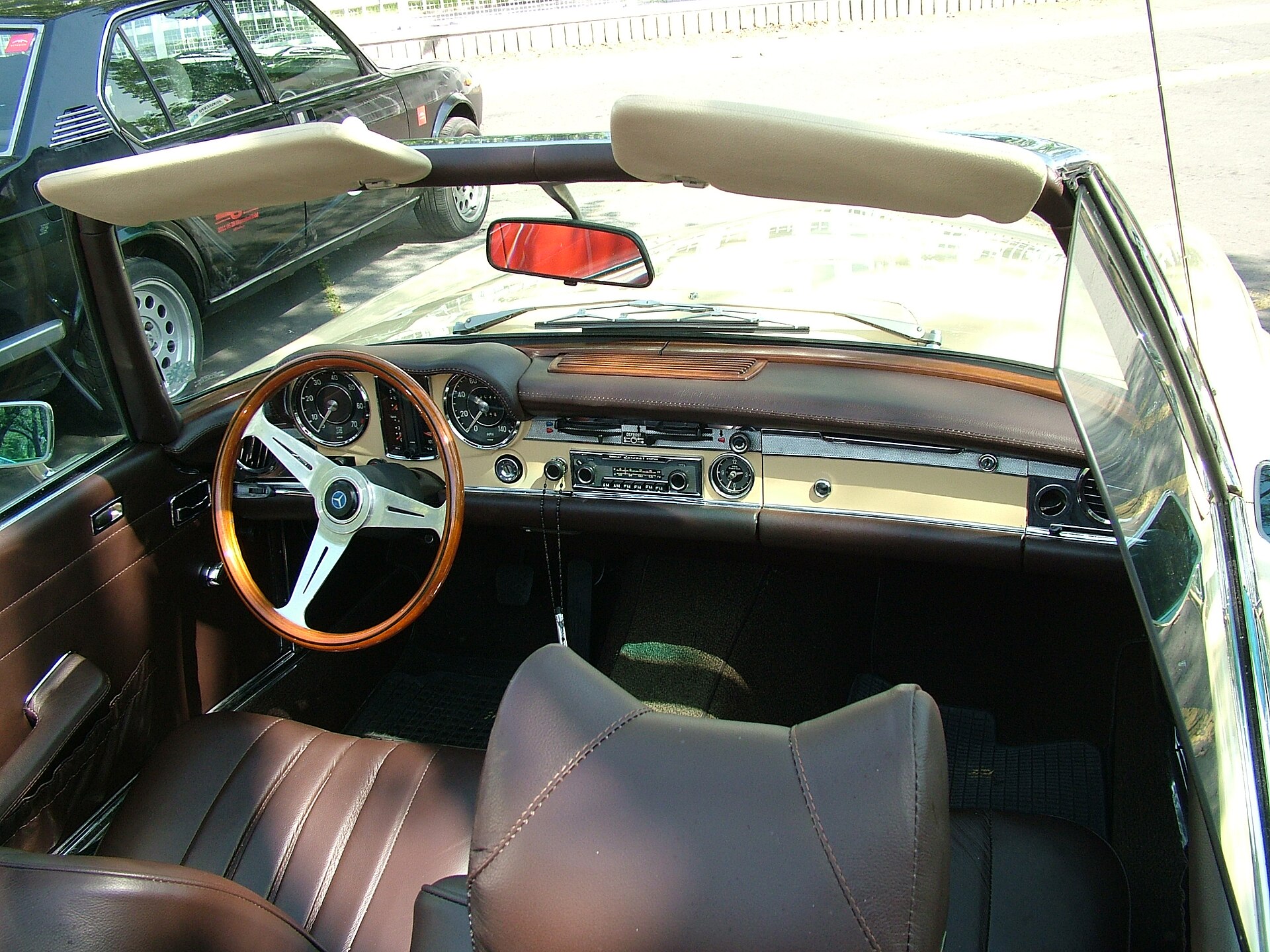
No touchscreen, no menus: a big, thin wooden wheel, clear round gauges, a handful of switches that your hand finds without looking. That was sovereignty sixty years ago. Image: Wikimedia Commons / granada_turnier (Flickr), CC BY 2.0.
Why the Shape Never Ages
It’s worth asking why a car from 1963 still looks right today, while a 2008 model often feels instantly dated. The answer lies in restraint. The Pagoda carries almost no decoration that serves no purpose. Surfaces are calm, edges crisp, proportions so balanced the eye never stumbles. What wasn’t fashionable can’t go out of fashion.
Add a forgotten craft truth: these cars were built to be kept. Brushed metal, solid wood, thick chrome-materials that grow more beautiful with age instead of cheapening. That’s patina, the opposite of the high-gloss plastic now coating every centre console and showing every fingerprint after the first summer. A car that may age without decaying: no accident, but the brief.
It’s also the honest simplicity inside that plays its part. A large, thin steering wheel. Round instruments read at a glance. Switches that click with a resistance the hand remembers. None of it tries to impress; all of it serves you. Sit in one and you understand why, sixty years later, industry is painstakingly trying to relearn much of it.
The Pagoda by the Numbers
Series W 113World premiere Geneva Motor Show, March 1963; production ended March 1971.
DesignPaul Bracq; safety concept by Béla Barényi, first sports car with safety body structure.
Three models230 SL (1963, 150 hp), 250 SL (from late 1966), 280 SL (from 1968, 170 hp).
48,912 builtof which 23,885 were 280 SLs, the line’s best-seller.
What it’s worth today
Anyone who knows the market knows: beauty alone won’t hold a price. Durability does. And the Pagoda is one of those classics where both come together. A 280 SL in top condition (grade 1 in German appraiser-speak, i.e. flawless and often restored) was listed in the Classic Data market report of the early 2020s at around €150,000 and up. Cars in average condition fetch significantly less; projects with substance start in the low five figures.
Honesty remains the best policy here too: this market breathes. After the peaks around the pandemic years, many classics have slipped back, and no one should buy an old car as if it were a savings account. Yet the long-term trend is unmistakable. A well-maintained, fully documented W 113 doesn’t quietly depreciate like a new car that loses half its value in the first years. It is sought after because there is a finite number of them – and no more will ever be made.
The beauty of it is that value and joy point in the same direction. You don’t buy a Pagoda to lock it away. You buy it to lower the roof on a summer evening, listen to the straight-six, and feel how a piece of engineering from another era simply feels right.
You don’t buy a Pagoda to lock it away. You buy it to lower the roof and hear how effortlessly good engineering feels.– On the real value of a classic
Perhaps that’s the true punchline of this car. It never had to be the fastest, the loudest, or the most expensive. It was simply right-in every line, every seam, in the quiet confidence with which it never had to fight for attention. And what is right never loses its appeal. It just waits for someone to turn the key again.
The Details
Where does the name “Pagoda” come from?
The removable hardtop. Its centre is concave, the sides rise sharply-lines that recall the curved roofs of Asian temples. In Italy the car quickly became known simply as “Pagoda,” and the name stuck.
Who designed the Pagoda?
The design was led by French stylist Paul Bracq, who shaped Mercedes-Benz in the 1960s and later worked at BMW. The car’s safety cell concept is credited to Béla Barényi, the brand’s safety pioneer.
Which models were built?
Three: the 230 SL from 1963, the 250 SL from late 1966, and the 280 SL from 1968. The 280 SL, with 170 hp, is the most powerful and, at 23,885 units, the best-selling. In total, 48,912 Pagodas were built until 1971.
Is the Pagoda a good investment?
As a passion piece: absolutely. Well-documented examples have held or increased their value for years. But the market fluctuates, and a car is not a savings account. Buy a Pagoda because you want to drive it. Everything else is a pleasant side effect.
❖
Source title image: Wikimedia Commons / Alexander Migl, CC BY-SA 4.0
Jakob Bach writes for InspiredByLuxury about what’s worth owning and what endures. This column expresses a personal point of view. The magazine loves classics and the new alike.
//Drive
More from //Drive
Cars you own instead of merely drive. Engineering, materials, and the things that last. Stay in //DRIVE.

 //DRIVE