The Hudson Hornet: A Sound That Needs No Modernizing
The 1954 Hudson Hornet redefines grand touring not through speed, but with an honest six-cylinder engine packing 170 hp and real NASCAR history.

 //DRIVE
The 1954 Hudson Hornet redefines grand touring not through speed, but with an honest six-cylinder engine packing 170 hp and real NASCAR history.
The Hudson Hornet stands for step-down design, NASCAR heritage, and a 308-ci six-cylinder with Twin-H-Power. In person, what truly counts is its sound.
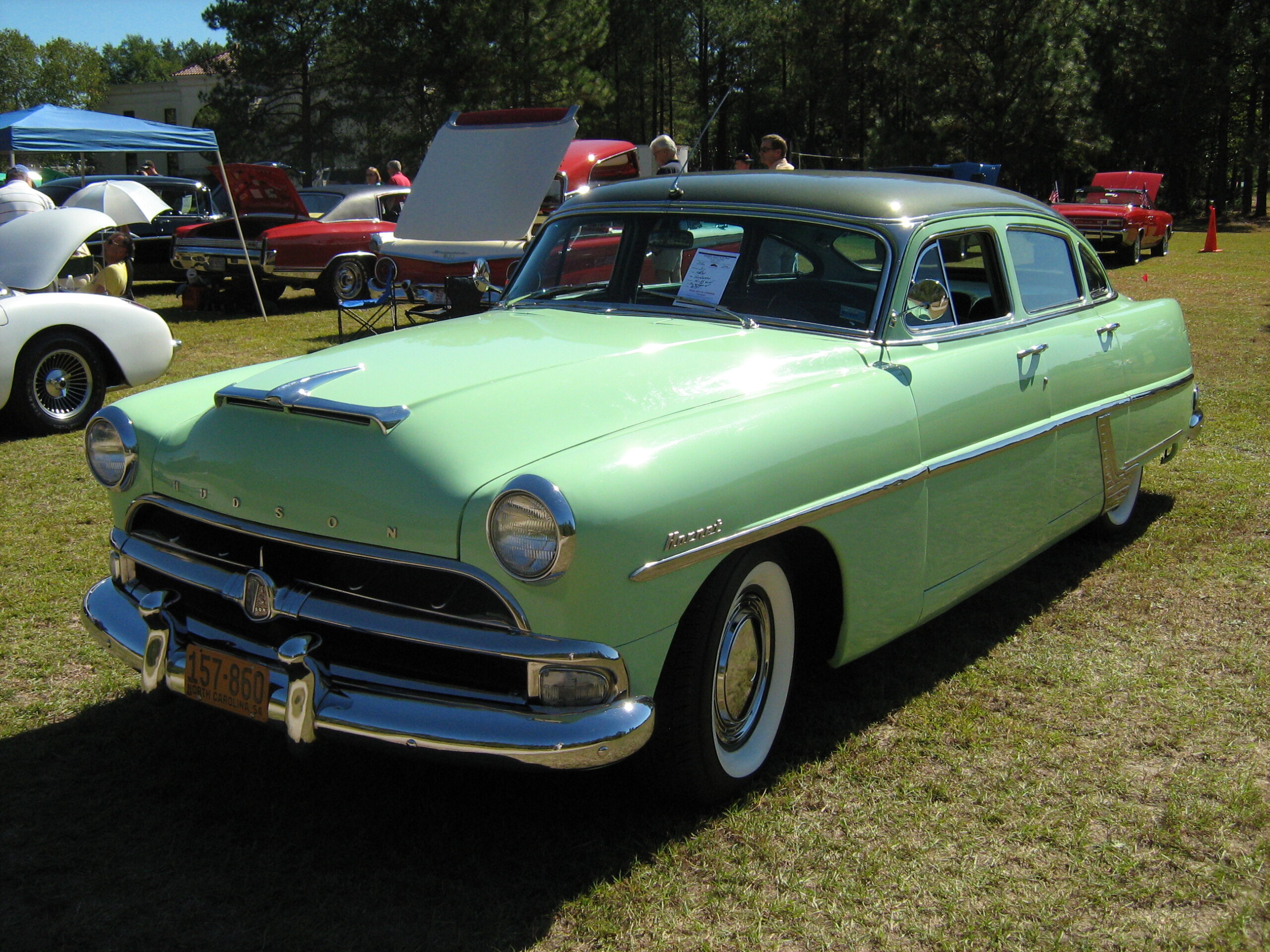
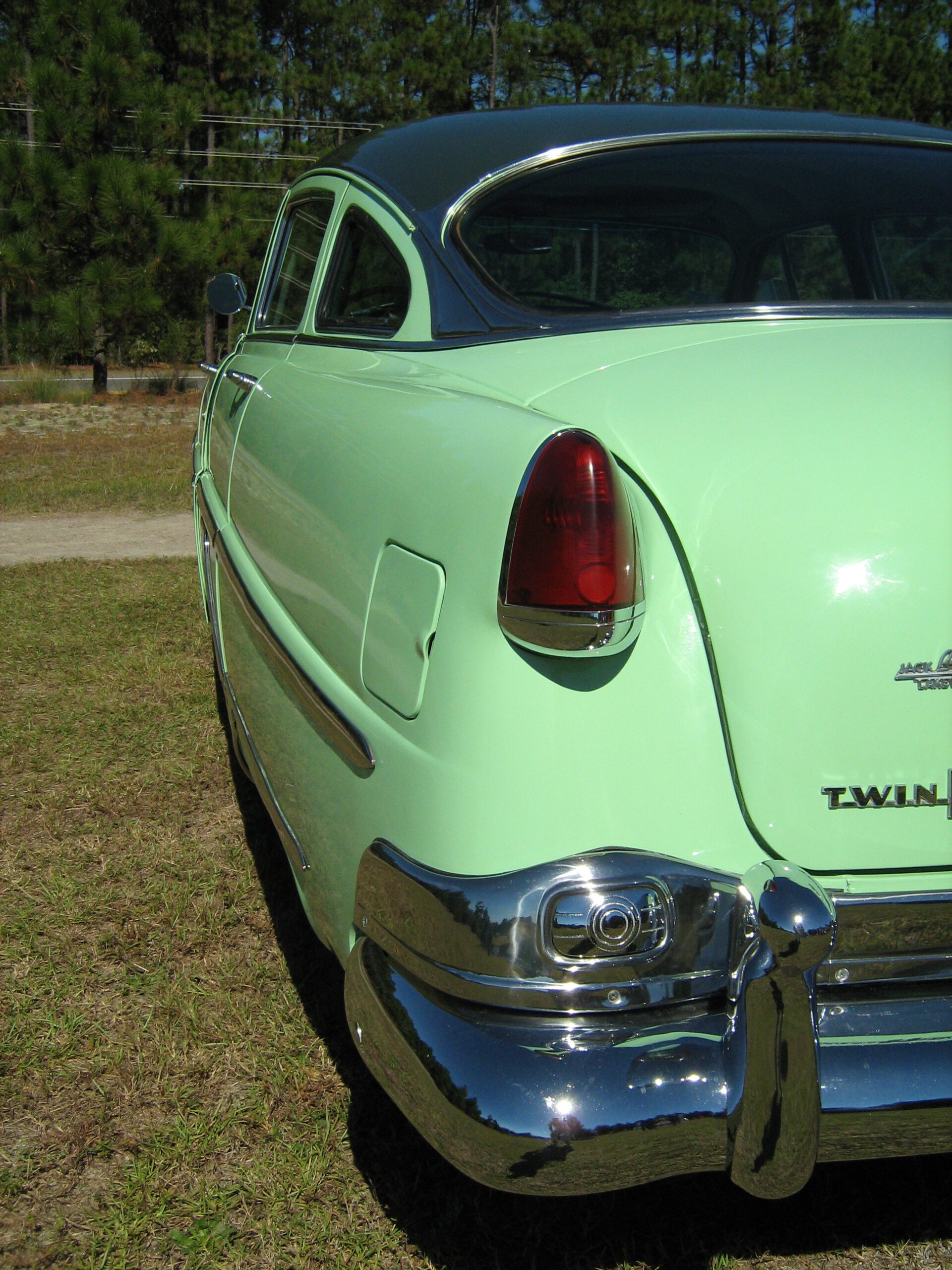
The Hornet needs no symbolic imagery. Public domain photos show exactly the 1954 model and the Twin-H engine this article is about.
The Hudson Hornet doesn’t approach you like a sports car. It glides into the space, wide and low, with a calm that few modern cars can match. At a show drive, you feel it immediately. It’s not the speed that makes it grand. It’s the sound.
That deep six-cylinder doesn’t roar aggressively. It resonates with the weight of metal, the promise of open roads, and an era when grand touring didn’t smell of carbon fiber. That’s why people stop when a car like this passes by.
The Hornet was more than just a beautiful postwar shape. Its step-down design lowered the floor into the frame, giving the car a low center of gravity. On the road, that meant effortless poise. On the racetrack, it became a competitive edge.
Hagerty notes the 1954 Hornet’s 308-ci six-cylinder and Twin-H dual-carb option, producing 170 hp. By today’s standards, that sounds modest. But in a car from this era-with that torque feel and road-holding-it was serious.
You can’t tell the Hornet’s story without stock-car racing. The car became a legend in the early 1950s because it wasn’t just beautiful-it was fast and stable. *Motor Sport Magazine* calls the real Hornet a NASCAR icon. That legacy is still embedded in its steel.
Yet today, you don’t need to recount its victories. Just stand beside it on a drive. You’ll hear why people don’t just collect these cars-they want to experience them in motion.
Modern cars can compose their own soundtracks. The Hudson doesn’t need to. It has nothing to prove because its sound wasn’t engineered for you. It simply exists-born from displacement, carburetors, exhaust, and time.
That’s what makes it so satisfying. It’s not loud to demand attention. It’s audible because mechanics *are* audible. In a world where many cars simulate emotion, the Hornet feels almost politely radical.
The Hudson Hornet wasn’t a small car, but it defied its size. The step-down construction placed passengers lower between the frame rails, lowering the center of gravity. At a time when many American cars felt tall and soft, the Hornet had its own commanding stance.
That stance explains much of its racing history. It wasn’t raw peak power that made it dominant, but the harmony of engine, balance, and stability. That’s a very grown-up kind of performance.
On drives today, you feel it. The car doesn’t need to feel nervous to feel alive. It moves with a deep voice and a steady spine. That’s a rare kind of pleasure.
The 308-ci inline-six isn’t an engine defined by revs. It tells its story through mass, rhythm, and tone. Twin-H-Power added two carburetors, giving the concept more breath without ruining its fundamental character.
When an engine like this passes you at low speed, it feels almost architectural. There’s no forced backfiring, no digital seasoning. Just combustion, mechanics, and an exhaust that doesn’t try to sound younger than it is.
For a luxury magazine, that’s intriguing because it reveals a different kind of desire. Not faster, louder, harder. But more authentic.
A concours d’elegance showcases form. A show drive showcases behavior. With the Hudson, that matters because while it looks imposing when stationary, it only truly makes sense in motion. Then you see how low it sits, how smoothly it rolls, how effortlessly its mass works.
Cars like this need movement to avoid becoming mere decoration. A Hornet in a museum is beautiful. A Hornet on a country road is convincing.
That’s why historic drives work better than static displays. They let the car be what it was built for: not an object, but a machine for the road.
Many contemporary vehicles translate emotion through programs. Sport mode, sound generators, animated displays, artificial shift jolts. The Hudson doesn’t speak that language. It only has its mechanics – and that’s enough.
That doesn’t make it better than modern cars, but it does make it more honest. You immediately understand where the feeling comes from. It doesn’t live in software logic, but in an old engine, a low-slung body, and the way the two work together.
Perhaps the lesson is this: not every driving experience needs to be dramatized. Sometimes, it’s enough for a car to keep its own voice.

The Hudson Hornet doesn’t sound old. It sounds like an era when speed still had weight.
Today, Grand Touring is often confused with high speed, heavy assistance, and even more isolation. The Hudson Hornet tells an older, more pleasant version of the story. You don’t sit in a capsule that shuts out the world. You sit in a large, low car that understands distance as rhythm.
That’s why its sound matters so much. The engine isn’t just propulsion-it’s a metronome. It doesn’t tell you you’re fast. It tells you you’re on the move. That sounds small, but it’s a big difference.
A modern GT often tries to do everything at once: sprint, glide, impress, protect. The Hudson has to do less. It can roll, carry, resonate. And precisely because of that, it feels more complete than many cars with ten times the computing power.
When you hear it on a drive, you suddenly understand why old American cars don’t just work through size. They work through composure. The Hornet has that composure without being sluggish.
Many people know the Hudson Hornet today through pop culture. That’s not a bad thing, but it shortens the story. Before the friendly legend, there was a serious car with a racing pedigree, technical idiosyncrasy, and a brand that, at its peak, was bolder than its legacy suggests.
The Step-Down design wasn’t just marketing jargon-it was a real concept. The low center of gravity gave the Hornet a stability that mattered in early 1950s stock car racing. Combined with the powerful inline-six, it created a car that’s remembered for more than just nostalgia.
That’s why the Hornet shouldn’t be dismissed as a cute movie car today. It was real before it became a symbol. And that’s probably why the symbol works so well.
A true classic doesn’t need to constantly explain why it matters. It just needs to get moving. With the Hornet, that’s enough. Then comes the deep tone, and suddenly history becomes tangible again.
With a Hudson Hornet, even the slowness is part of the tale. Not every good drive needs speed. Sometimes a steady pull, a quiet shift of scenery, and that deep tone-never begging for attention yet always getting it-are enough.
That’s what makes it so compelling to today’s observers. Many classics are defined by scarcity, auction results, or famous previous owners. The Hornet defines itself through presence. It has history, but it doesn’t lean on it like a crutch.
Its design plays a role, too. The ponton shape, the wide track, the low stance-all of it looks approachable in photos but surprisingly serious in person. You understand why this car didn’t feel like an accident in motorsport. It had an attitude long before marketing departments co-opted the word.
For collectors, that’s precisely the appeal: The Hornet isn’t an obvious European prestige object, no Italian sports car, no British roadster. It’s American individualism at its best. Less showpiece, more character actor.
And perhaps that’s its greatest luxury. It doesn’t need to please those who buy by brand name alone. If you get it, you hear it first anyway.
Maybe that’s why the Hornet is so powerful today. It comes from an era that didn’t yet know how much later cars would stage their emotions. It doesn’t do anything secondhand. It sounds the way it does because of how it’s built. It sits low because its structure allows it. It feels unhurried because it doesn’t have to fight for significance.
This is the kind of classic that doesn’t shrink under closer inspection. Quite the opposite: The more you know about Step-Down construction, Twin-H-Power, and racing history, the better you understand that first impression. The sound was just the door. Behind it stands a remarkably clever car.
How classic form and modern driving don’t have to be at odds is explored in our feature on handcrafted sheet metal in restomods. For another take on design longevity, dive into Luigi Colani’s story: Rounded was his sharpest edge.
It refers to the dual-carburetor setup of the 308-ci inline-six. Hagerty lists 170 hp for the 1954 version.
Its low Step-Down chassis and powerful inline-six made it highly competitive in NASCAR’s early years.
It embodies both. Today, it shines as a supremely capable grand tourer with genuine racing pedigree.
The Hornet doesn’t explain itself through volume. It lingers in your mind because its form, engine, and movement still follow the same mechanical logic.
Image sources: Wikimedia Commons / CZmarlin, Public Domain.