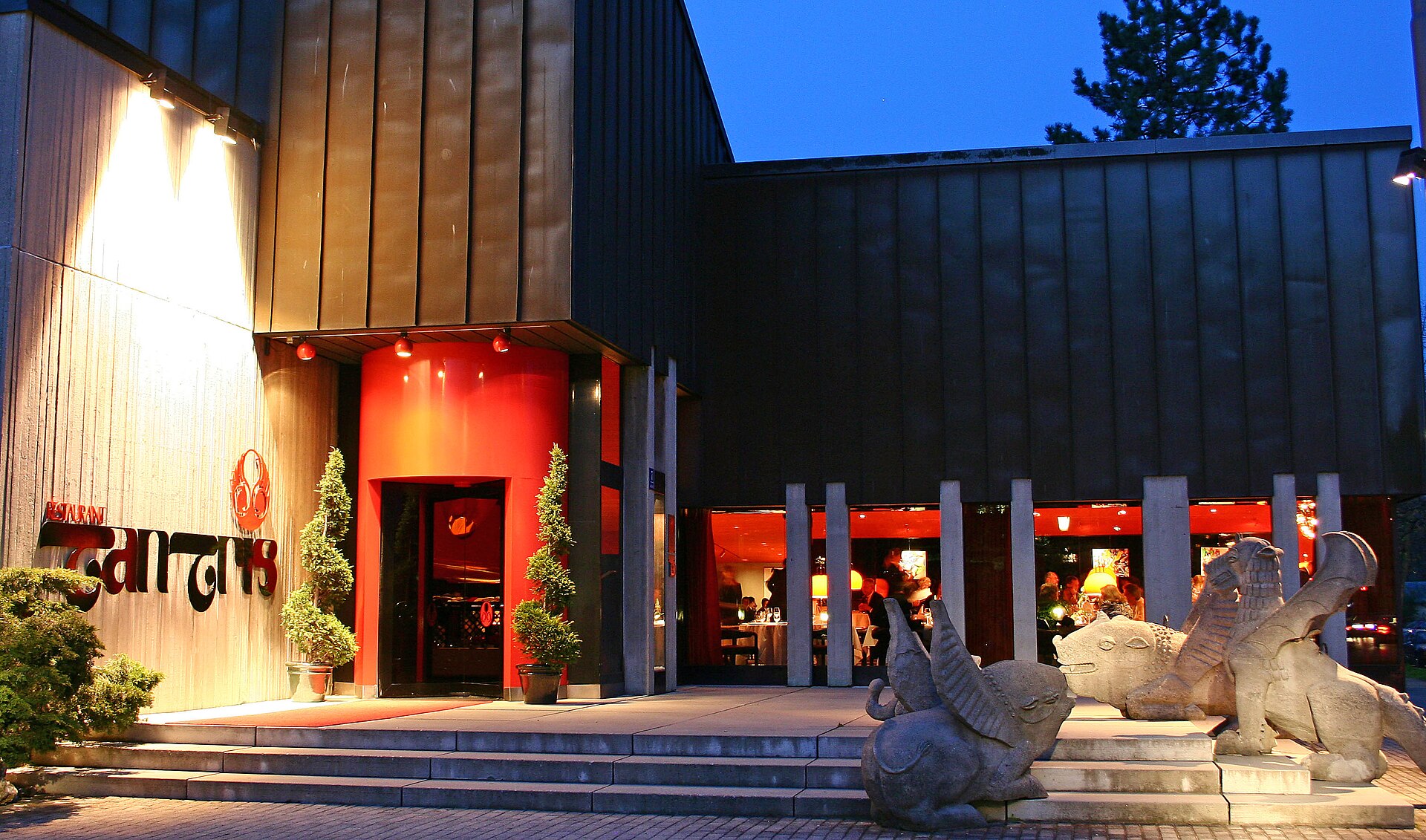
You’re not entering a restaurant; you’re stepping into a conviction. The door gives way, the noise of suburban Munich falls away, and above you hang them: hemispheres of orange plastic casting a light that hasn’t existed anywhere else for fifty years. Lobster-red walls, truffle-black leather chairs. The scent of beeswax mingles with something that’s just left the kitchen. You’re in Tantris. You’re in 1971. And that’s not a criticism-it’s the best part of it.
Quick Facts
- The Tantris on Johann-Fichte-Straße in the Schwabing-Freimann district opened on 2 December 1971 and still looks the same inside: lobster-red, truffle-black, with the iconic orange globe lamps.
- The building by Swiss architect Justus Dahinden has been a listed monument since 2012 and is regarded as one of Munich’s outstanding post-war architectural landmarks.
- Four chefs made history here: Eckart Witzigmann, Heinz Winkler, Hans Haas, and today Benjamin Chmura, who runs the two-Michelin-starred Tantris.
- Since the 2021 refurbishment the house has operated as a “Maison Culinaire” with multiple concepts under one roof: the flagship Tantris restaurant, the à-la-carte Tantris DNA, and the Tantris bar.
Most fine-dining restaurants age like a suit going out of style. They’re gutted, sanded back to grey, and re-dressed until they look like every other expensive place from Copenhagen to Singapore. Tantris refused. It stayed loyal to its decade with a stubbornness you first call courage and then call greatness. And that stubborn fidelity is the story that makes this house fascinating again today.
A builder builds himself a restaurant
It didn’t start with a chef; it started with a man who had an idea Munich didn’t yet have. Fritz Eichbauer, a Munich building contractor, wanted a top-tier restaurant not as a business but as a statement. One year before the Olympic Games, in December 1971, he opened a house on Johann-Fichte-Straße that had as little to do with Bavarian cosiness as a spaceship has to do with a bus stop.
He commissioned Swiss architect Justus Dahinden. What Dahinden delivered was almost a sacred architecture of exposed concrete, with steeply rising walls that tower toward the centre: a temple of the senses, not of worship. Today the building is a listed monument and one of Munich’s most important post-war Modernist landmarks. Back then it must have felt like a concrete provocation.
The name itself is a promise. Tantris is an anagram of Tristan, the lover of legend-a hint that this place aimed for more than mere repletion. It aimed for devotion.
The Chefs Who Wrote History Here
Eichbauer brought in a young, then-unknown Austrian on the recommendation of Alsatian master Paul Haeberlin: Eckart Witzigmann. It was one of the most consequential personnel decisions in German gastronomic history. Witzigmann brought the Tantris its first Michelin stars and later, in his own Munich restaurant Aubergine, became the first German-speaking three-star chef and the only one Gault-Millau ever named “Chef of the Century.” The Tantris was his stage before he himself became a legend.
In 1978 Heinz Winkler took over the kitchen and steered the Tantris to three Michelin stars in 1981, making it only the second German restaurant ever to achieve that distinction. At the time Winkler was one of the youngest three-star chefs in the world. After him, Hans Haas-an unassuming Tyrolean of quiet resolve-shaped the house for decades, holding two stars with a reliability that seemed almost anachronistic in the jittery star-chasing scene.
It is a lineage unmatched anywhere. Few European restaurants can boast such a dense succession of chefs who left their mark, and none has allowed that history to fossilize into mere relic.
True gastronomy is something that must come from the heart rather than the head.– Felix Eichbauer, owner of the Tantris
The Interior No One Was Allowed to Touch
First-time visitors today need a moment to adjust. The eyes must acclimate to the warm, muted glow of the orange lamps, to the red walls, to the black leather chairs that envelop you like an appointment with indulgence. It is a chromatic world no contemporary design manual would endorse – and that is precisely the point.
When the restaurant was restored in the early 2000s by architect Stephan Braunfels, the goal was preservation, not modernization. Carpets were rewoven in Switzerland to the original specifications; the iconic orange lamp shades, patterned after 1970s originals, were recreated in Italy. Nothing was tidied away. Everything was conserved that most would have discarded long ago.
It is a wager against the spirit of the age, and it pays off. While global fine-dining interiors grow ever more alike, the Tantris today feels like the antithesis of interchangeable. It is unmistakable because it never bent to fashion. You are not seated in a 2026 restaurant pretending to be timeless; you are in an authentic slice of 1971, and that carries more weight than any imitation of the timeless.
Maison Culinaire: The Rebirth
In 2021, the house took perhaps the boldest step in its recent history. From the single Tantris emerged a “Maison Culinaire,” a gourmet house uniting several concepts under one roof. Restaurant Tantris for the grand, classical line. Tantris DNA as a more agile, à-la-carte venue. And Bar Tantris for the hour before or after. One restaurant opened up without letting go of itself.
Today, the kitchen is led by Benjamin Chmura, who has borne culinary responsibility since October 2021. In spring 2022 he earned Restaurant Tantris two Michelin stars-the first proof that the transformation was more than symbolism. Trained, among other places, at the renowned Institut Paul Bocuse in Lyon, Chmura blends French discipline with the rigor this house has demanded since Witzigmann. Tantris DNA, in turn, has its own star and a distinctly relaxed tone.
By spring 2026 the house’s leadership had also been reshaped: Sabine Eichbauer took over as managing director, upholding the tradition of family stewardship and assuming responsibility for a legacy now in its third generation. A house that moves without severing its roots.
1971
Opened on 2 December, one year before the Munich Olympic Games
2
Michelin stars for Restaurant Tantris under Benjamin Chmura (as of 2026)
2012
Since this year, the Dahinden building has been a protected monument
Why it’s worth visiting today
Munich boasts more dazzling addresses, cooler, trendier venues. Some pivot faster to the next big thing. None, however, carries this depth of provenance. When you sit in Tantris, you’re not merely eating a meal. You’re seated in a room where Witzigmann earned his first stars, where fifty years of German gastronomic history have unfolded – and yet it never feels like a museum. That’s a rare blend: substance without dust.
To be clear: an evening here is an investment, and the seventies’ burnt-orange palette isn’t everyone’s cup of tea. If you favor minimalism or Nordic understatement, you may feel overwhelmed. Tantris is loud in design and quiet in everything else. It asks you to commit to a decade that isn’t yours.
But those who do receive something most restaurants have forgotten: an evening you can’t confuse with any other. In a city that often sandpapers its best houses into generic sparkle, Tantris is a statement. It makes no claim to timelessness. It simply stayed itself – and, half a century on, that may be the most modern thing a restaurant can be.
Good to know
AddressJohann-Fichte-Straße 7, 80805 Munich (Schwabing-Freimann), in the north of the city.
ConceptTantris Maison Culinaire: Restaurant Tantris (classic, tasting menu), Tantris DNA (à la carte) and Bar Tantris.
CuisineRestaurant Tantris under Benjamin Chmura, two Michelin stars (as of 2026); Tantris DNA with its own star.
ArchitectureBuilding by Justus Dahinden (1971), protected since 2012; restored by Stephan Braunfels.
HeritageFounded by Fritz Eichbauer; culinary legends Eckart Witzigmann, Heinz Winkler and Hans Haas shaped the house.
Perhaps that’s the house’s truest lesson. Fashion arrives and departs; today’s greige is tomorrow’s forgotten shade. What endures is the courage to remain true to oneself. Next time you drive through Munich’s north, remember: behind the exposed concrete, an orange glow has burned for over fifty years – and it won’t flicker out just because tastes change. Some things don’t need reinvention. They only need to be held.
Details
Where exactly is Tantris located?
At Johann-Fichte-Straße 7, 80805 Munich, in the Schwabing-Freimann district in the north of the city. The listed building by Justus Dahinden dates back to 1971.
How many Michelin stars does Tantris hold?
Restaurant Tantris, under chef Benjamin Chmura, holds two Michelin stars (as of 2026), while the separate venue Tantris DNA in the same building holds an additional star.
What makes the interior so special?
The interior remains in its original early-1970s style: lobster-red walls, black leather armchairs, and the iconic orange spherical lamps. During restoration, carpets and lamps were recreated faithfully to the original rather than modernized.
Which famous chefs have worked here?
Eckart Witzigmann opened the kitchen in 1971, Heinz Winkler earned three stars in 1981, and Hans Haas shaped the house for decades. Today, Benjamin Chmura leads Restaurant Tantris.
❖
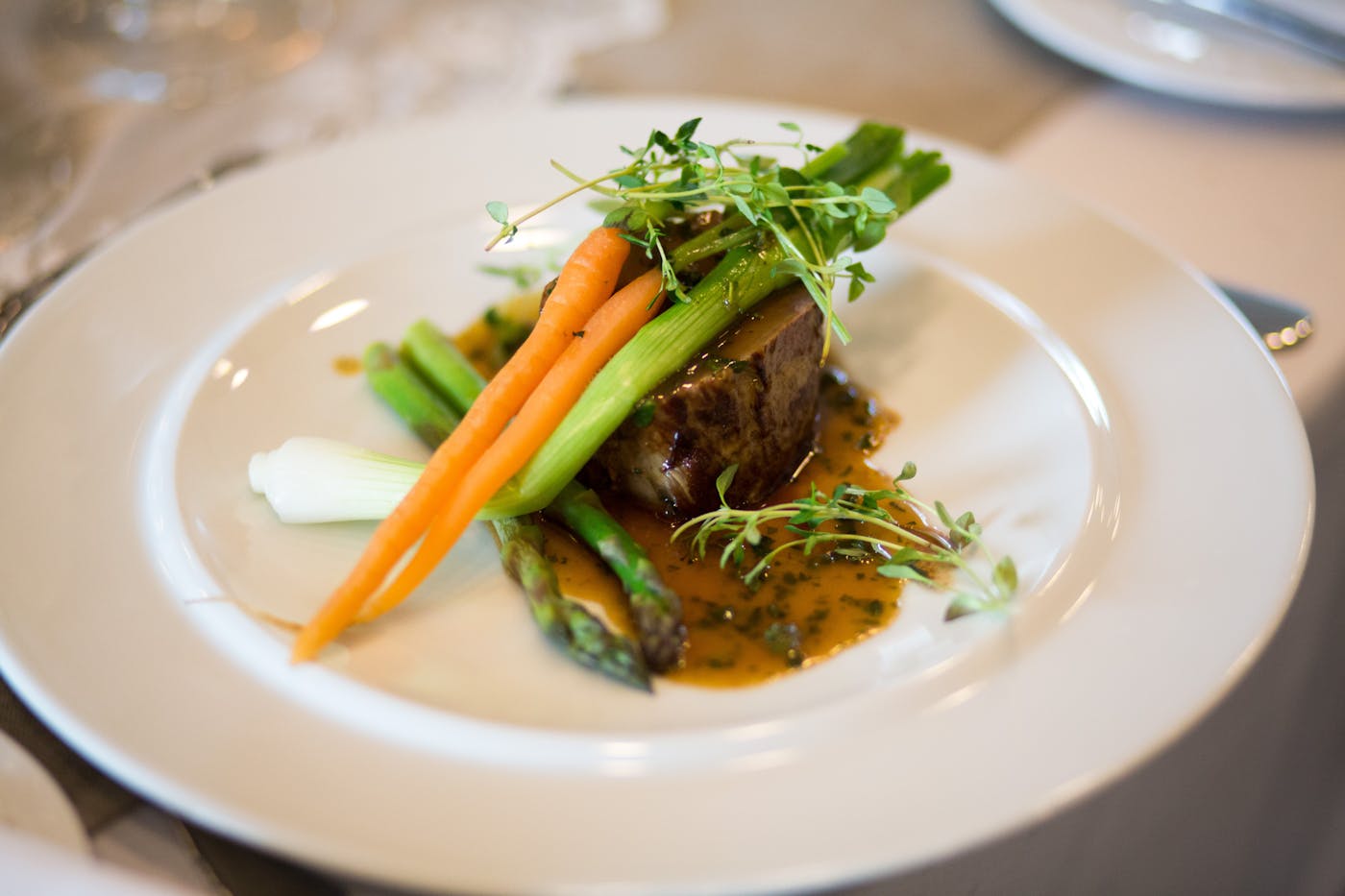
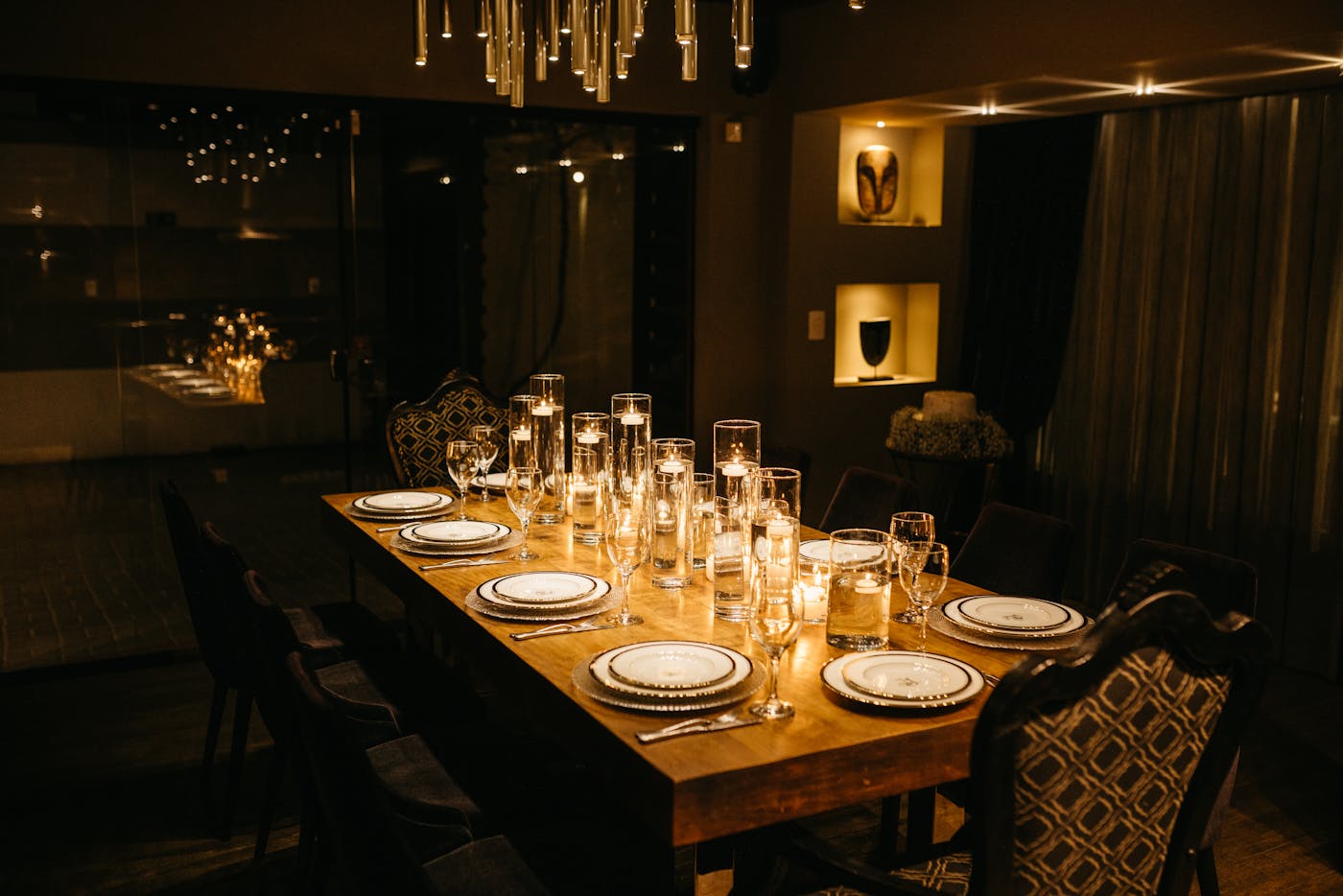
Image credits for this story: The cover image shows the real Tantris; the two interior shots are mood images via Pexels. Cover image source: Wikimedia Commons / Oliver Raupach, CC BY 2.5. Facts, among others, according to information from the house (tantris.de), the Guide Michelin, münchen.travel, MünchenWiki, and HOGAPAGE.
Jakob Bach writes for InspiredByLuxury about what’s worth your time and what endures. This perspective is a personal take, not a restaurant guide. You’ll still need to make your own reservation.
//Taste
More from //Taste
What belongs on the plate and in the glass. Craftsmanship, provenance, and the art of fine taste. Stay in //TASTE.
Visit the section →

 //TASTE