
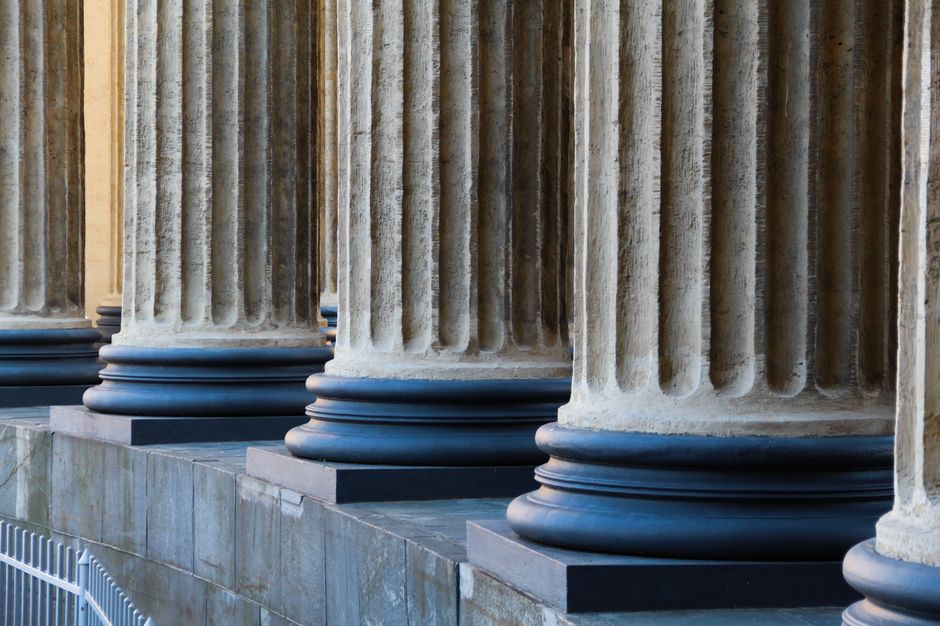
When the marble breathes again at dusk
A Thursday evening at Königsplatz: the Glyptothek stays open until 20:00. The ancient sculpture feels different in the fading light than it does at midday. A visit to Munich’s oldest museum.
Marble looks different by day than by evening. When the noon sun streams through the skylights, an ancient figure appears clear and cool. Just before closing, when the light turns warm and flat, the same stone takes on something soft, almost alive. You can experience this moment every Thursday at the Glyptothek in Munich, where the house stays open until 20:00.
- The Glyptothek on Königsplatz is Munich’s oldest public museum
- It is the world’s only museum dedicated exclusively to ancient sculpture
- Thursdays it stays open until 20:00, with a free curator tour at 18:00
- The Barberini Faun is among the house’s most famous marble works
A temple for antiquity
The Glyptothek stands at Königsplatz 3 in Munich’s Kunstareal and is a special place in the museum landscape. It is not only Munich’s oldest public museum, it is the world’s only institution devoted exclusively to ancient sculpture. Whoever enters finds no painting gallery and no modern-style temporary exhibition, but a space that belongs entirely to stone and figure.
Built between 1816 and 1830 to plans by Leo von Klenze on behalf of King Ludwig I, the entrance is carried by twelve Ionic columns; above them a pediment group with Athena as protector of the plastic arts. The architecture does not curry favour. From the outside it already declares what awaits within: the art of antiquity, taken seriously and housed with dignity. Ludwig I wanted no mere depot for finds, but a place that presents antiquity on equal terms. That claim still shapes the house today. You do not enter a storeroom, but a temple built for its stone inhabitants.

The halls and their light
The interior arranges fourteen halls around a square courtyard. Since its reopening in 1972, exposed brick walls with slurry finish and bluish-grey shell-limestone floors and plinths shape the spatial experience. That is a deliberate choice. Instead of lavish decoration, the space received a restrained, almost raw surface that lets the figures command full attention. It is a bold renunciation. Other houses from the same era opt for stucco, gilding and coloured walls. The Glyptothek after 1972 does the opposite and lets the stone speak for itself. Whoever walks through the halls attentively feels how much this restraint benefits the works.
Underfoot lies the bluish-grey shell-limestone of the exhibition plinths, cool, matte and faintly chalky. It forms a quiet counterpoint to the warm evening sun filtering through the courtyard windows. This interplay of raw floor and soft light is why a late visit is worthwhile. You do not see the sculptures under uniform museum lighting, but in a light that changes across the evening. At sunset a warm band slowly travels across the floor. The figures’ shadows grow longer. Anyone who has ever stood almost alone in one of these halls just before closing knows the feeling. The space then feels almost private, as if you had the antiquity to yourself for a moment.
The Sleeping Faun
Among the Glyptothek’s masterpieces is the Barberini Faun, an 1.81-metre marble satyr carved around 220 BCE. From a distance the figure reads as a study in relaxation frozen in stone. The satyr slumps back in drunken slumber; the marble feels softer than the material should allow. It is one of those moments when you forget you are looking at a block of rock. Two millennia old, the statue still feels surprisingly present. No specialist knowledge is required to sense the calm it radiates, its effect is immediate, physical, conveyed through the relaxed posture and the sculptor’s ability to coax softness from the hardest marble.
Works like this reward a quiet evening visit. When crowds thin, you can step back and circle the figure without a tour group cutting across your view. The Faun needs that silence. Its power does not come from a single dramatic angle, but from slowly walking around it, watching light and shadow glide across the stone.
You do not see the sculptures under uniform museum lighting, but in a light that changes hour by hour. At sunset a warm band creeps across the floor; the shadows lengthen. Anyone who has stood almost alone in one of these halls just before closing knows the feeling. The space feels almost private, as if antiquity had been handed to you for a moment.
The Königsplatz as Stage
The Glyptothek’s stage is its square. The building, together with the Propylaea and the State Collections of Antiquities, forms the neoclassical ensemble of Königsplatz, a slice of ancient Greece transplanted to Munich. On the portico twelve Ionic columns bear the weight of the pediment. In the evening light their fluting reads like vertical shadows against the pale marble of the façade.
That façade has its own story. After a three-year comprehensive renovation the Glyptothek reopened in 2021, reclaiming its original polychromy. The building now looks closer to what Leo von Klenze and King Ludwig I envisaged. Crossing the square at dusk, you see an ensemble that is not only ancient but carefully tended. The broad, open space gives the architecture room to breathe. Unlike a museum you enter and leave, the Königsplatz is a place where architecture and urban space merge into one. When the tourist tide ebbs in the evening, that stillness finally takes centre stage.

Practical Tips for an Evening Visit
For the quietest moment, aim for Thursday. The Glyptothek stays open until 20:00, and at 18:00 there is a free curator-led tour. Admission is €6 regular, €4 reduced; on Sundays it drops to €1. Entry is free for under-18s. The easiest route is U-Bahn line U2 to Königsplatz station.
Summer highlight: from 8 July the Glyptothek’s courtyard hosts open-air theatre, the premiere being “Dionysos.” Antique sculpture meets living performance in the same space where statues usually stand silent. For anyone wanting to experience the house differently, it’s a perfect excuse to visit the square after dark. Between ancient stone and modern drama a rare tension arises, something you rarely find in a conventional museum. That is what makes the Glyptothek more than a quick walk-through.
Quick Clarification
▸What makes the Glyptothek unique?
It is Munich’s oldest public museum and the only one in the world dedicated exclusively to ancient sculpture. Instead of paintings or rotating exhibitions, it displays ancient figures continuously within a purpose-built neoclassical setting.
▸When is an evening visit worthwhile?
On Thursdays the Glyptothek stays open until 8 pm, with a free curator-led tour at 6 pm. Later hours often mean lighter crowds, and the warm, low evening light makes the marble appear especially vibrant.
▸How much is admission?
Regular admission is €6, reduced €4. Sundays cost just €1. Admission is free for children and teens under 18. The easiest way to reach the museum is via U-Bahn line U2 to Königsplatz.
Image sources: title image Alena Rubtsova; contribution images Shvets Anna and Gabriel Périssé (Pexels).
Sources and further information: muenchen.de and Antike am Königsplatz.


